
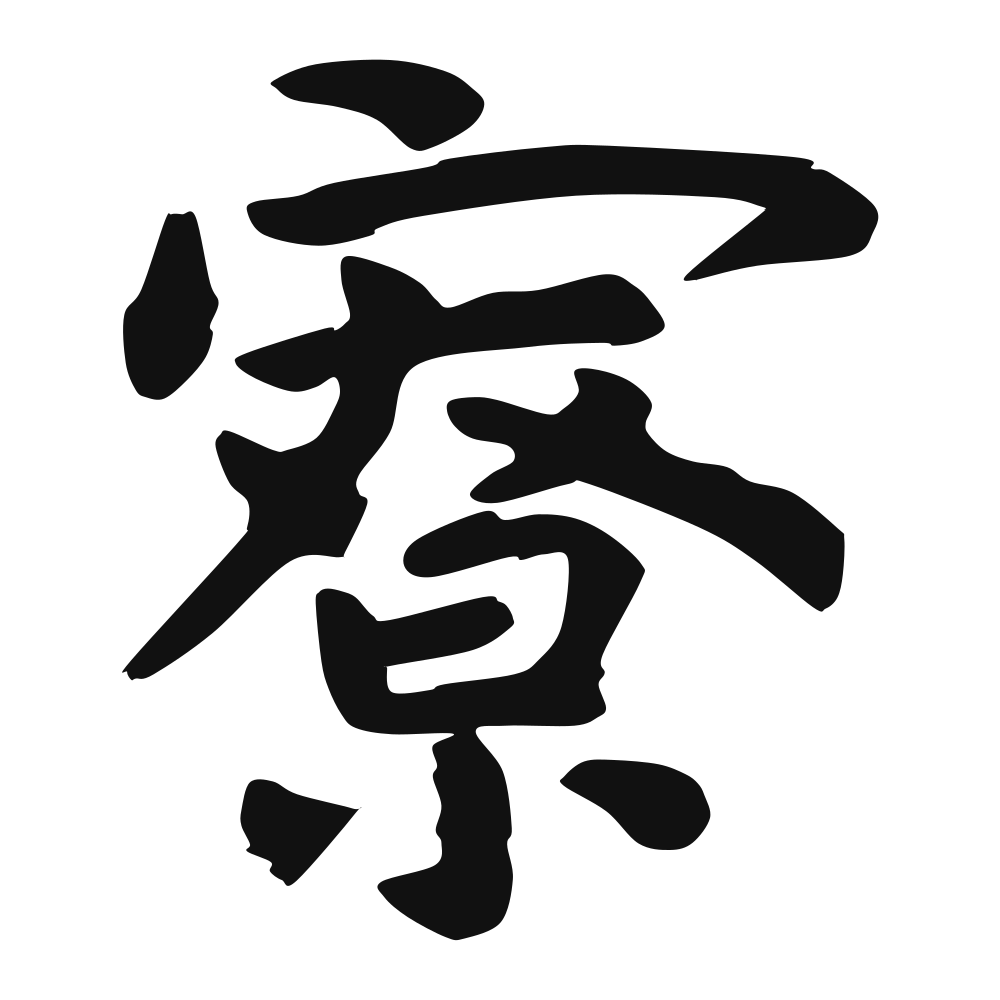
寮
Laos; hut; shack; small window
Closest English meanings
hut·small house
The Calligrapher — Yú Shìnán 虞世南
Tang court calligrapher revered for refined, restrained regular script.
Tang calligrapher (558–638), master of regular script — Tang master of quiet, inward regular script and teacher to the imperial academy. Tang dynasty
Cultural Story
寮 appears in the Classics as a small hut or humble dwelling; the Erya glosses it as a small windowed house. Monks and hermits built a 茅寮 (thatched hut) to live simply, and travelers found shelter in a 茶寮 (tea house) by the road. A 寮棚 (shed) was the very poorest of roofs over one's head.
Common words & phrases
- 茅寮 thatched hut
- 茶寮 tea house
- 寮棚 hut · shed
Read the story behind the character
You sip tea in a riverside 茶寮 (tea house) on vacation, or snap a photo of a fisherman's 茅寮 (thatched hut) on the coast. A market 寮棚 (hut, shed) sells noodles in the rain. The character keeps its humble, small-house feel even when the hut is now a trendy café with a long queue.
Why this character belongs on skin
寮 is the smallest kind of home: a monk's cell, a tea hut, a shack at the edge of the fields—roof radical laid over the barest shelter that still counts as dwelling. Zen monks in China and Japan called their own rooms 寮 and meant no insult by it; poverty of housing was richness of intention. One bowl, one mat, one door left open to the mountain. Thoreau built his cabin at Walden in the same spirit and told the truth about it: he did not want to live what was not life, and living is so dear. Not deprivation—distillation. The small room is where the large self finally has space to breathe, because everything that filled the big house was standing in for something else. Ink 寮 for the life pared to essentials. The mark is small, like the hut. That is the joke, and the blessing.
Own this character
Purchase delivers the original SVG of this glyph, brushed by Yú Shìnán 虞世南, ready to place on skin, paper, or screen.