
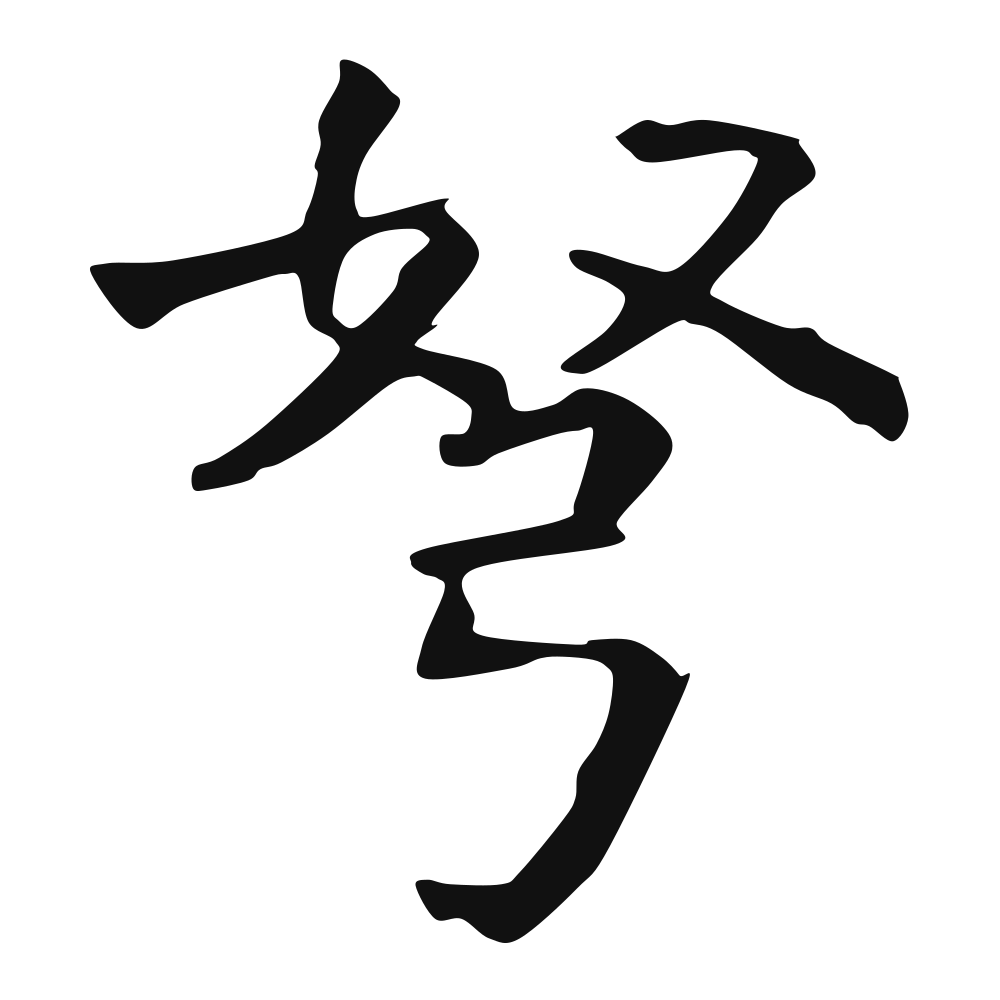
The Calligrapher — Yú Shìnán 虞世南
Tang court calligrapher revered for refined, restrained regular script.
Tang calligrapher (558–638), master of regular script — Tang master of quiet, inward regular script and teacher to the imperial academy. Tang dynasty
Cultural Story
弩 is the crossbow, the bow laid flat on a stock with a trigger of bronze. 諸葛亮's 連弩 loosed ten bolts before a foe could blink, and the histories count it among the engines that held the passes. The character is the bow made mechanical, patience given a mechanism.
Common words & phrases
- 弩弓 crossbow
- 弓弩 bow and crossbow
Read the story behind the character
弩弓 and 弓弩 surface in the wuxia film and the hunter's license, rarely in a drawer. The repeating engine is a museum replica and a prop; the real triggers are elsewhere. The character keeps its martial gloss, but the bow that fired ten bolts is mostly a story now.
Why this character belongs on skin
Patience, weaponized. 弩 is the crossbow — the bow turned horizontal, cocked and held, power stored in silence until the single instant of release. Chinese armies fielded them in mass by the fifth century BC, and the weapon changed the old aristocracy of war: a peasant with a crossbow and a year of discipline could unseat a knight who had trained since boyhood. The entire invention lives in the trigger — a mechanism that holds enormous force steady, without trembling, for as long as the moment requires. Every serious life borrows this machine. The long degree, the savings account, the grudge deliberately not voiced, the athlete's slow decade of training before one Olympic morning: all of it is stored tension, aimed and quiet. Sun Tzu compared the crossbow's stored energy to a fully drawn potential waiting for its moment. To wear 弩 is to honor the holding as much as the release — to be, on purpose, the calm mechanism that tension builds and patience aims.
Own this character
Purchase delivers the original SVG of this glyph, brushed by Yú Shìnán 虞世南, ready to place on skin, paper, or screen.