
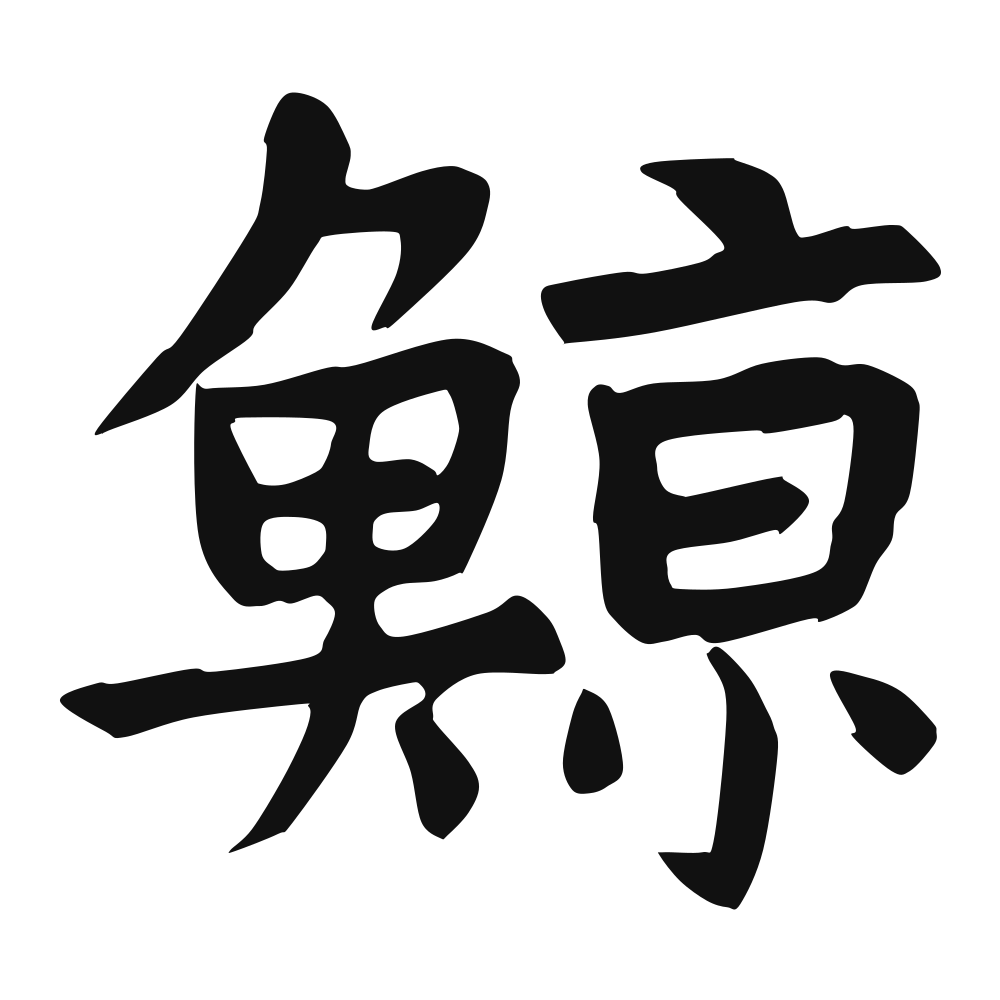
The Calligrapher — Yú Shìnán 虞世南
Tang court calligrapher revered for refined, restrained regular script.
Tang calligrapher (558–638), master of regular script — Tang master of quiet, inward regular script and teacher to the imperial academy. Tang dynasty
Cultural Story
鲸 joins 鱼 with 京 and was classed under the fish radical because the ancients knew it only as a great sea creature. The 《説文解字》 calls it 海大鱼也, "the great fish of the sea."
Common words & phrases
- 鲸鱼 whale
- 鲸鲨 whale shark
- 鲸吞 to swallow like a whale · to annex
- 蓝鲸 blue whale
Read the story behind the character
鲸 is the whale: 鲸鱼 the leviathan, 蓝鲸 the blue whale, 鲸鲨 the whale shark. 鲸吞, "to swallow like a whale," describes a corporate takeover or annexation. Though mammals, whales keep the fish radical—an ancient label science has not erased.
Why this character belongs on skin
The largest heart on earth beats inside a whale—slow, room-sized, audible through water for miles. 鲸 names that sovereign animal, the fish radical yielding to something that is emphatically not a fish: a mammal that once walked on land and chose the deep instead. Ancient Chinese chroniclers recorded whales beaching as omens; Melville made the white one the axis of an American obsession; every coastal culture has stood on the sand watching a spout rise and felt the smallness humans pretend not to feel. Yet the feeling is not dread—it is invitation. The whale moves through crushing dark unbothered, sings songs that travel whole ocean basins, and grief is in its eye and patience too. Ink this creature along a rib or forearm and you carry the memory of scale: that your troubles are rowboats on a sea with leviathans in it, and that the deep, looked at long enough, is beautiful.
Own this character
Purchase delivers the original SVG of this glyph, brushed by Yú Shìnán 虞世南, ready to place on skin, paper, or screen.