
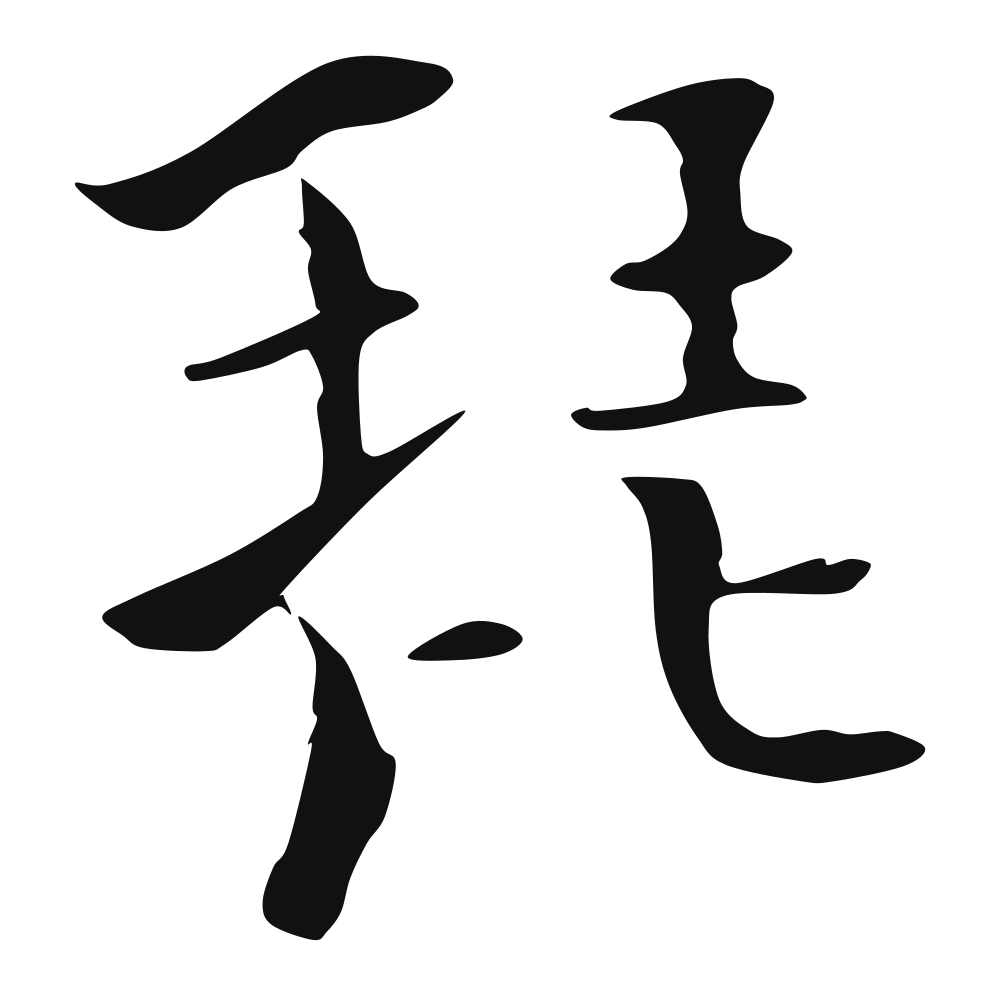
琵
usually seen in: mandolin (洋琵琶); (bird species of China) northern shoveler (Spatula clypeata) (琵嘴鸭); pipa, Chinese lute, with 4 strings, a large pear-shaped body and a fretted fingerboard (琵琶); Song of the Pipa Player, long poem by Tang poet Bai Juyi 白居易[Bai2 Ju1 yi4] (琵琶行)
Closest English meanings
pipa·lute
The Calligrapher — Zhāng Jízhī 张即之
Song master of vigorous regular and running script.
Song calligrapher (), master of regular script/running script — known for 《佛遗教经》. Song dynasty
Cultural Story
Pi exists almost solely to serve its partner: 琵琶, the pear-shaped lute, is an ancient onomatopoeia mimicking the two basic strokes — pi forward, pa back. Bai Juyi's 'Song of the Pipa' fixed the instrument forever in Chinese memory, a moonlit river, a reluctant player, and strings that spoke of exile.
Common words & phrases
- 琵琶 pipa · Chinese lute
Read the story behind the character
The pipa still commands the concert stage and conservatory practice rooms, its-metal strings thundering in 'Ambush from Ten Sides' or sighing in love songs. Yet the character rarely travels alone — write 琵 without 琶 and readers will suspect a typo.
Why this character belongs on skin
Some instruments you play; the pipa you contend with. Held upright on the knee like a small moon of lacquered wood, it answers the fingers with fury or with silk — thunderstorms on four strings, then a whisper like a woman remembering. This character is the first half of its name, the word's opening syllable, and in the old dictionaries both halves trace to the sound of the instrument itself: the plucked voice of silk strings. The Tang poets could not leave it alone. Bai Juyi, exiled on a river at night, heard a stranger play and wrote twenty years of homesickness into one description of her hands. Music, said the Confucians, reveals the state of a heart faster than any confession. To wear this mark is to keep a string taut in yourself. Something in you is always about to sound. The ink is the first note.
Own this character
Purchase delivers the original SVG of this glyph, brushed by Zhāng Jízhī 张即之, ready to place on skin, paper, or screen.