
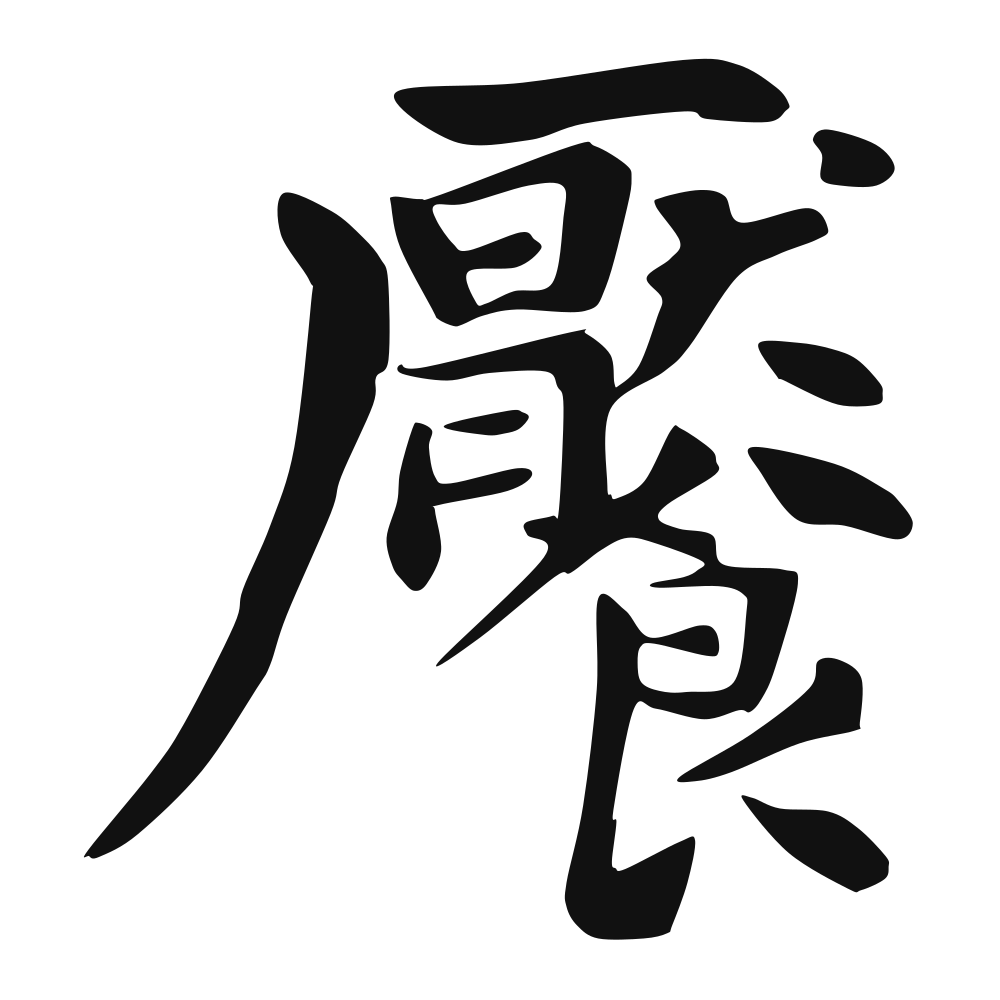
餍
to eat to the full
Closest English meanings
satiate·satisfy·full
The Calligrapher — Zhāng Yǔ 张雨
Yuan Taoist calligrapher who studied under Zhao Mengfu; known for regular and running script.
Yuan calligrapher (), master of regular script/running script — known for 《题画诗》. Yuan dynasty
Cultural Story
餍 (yàn) combines 食, “food,” with the phonetic 厭. 《説文解字》 gives simply 飽也, “to be full,” recording the satisfaction of a person who has eaten enough. It later broadened to mean any deep satiation or satisfaction.
Common words & phrases
- 餍足 satiated · satisfied
- 餍饱 full · satiated
Read the story behind the character
We use 餍 for being thoroughly satisfied. After a feast one feels 餍足 (satiated, satisfied), and a 餍饱 (full, satiated) child pushes the bowl away. The word lingers in literary praise for a craving completely fulfilled.
Why this character belongs on skin
Most appetites lie. They promise that the tenth time will feel like the first, and it never does — and yet the character for full satisfaction exists, and it is honest about the arithmetic. 餍 is the state of having had enough: not deprivation, not gluttony, but the exact moment the appetite has been met and honored and can stand down. Chinese medicine built a whole ethic around it — eat to seven-tenths, stop while the meal is still pleasant, for the belly that is completely full turns good food into burden. The Daoists made it a philosophy: he who knows he has enough is rich, and the chase that never ends is its own punishment. The difficulty, of course, is that satiety has no appetite for advertising. Nothing sells by telling you that you already have enough. To wear 餍 is to carry the counter-spell: the quiet confidence of the person who can stop, the fullness that asks for nothing more, enough as a place you actually live.
Own this character
Purchase delivers the original SVG of this glyph, brushed by Zhāng Yǔ 张雨, ready to place on skin, paper, or screen.