
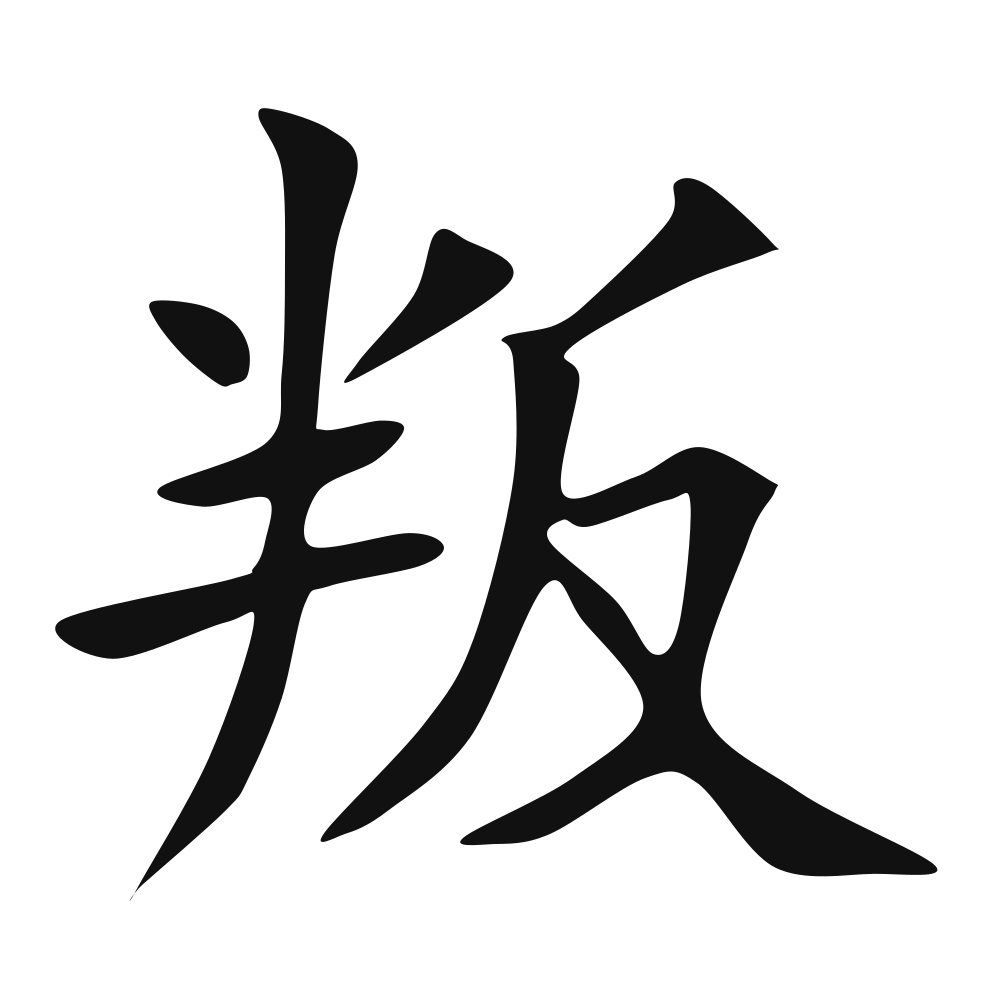
叛
to betray; to rebel; to revolt
Closest English meanings
rebel·betray·treason
The Calligrapher — Zhāng Zhī 张芝
Han 'Sage of Cursive', father of the connected-cursive style.
Han calligrapher (?–192), master of cursive script/clerical cursive — Han dynasty 'Cursive Sage' who turned rapid writing into an art form centuries before cursive peaked. Han dynasty
Etymology & Meaning · 字义溯源
2 · The Character: 叛 Pàn (4th tone). 《说文·半部》: 「叛,半也。从半反声。」 Duan Yucai corrects the received text to 「半反也」 — a half-reversal: 反 is the total overturn, 叛 is the turn made by one part of a body against the rest. Zhang Taiyan's 1908 Tokyo lectures sharpen it: 反 is the man who rises on his own authority, 叛 the man who turns while leaning on an outside power. Classical usage is uniformly a verdict, never a compliment. 《左传·隐公四年》 「众叛亲离,难以济矣」 — the crowd defects, kin depart, nothing can be accomplished. 《楚辞·逢纷》 「信中涂而叛之」. Modern compounds are criminal-legal: 叛国 treason, 叛徒 traitor, 叛逃 defection, 叛乱 insurrection. Honest disclosure: this is not the Western 'rebel / outlaw / punk' glyph. English 'rebel' carries romance; 叛 carries only betrayal, and a Chinese reader sees a court judgment rather than an attitude. If defiance is the message, 逆, 反骨 or 狂 say it honestly.
Cultural Story
叛 was to turn against. When An Lushan rose against the Tang in 755 the realm called it the 安史之乱, a rebellion that broke the capital and the age. A 叛徒 broke his oath; a border 叛乱 flared and was put down. The word named the breach of loyalty -- the subordinate who turned, the general who marched the other way.
Where a Western reader can stand: Zhang Zhi (?–c. 192), the Eastern Han Sage of Cursive, invented flowing cursive and the one-stroke line that Wang Xizhi conceded he could only 'fly beside.' But no beauty of hand redeems 叛: it means 'betray / defect / treason,' a half-reversal (半反) of one part against the whole. Unlike the English 'rebel,' which can feel romantic, 叛 carries only betrayal — a court verdict (叛国 treason, 叛徒 traitor), the standard Chinese word for selling out one's country, and it can genuinely offend. We flag this combination honestly: do NOT wear 叛 to signal 'outlaw.' If defiance is your message, 逆 (go against), 狂 (unbridled) or 反骨 (the rebel bone) say it without the treason charge. Element Water (水).
Common words & phrases
- 背叛 betray · desert · turn traitor
- 叛徒 traitor · turncoat · renegade
- 叛乱 rebellion · revolt · insurgency
- 叛变 defect · turn traitor · revolt
- 反叛 rebel · revolt · defy
Read the story behind the character
A player 背叛 his club for a rival; the game resets after a 叛乱 by the AI foe. A defector is 叛变; a faction 反叛 the council. The word keeps its old charge of broken allegiance -- the friend who turns, the traitor named in the headline, the mutiny in the story. It marks the moment a bond snaps and the side is changed.
Why this character belongs on skin
There is a clean line between disobedience and betrayal, and this stands on the far side of it. The character splits to turn against with half; you become half of what you were, and the other half turns. To rebel is not to quarrel; it is to walk out, to become the one the gate closes against. History is written by the rebels who could not be governed, from the warrior who broke his oath to the saint who broke his church. The Daoist knows rebellion as the natural curvature of water against the stone. Wear this only if you mean it. It is not a fashion; it is a cut. Place it where it will be seen when you take your shirt off, a scar you chose. Let it name the moment you refused the inheritance handed to you, and the lonely, electric freedom of the one who belongs nowhere but himself.
Own this character
Purchase delivers the original SVG of this glyph, brushed by Zhāng Zhī 张芝, ready to place on skin, paper, or screen.