
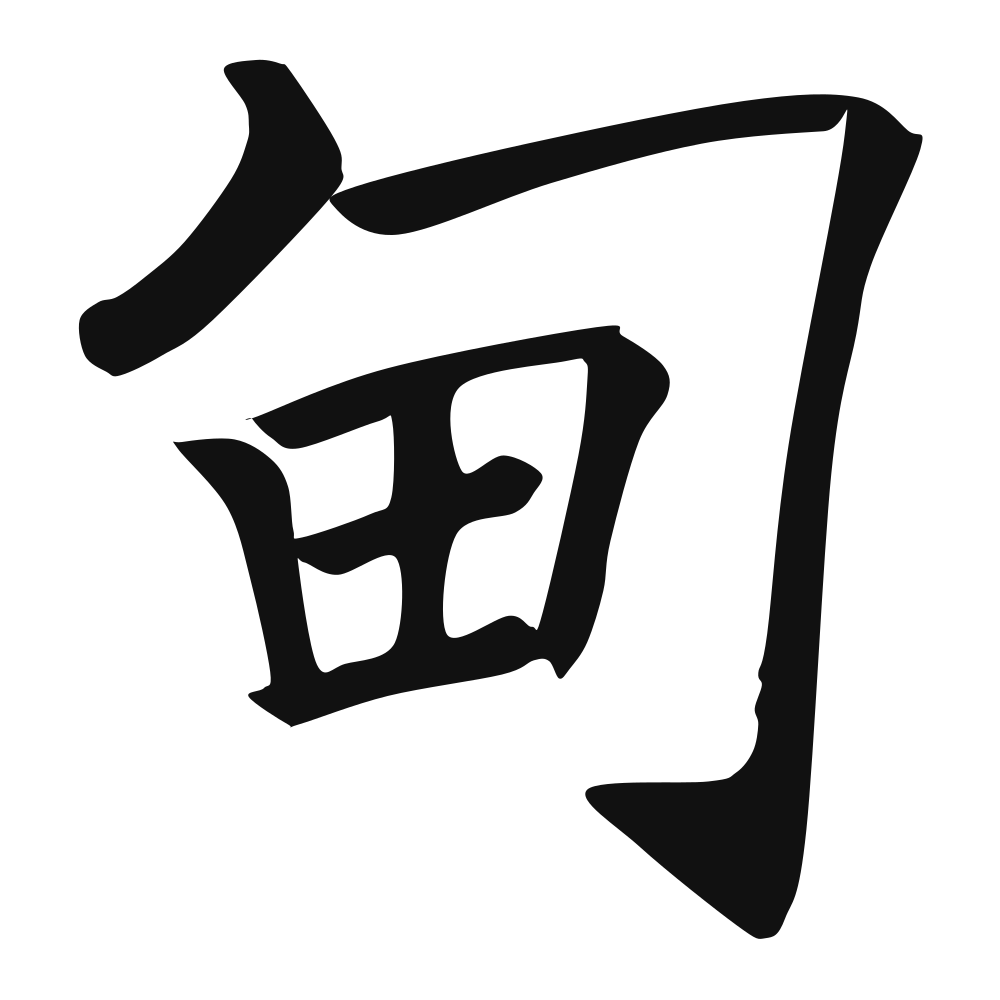
甸
surname Dian; suburbs or outskirts; one of the five degrees of official mourning attire in dynastic China; official in charge of fields (old)
Closest English meanings
suburbs·fields
The Calligrapher — Chǔ Suíliáng 褚遂良
Tang chancellor and regular-script master of elegant, balanced strokes.
Tang calligrapher (596–658), master of regular script — Tang master of graceful, tensile regular script favored by the imperial court. Tang dynasty
Cultural Story
Dian marked the king's outer reaches — the 畿甸, lands within reach of the capital that owed grain and guard duty. Ancient geography texts ringed the realm in zones, and dian named the nearest cultivated ring, fields feeding the court.
Common words & phrases
- 沉甸甸 heavy
- 甸子 prairie · fields
- 伊甸园 Eden
- 畿甸 suburbs of capital
Read the story behind the character
Modern Chinese keeps it mostly as texture: 沉甸甸, heavy and substantial, describing a full purse or a heavy heart; a 甸子, grassland meadow, in northeastern speech; and 伊甸园, the Garden of Eden — a biblical import that borrowed the character of fields for paradise.
Why this character belongs on skin
Beyond the city wall the fields begin, and the soul exhales. Diān is that open country—the cultivated plain where the empire's edge softens into grass, where a load well carried feels heavy in the good way, full and earned. The ancients measured a man's land in diān, and a man's worth in what he could bear without complaint. To mark yourself with this is to choose the wide horizon over the crowded room, the honest weight over the empty ease. Let it lie across a shoulder that has held things. You were not built for the narrow. The ink is the field you carry—fertile, open, quietly heavy with everything you have chosen to hold. Walk it. The harvest is yours to tend.
Own this character
Purchase delivers the original SVG of this glyph, brushed by Chǔ Suíliáng 褚遂良, ready to place on skin, paper, or screen.