
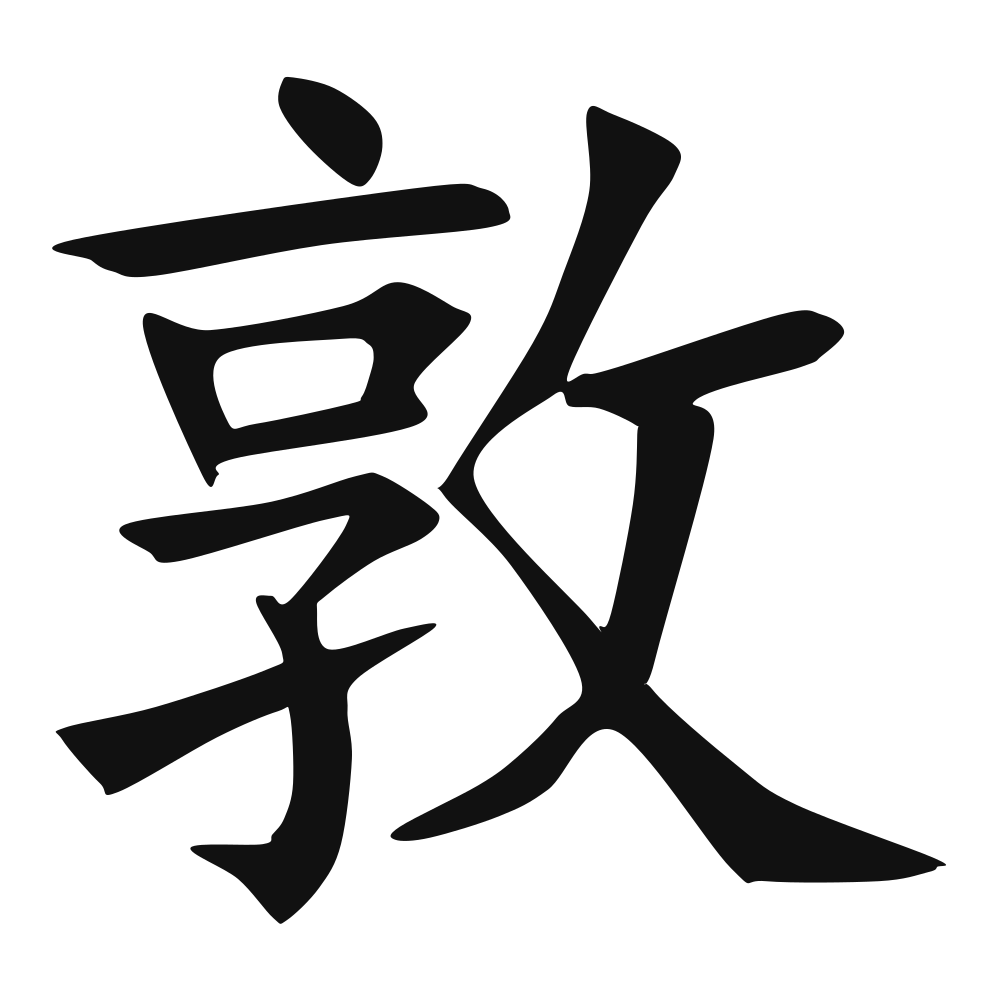
敦
kindhearted; place name
Closest English meanings
honest·sincere·thick·earnest
The Calligrapher — Zhāng Zhī 张芝
Han 'Sage of Cursive', father of the connected-cursive style.
Han calligrapher (?–192), master of cursive script/clerical cursive — Han dynasty 'Cursive Sage' who turned rapid writing into an art form centuries before cursive peaked. Han dynasty
Etymology & Meaning · 字义溯源
2 · The Character: 敦 Dun (1st tone). The Shuowen Jiezi reads 「敦, 怒也, 诋也」 — angry, reproaching; Duan Yucai ties it to 墩 (a mound) and to 厚 (thick). The graph thus holds two lives: an old, harsh sense (to chide, to be stern), and the beloved modern sense 'honest and thick' (敦厚). The Odes, Bei Feng, cry 「王事敦我」 (royal service presses hard on me); the Documents and the Analects praise 敦厚 (honest, generous). The Hexagram Lin even has a line 「敦临, 吉」 (grave, sincere oversight — fortune). Name-lore assigns Fire (火) and twelve Kangxi strokes. As a free morpheme 敦 today means sincere, solid, generous. Honest route: the Shuowen base is 'anger/reproof', so disclose that the warm sense 敦厚 is the living one, the harsh root dormant — do not sell it as 'wrath'.
Cultural Story
敦 is weight with kindness. 敦厚 is the plain, solid man the village trusts; 敦煌 the 'blazing' frontier town where the caves keep a thousand years of painted prayer. 敦促 is to press a friend kindly to decide. The word is sincerity you can lean on — the thick wall, the honest neighbor, the painted cliff at the desert's edge.
Where a Western reader can stand: Where a Western reader can stand: 敦 once meant 'to chide, to be angry' — and grew into 敦厚, 'honest and thick', the Latin sincerus made solid. The honest read: its root is reproof, its flower is warmth. Wear it for sincerity you can lean on, and know the stern old sense is still in the grain. And note: the flowing-cursive hand is attributed to Zhang Zhi, the Sage of Cursive, whose own brush does not survive — the famous 冠军帖 is now read as Zhang Xu's.
Common words & phrases
- 敦厚 honest · sincere · simple
- 伦敦 London · capital of UK
- 敦促 urge · press · exhort
- 敦实 sturdy · stocky · solid
- 敦请 cordially invite · earnestly request
- 敦睦 harmonize · promote friendship
Read the story behind the character
伦敦 is London, borrowed and unchanged in sound. 敦促 the diplomat's note; 敦睦 the treaty's aim. 敦实 the sturdy kid; 敦厚 the character reference. The word sells reliability — the bank, the build, the brother-in-law. From the cave shrines of 敦煌 to the embassy's polite 敦请, it names substance worn without shine. The solid thing, praised plainly, without gloss.
Why this character belongs on skin
There is a stone quality to real goodness. 敦 means honest, sincere, generous of heart — and its oldest sense was heavy: a thick mound, solid ground, a ritual vessel of bronze filled for the ancestors. The Confucians took that weight and made it a virtue: 敦厚, thickness of character, the person whose word is a load-bearing beam, who does not erode under weather. This is kindness with mass — not the performed gentleness of the moment but a warmth with foundations, the friend who is the same on his worst year as his best. In a thin age of performance, thickness is almost scandalous: to be simply, densely reliable, grain upon grain like silt building land. To ink 敦 is to aspire to that — to promise your weight will hold, that love deposited with you earns interest forever. Place it on the chest, near the bulk of things. Be the ground someone else can build on.
Own this character
Purchase delivers the original SVG of this glyph, brushed by Zhāng Zhī 张芝, ready to place on skin, paper, or screen.