
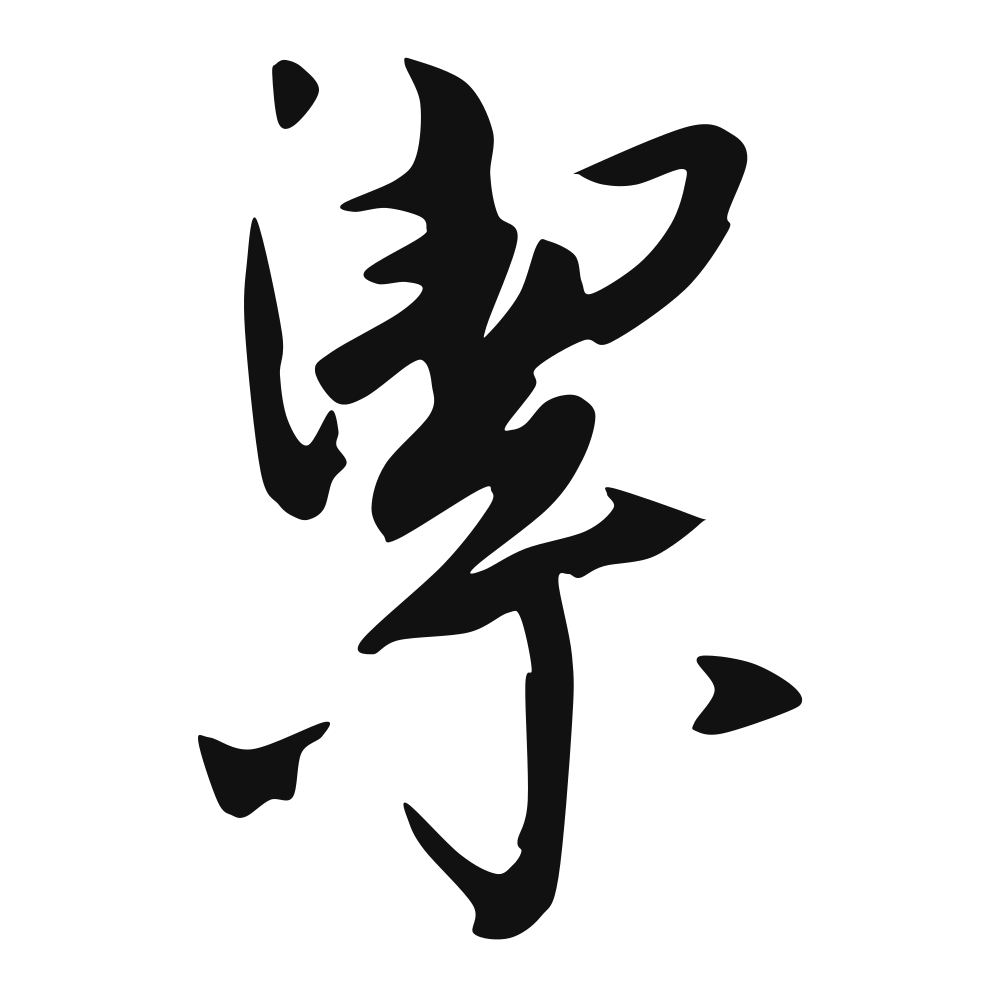
洁
clean
Closest English meanings
clean·pure·spotless·untainted·chaste
The Calligrapher — Cài Jīng 蔡京
Powerful Song statesman and gifted calligrapher once ranked among the 'Four Masters' (Su-Huang-Mi-Cai).
Song calligrapher (1047–1126), master of running script — known for 《节夫帖》. Song dynasty
Etymology & Meaning · 字义溯源
2 · The Character: 洁 洁 (jié, 2nd tone; traditional 潔) is cleanness with a moral second meaning. It is a late graph, and the honest way to say so is this: 潔 is not in Xu Shen's original Shuowen at all — it stands among Xu Xuan's Song-dynasty 新附 additions to 水部, glossed 瀞也 ('clean water'), 从水絜聲, 古屑切. The classics used the older 絜; the Guangyun says so outright — 經典用絜. The Liji gives the temperament: 絜靜精微,《易》教也 (經解) — 'pure, still, exact and fine: that is the teaching of the Changes.' The Analects gives the ethic: 人潔己以進,與其潔也,不保其往也 (述而) — 'if a man cleans himself up to come forward, accept the cleanness; do not hold his past against him.' The Chuci makes it a choice at a crossroads: 寧廉潔正直以自清乎 (卜居), 'shall I be incorrupt, clean and upright, and so keep myself clear?' Honest disclosure: in modern signage 洁 mostly means hygiene — 清洁, 洁具, 洁厕.
Cultural Story
洁 means clean and unsoiled; the 說文 gives to clean. The 楚辭 praises the 纯洁 heart of the exiled poet. A 廉洁 official refuses the bribe. Rites required 洁净 vessels, and 洁白 robes marked the sacrificer at the altar.
Where a Western reader can stand: Where a Western reader can stand: 洁 is Latin 'purus' and 'integer' — clean, unstained, pure, morally upright. The Analects (Shu Er) says 人潔己以進, 'a man purifies himself and comes forward' — take his cleanness as it stands now, do not hold his past against him. The Hexagram Jǐng (48), the Well, runs 井洌,寒泉食, the well clear, the cold spring drunk. Cai Jing is the dissonance. He was condemned by later historians as a corrupt minister — and here he is, writing 洁, the very word for incorrupt. The honest position is a tension, and his sleek court hand makes it visible: exquisite brushwork spelling 廉潔 (clean hands) from a man history calls rapacious. The catch to disclose: in modern China 洁 lives mostly in hygiene vocabulary — 清潔 (cleaning), 潔具 (bathroom fittings), 潔廁靈 (toilet cleaner) — so a lone 洁 can read 'sanitary' before it reads 'pure'. Pair with 廉 (廉潔) for the moral register, and remember Cai wrote the traditional 潔.
Common words & phrases
- 清洁 clean · cleaning · sanitation
- 整洁 neat · tidy · orderly
- 纯洁 pure · innocent · chaste
- 洁净 clean · spotless · pure
- 洁白 white · spotless · pure white
- 廉洁 honest · incorruptible · clean-handed
Read the story behind the character
The street sweeper keeps the city 清洁 (clean, sanitation). Her desk is always 整洁 (neat, tidy). A 纯洁 (pure, innocent) child's smile warms all. The lab must stay 洁净 (clean, spotless). Brides wear 洁白 (pure white) gowns. Voters demand a 廉洁 (incorruptible) government.
Why this character belongs on skin
Cleanliness is not sterility; it is a kind of loyalty. 洁 sets water beside auspicious, pure, clean, unsoiled, the clarity that comes when nothing false is mixed in. The Confucian gentleman kept his body and name unsullied; the Daoist sought the still pool that reflects the moon without distortion. In a loud, smeared age, this is a radical word: it means you have refused the compromise that would make life easier and you cheaper. The Christian baptism bends the same way, the water that marks a self set apart. Wear it where the skin is thin and honest, the inner wrist, the breast. Let it say you would rather be empty than crowded with the wrong things, that your clarity is a discipline and not a luck, and that the pure thing is not the untouched thing but the one that was soiled and washed and chose not to keep the stain.
Own this character
Purchase delivers the original SVG of this glyph, brushed by Cài Jīng 蔡京, ready to place on skin, paper, or screen.