
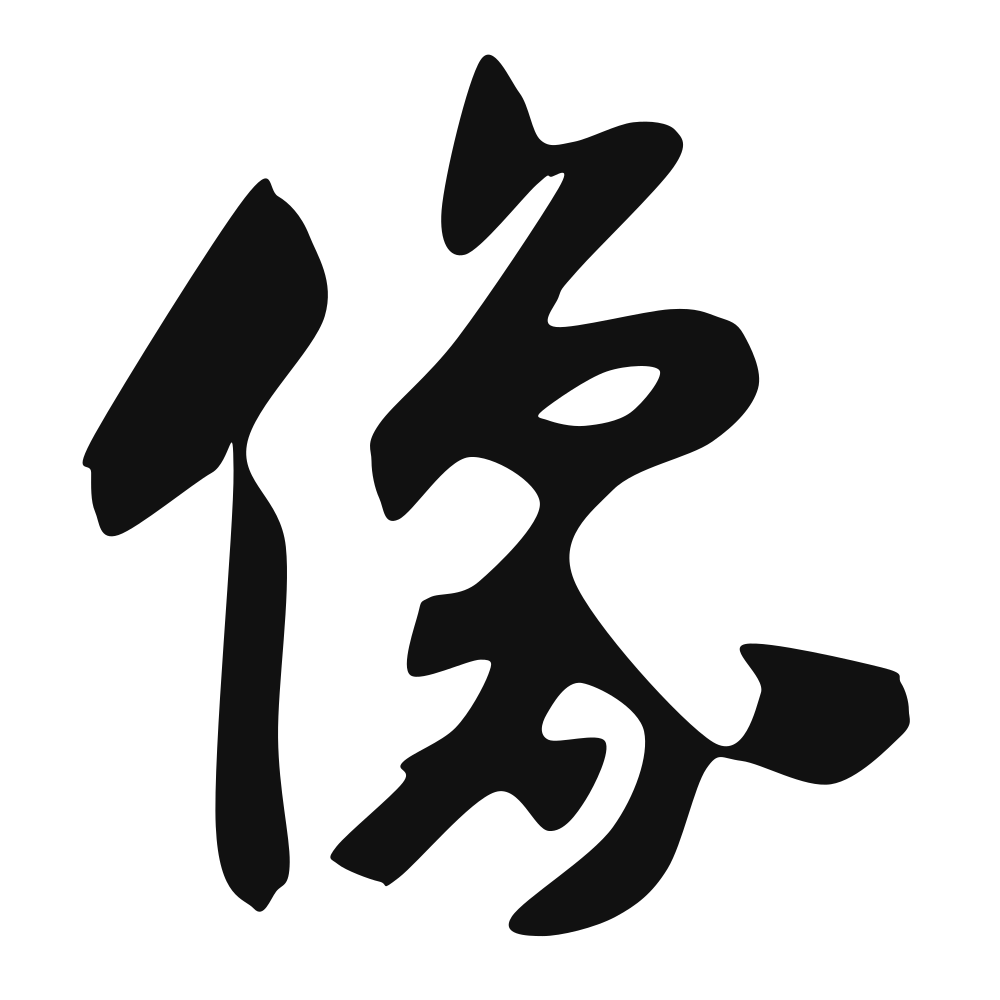
像
to resemble; to be like; to look as if; such as; appearance; image; portrait; image under a mapping (math.)
Closest English meanings
image·picture·resemble·statue
The Calligrapher — Zhào Gòu 赵构
Southern Song emperor and prolific patron of running-script calligraphy.
Song calligrapher (1107–1187), master of regular script/running script — known for 《草书洛神赋》. Song dynasty
Etymology & Meaning · 字义溯源
2 · The Character: 像 像 (xiàng, 4th tone) means 'image, portrait, likeness' — it pairs 人 (person) with 象 (appearance/form), the visible form of a thing. It is a portrait, a statue (佛像), or the verb 'to resemble' (好像); not the English 'idol' (no false-god baggage) and not a snapshot (照片).
Cultural Story
After Buddhism reached China, artisans cut 雕像 and 佛像 into the cliffs at Yungang and Longmen, each 像 a focus for devotion. The "Analects" had already urged, "sacrifice as if present" — 祭如在 — training the mind to meet the absent as if face to face. The word 像 thus bridged the carved stone and the act of regard.
Where a Western reader can stand: Zhao Gou (Emperor Gaozong, 1107–1187) founded the Southern Song and, as a devoted calligrapher, authored the Hanmo Zhi defending the Wang Xizhi orthodox line; his regular, running and cursive are elegant and disciplined. 像 in his imperial, balanced hand is the image rendered with courtly calm. Honest caveat: 像 ranges from portrait/statue to 'seems like' (好像); it is not the English 'idol' and not a photo (照片). For a Buddhist image pair as 佛像; for resemblance use 好像/肖像. (Gaozong is politically divisive as a ruler who made peace with the Jin — note only if relevant.)
Common words & phrases
- 好像 seem · as if · like
- 图像 image · picture · graphic
- 画像 portrait · drawing · portray
- 雕像 statue · sculpture · carving
- 录像 video · record · tape
- 偶像 idol · icon · image
Read the story behind the character
A phone keeps a 图像 of the receipt; a 录像 captures the break-in. The museum restores a 雕像 of the founder, and a fan edits a 偶像's clip late at night. The word still means the made likeness — a photo, a video, a figure — the copy that stands in for the thing or the person one cannot hold.
Why this character belongs on skin
Under the person-radical, 像 means to resemble—and also the image itself: a portrait, a statue, a reflection. Buddhism imported a whole metaphysics with the phrase 想像, imagination, and with the statues carved into cliff faces at Dunhuang, faces that have watched fourteen centuries of travelers look up. To be like something is to be haunted by it gently—a daughter like her mother, a face like the one in the old photograph. Every icon in every temple was made by a hand copying another hand, back and back, until the chain vanished into heaven—no one the original, everyone the likeness, the holiness undiminished by repetition. The character asks a quiet question: what is the image, and what is the original? Wear 像 and you carry the truth that we are all portraits of something—a parent, a hope, a person we lost—and that resemblance is a kind of love.
Own this character
Purchase delivers the original SVG of this glyph, brushed by Zhào Gòu 赵构, ready to place on skin, paper, or screen.