
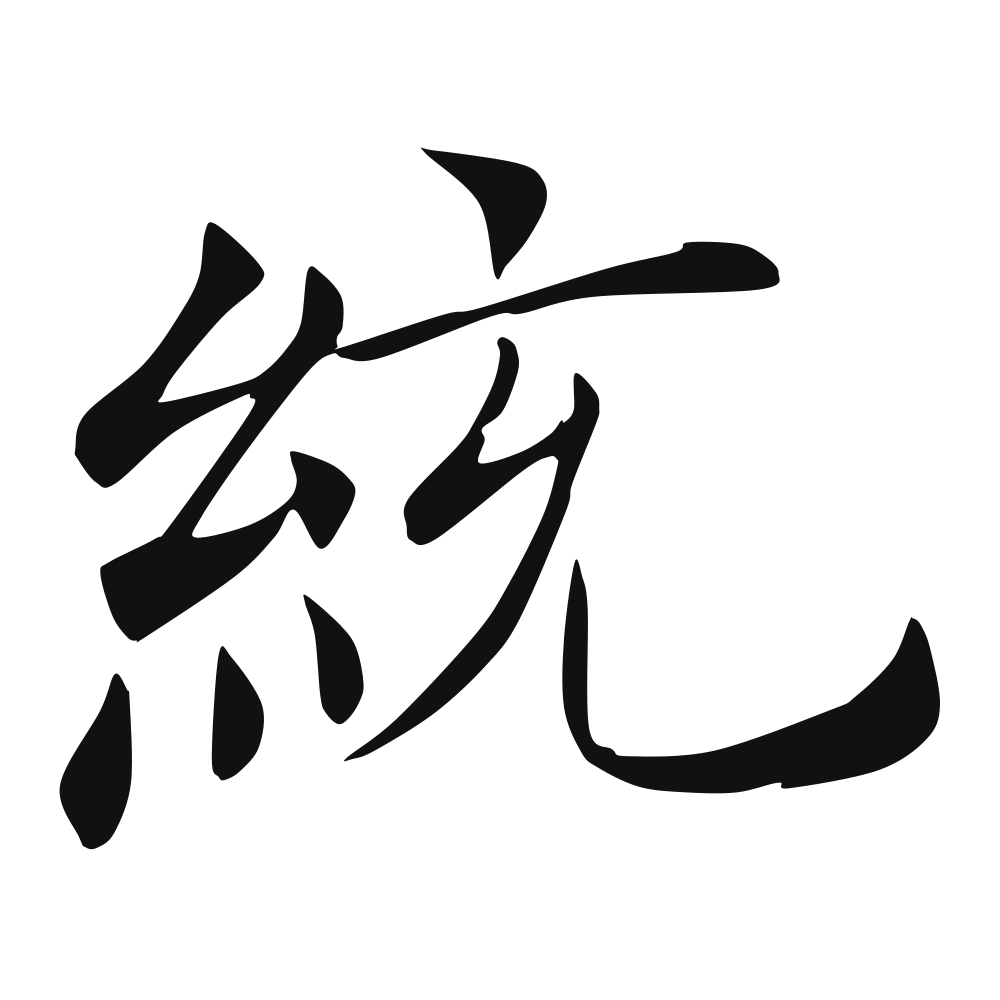
统
to gather; to unite; to unify; whole
Closest English meanings
unify·system·all
The Calligrapher — Chǔ Suíliáng 褚遂良
Tang chancellor and regular-script master of elegant, balanced strokes.
Tang calligrapher (596–658), master of regular script — Tang master of graceful, tensile regular script favored by the imperial court. Tang dynasty
Etymology & Meaning · 字义溯源
### Soundtǒng — tǒng (3rd tone). Free-standing morpheme ### Original meaningTǒng (3rd tone; traditional 統). The Shuowen Jiezi defines it as 「紀也。从糸充聲」 — 'the governing thread', 糸 for the field and 充 for the sound. Duan Yucai's commentary quotes 《淮南子·泰族訓》 for the original picture: 「繭之性爲絲,然非得女工煑以熱湯而抽其統紀,則不能成絲」 — 'a cocoon is silk by nature, yet unless the woman worker boils it and draws out its governing threads, it never becomes thread'. From that one thread at the head of the skein, everything else follows: 《釋名》「統,緒也,主緒人世,類相繼如統緒也」 — the thread by which generations succeed one another. 《公羊傳·隱公元年》「何言乎王正月?大一統也」 (He Xiu: 統者,始也,總繫之辭) makes it the word for the great unification. And 《易·乾》「乃統天」 — Zheng Xuan glosses 統 as 本, 'the root'. Honest disclosure: in modern Chinese 統 is administrative and abstract — 統一 (unify), 統治 (rule), 傳統 (tradition), 系統 (system) — and it carries the flavour of governing, not of poetry. ### The structure (形聲 · 从糸,充聲 — silk (糸) for the field, 充 (chōng) for the sound; the thread that leads the skein)①糸mìsilk (radical)the field: thread, and things made of thread②充chōngto fill / (phonetic)the sound-bearer; also the sense of filling out to completeness③統紀tǒng jìthe governing threadsthe Huainanzi picture: the threads you must find first④大一統dà yī tǒngthe great unificationthe Gongyang phrase that carried 統 into political language ### In use todayItemReading / meaningNoteReadingtǒng (3rd tone)single syllable; traditional 統Core sensethe thread that binds into oneoriginally the head-thread of a skeinGrammarbound morpheme (modern)統一 unify · 統治 rule · 傳統 tradition · 系統 system · 血統 bloodlineTattoo fitcaution — classical image, modern administrative flavourreads as governance and lineage rather than as romance ### Closest words in English — and what each misses - Unity — 一 holds 'one'; 統 is the binding that makes many into one, an act and a thread rather than a number - Control / Rule — 治/御 hold governing outright; 統 is the older, gentler image — the thread by which things hang together - Tradition — 傳統 (tradition) is a compound built on 統; 統 alone is the thread of succession, not the customs passed along it - Total / General — 總 (zǒng) holds 'to gather up, general'; it is 統's modern neighbour in sense, not the same characterAn honest note on grammar. Free morpheme in classical usage; in modern Mandarin a productive bound morpheme — 統一, 統治, 傳統, 系統, 血統 — and also a surname (《廣韻》) and a geological term (統, a series of strata)Where a Western reader can stand: 统 (tǒng) is the head-thread of a skein — the one filament a silk-worker must find before a cocoo
Cultural Story
统 originally named the single main thread from which a cocoon or a lineage unwound, so it became the word for inheritance and for unity. Qin's conquest of the warring states was remembered as the first great 统一, unification, and the Gongyang commentary exalted 大一统, grand unification, as the ideal under heaven. To 统治, rule, was to hold the one thread all others hung from.
Where a Western reader can stand: 統 is the head-thread of a skein - that which binds many into one, and by extension to unify, govern, and succeed. Its classic phrase is 大一統 ('great unity'). Today it is mostly administrative - 'unify', 'rule', 'system'. As a tattoo it is order holding many together; do not sell it as a mystic 'unity of the soul'. Chu Suiliang's composed script fits.
Common words & phrases
- 統一 unify
- 系統 system
- 傳統 tradition
- 統計 statistics
- 統治 rule · govern
Read the story behind the character
Tǒng runs the machines of modern life. Every phone begs to update its 系統, system, at midnight; families argue over which 傳統, tradition, the Spring Festival dinner must keep. Officials 統計, tally, the census; tech giants 統一, unify, their account systems; historians dissect how dynasties 統治, ruled, and what held each realm together.
Why this character belongs on skin
A single thread runs through the scattered silk, and where it passes, the chaos becomes cloth. Tǒng is to unify, to govern, to draw the many under one line — the emperor's authority, the system that holds a people, the mind that gathers its warring thoughts into one will. The Confucians prized the ruler who could tǒng without crushing, whose thread bound but did not strangle. We each rule a small empire of impulses; the one who tǒng them is free, the one who does not is a province at war with itself. To carry this character is to claim the center, the hand on the spindle. Ink it along the spine, that column which holds the scattered body as one, a quiet assertion that you are not merely tossed by the weather but the one who gather the winds. Let it mark the place where your many selves agree to be, at last, a single country.
Own this character
Purchase delivers the original SVG of this glyph, brushed by Chǔ Suíliáng 褚遂良, ready to place on skin, paper, or screen.