
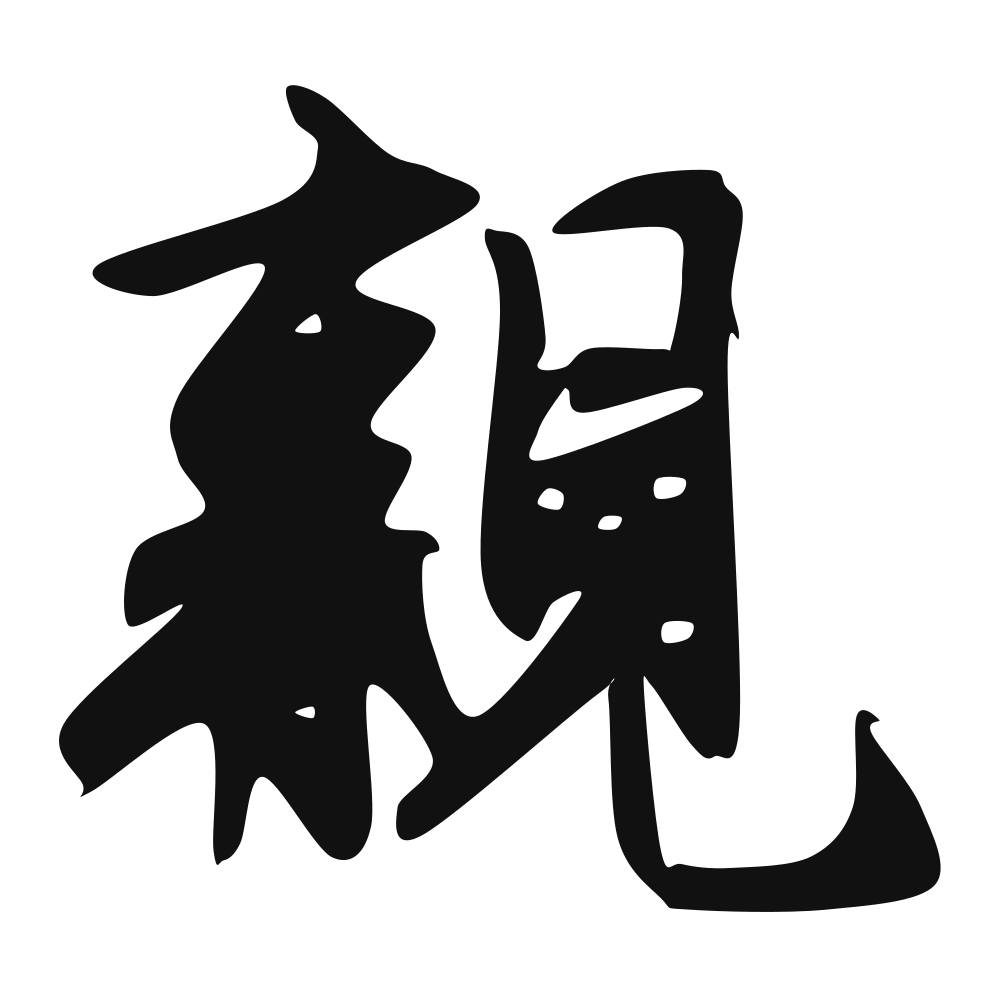
亲
parent; one's own (flesh and blood); relative; related; marriage; bride; close; intimate; in person; first-hand; in favor of; pro-; to kiss; (Internet slang) dear; parents-in-law of one's offspring
Closest English meanings
relative·dear·parent·intimate·kin
The Calligrapher — Zhào Mèngfǔ 赵孟頫
Yuan master whose elegant regular and running script revived classical tradition.
Yuan calligrapher (1254–1322), master of regular script/running script/cursive script — Yuan reviver of classical elegance who could write any script beautifully and did. Yuan dynasty
Etymology & Meaning · 字义溯源
2 · The Character: 亲 亲 (qīn, 1st tone; traditional 親) is, in Xu Shen, arrival and closeness: 至也。从見亲聲 — 'to arrive; from 見 (see) and 亲 (sound),' i.e., to draw near and behold. The classics make it the bond of kinship and love: the Yijing (乾卦) '本乎天者親上,本乎地者親下' (what is rooted in heaven draws near the high, in earth the low); the Xiaojing '慈愛之心曰親' (a tender heart is 親); the Liji (大传) '親者,屬也' (kin are those bound to you); the Mengzi weighs 親親. As a free morpheme 亲 means 'kin, dear, to be close,' and is wholly warm — 亲人, 亲密, 亲仁. Honest disclosure: the simplified 亲 drops the 見 (see) of 親, so a purist may note the lost 'beholding' root; on skin it is a clean, friendly character. Pair it with 人 or 仁 if you want 'dear one / benevolence' explicit; in Japanese it is shi / oya. The Wuxing attribution is confident: 亲 is Wood (木), the growing bond.
Cultural Story
親 showed a man peering at the mourner's coffin, to be present at the rites, the root of kin, intimate. The 說文 reads it as to be close, to witness. 父親 and 母親 are the parents you bury and honor; 親戚 the wide net of relations the ancestral hall recorded. The character is presence at the moment that matters, the body that shows up, the bond made by standing near.
Where a Western reader can stand: Zhao Mengfu (1254–1322), 'Crown of the Yuan,' was a Song imperial clansman and one of the Four Masters of Standard Script, famed for the rounded, fluent Zhao style (赵体) worked back through Zhiyong to the two Wangs. 亲 means 'kin, dear, close.' His elegant, controlled brush gives the warm char a courtly grace — the bond as refined manners, love with good posture. Note his honest history: a prince who served the Mongol court, branded a 'twice-serving minister,' yet his defence stands — learn the brush from the two Wangs, loyalty from Yan. For the client it is a beautiful, uncontroversial family mark, grace over drama.
Common words & phrases
- 亲戚 relative · kinsfolk · kin
- 亲切 warm · kind · cordial · friendly
- 亲自 personally · in person · oneself
- 亲密 close · intimate · familiar
- 父亲 father · dad
- 母亲 mother · mom
Read the story behind the character
亲戚 is the reunion you cannot skip; 亲切 the warmth of the hometown dialect. 亲自 is the boss who shows instead of delegating; 亲密 the relationship you post about. 父亲 and 母亲 are the parents in every school form. The character names the close and the blood, the presence that defines intimacy. It still means showing up, at the grave, at the door, at the bed, the nearness that makes a relation real.
Why this character belongs on skin
亲 is what makes someone 亲人 — not the relatives on the form, but the people who are really yours. Intimate, close, the ones who have seen you undone and leaned in rather than away. For so many of us the word had to be rebuilt from scratch: the family that dissolved and the family that formed in its place, the friends who became the emergency contacts, the person who knows the sound you make when you're trying not to cry. 亲 is that nearness, claimed. It is also the tenderness of being known without armor, of being called by a name only your people use. Ink it where you can press a thumb when the old loneliness visits. Let it testify: you have kin. Not by accident of birth, but by the slower, braver road of being chosen and choosing back. 亲 is the proof the road was worth it.
Own this character
Purchase delivers the original SVG of this glyph, brushed by Zhào Mèngfǔ 赵孟頫, ready to place on skin, paper, or screen.