
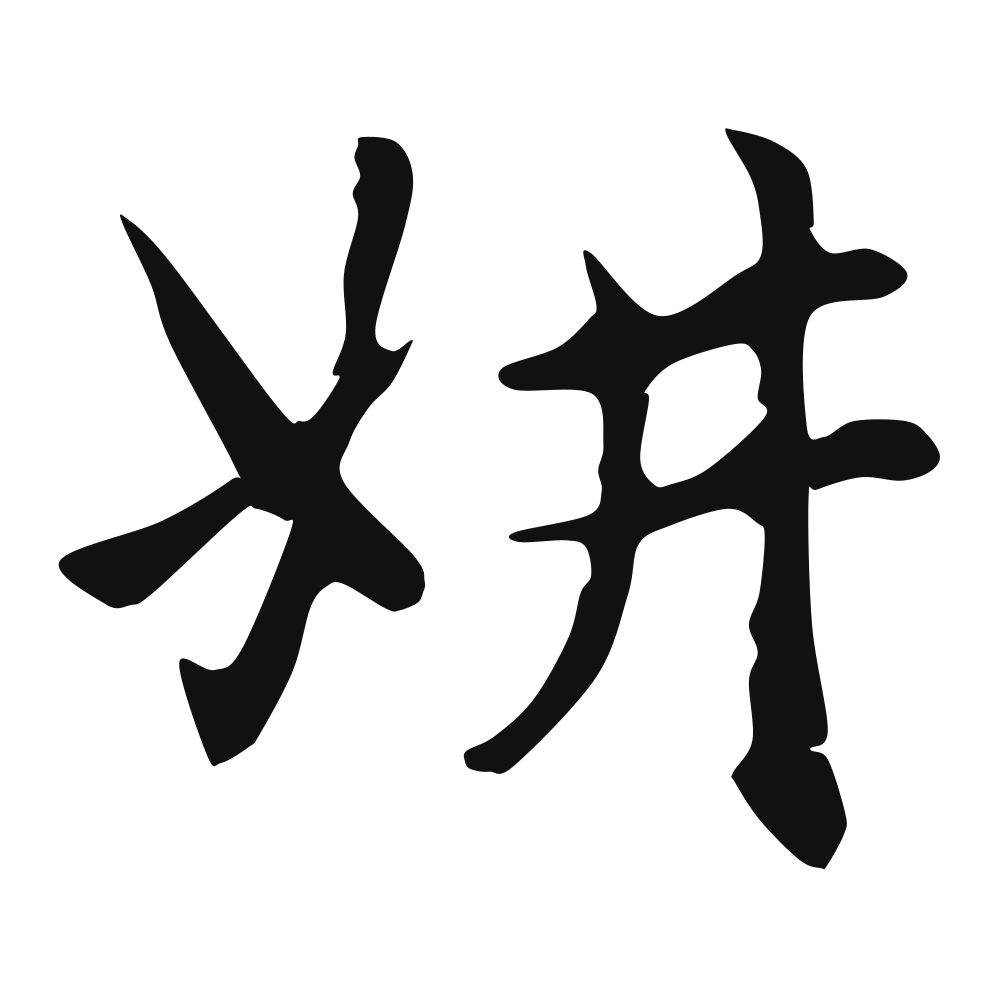
The Calligrapher — Zhào Mèngfǔ 赵孟頫
Yuan master whose elegant regular and running script revived classical tradition.
Yuan calligrapher (1254–1322), master of regular script/running script/cursive script — Yuan reviver of classical elegance who could write any script beautifully and did. Yuan dynasty
Cultural Story
The Shuowen gives 妍 as skill and, by extension, beauty — a character of woman (女) with 幵, suggesting a fine, even face. The critics of the Six Dynasties set 妍媸 side by side, beauty and ugliness, as the twin measures of a face or a line of verse, and poets bade flowers 爭妍, competing in beauty before the spring. For the classical eye 妍 was not mere prettiness but a composed harmony — the loveliness of a face, a garden, or a well-turned phrase that pleased without strain.
Common words & phrases
- 妍丽 beautiful
- 妍媸 beauty and ugliness
- 争妍 compete in beauty
Read the story behind the character
A beauty blog praises a 妍麗 (beautiful) model's features; an art critic weighs 妍媸 (beauty and ugliness) in a student's sketch. Flowers in the park 爭妍 (compete in beauty) each spring, and a bride is called 妍麗 in the wedding post. A makeup ad promises 妍 skin, and friends debate 妍媸 in a photo contest. 妍 is the modern word for beauty — the lovely face, the blooming garden, and the quiet contest of looks that fills feeds and mirror alike.
Why this character belongs on skin
There is beauty that arrives and beauty that is composed—and 妍 belongs to the second kind: loveliness with craft in it, the exquisite, the deliberately lovely. The character sets a woman radical beside the strokes of opening and unfolding, as though beauty were a thing gently unwrapped. Classical critics used 妍 to judge calligraphy—the 妍美 style, polished and flowering—and poets used it for plum blossoms that bloom with an almost arrogant perfection in snow. This is not the raw sublime; it is beauty that knows itself, that has been attended to, that repays attention. There is nothing vain in that. To make something beautiful—including yourself, including a life—is among the oldest devotions we have; the Song dynasty tea masters would have called it a form of sincerity. To ink 妍 is to claim loveliness as a practice rather than an accident, an offering rather than a gift of luck. Place it somewhere it will be seen only by choice. Beauty kept half-secret carries twice the voltage. Ask any plum branch blooming alone in the cold.
Own this character
Purchase delivers the original SVG of this glyph, brushed by Zhào Mèngfǔ 赵孟頫, ready to place on skin, paper, or screen.