
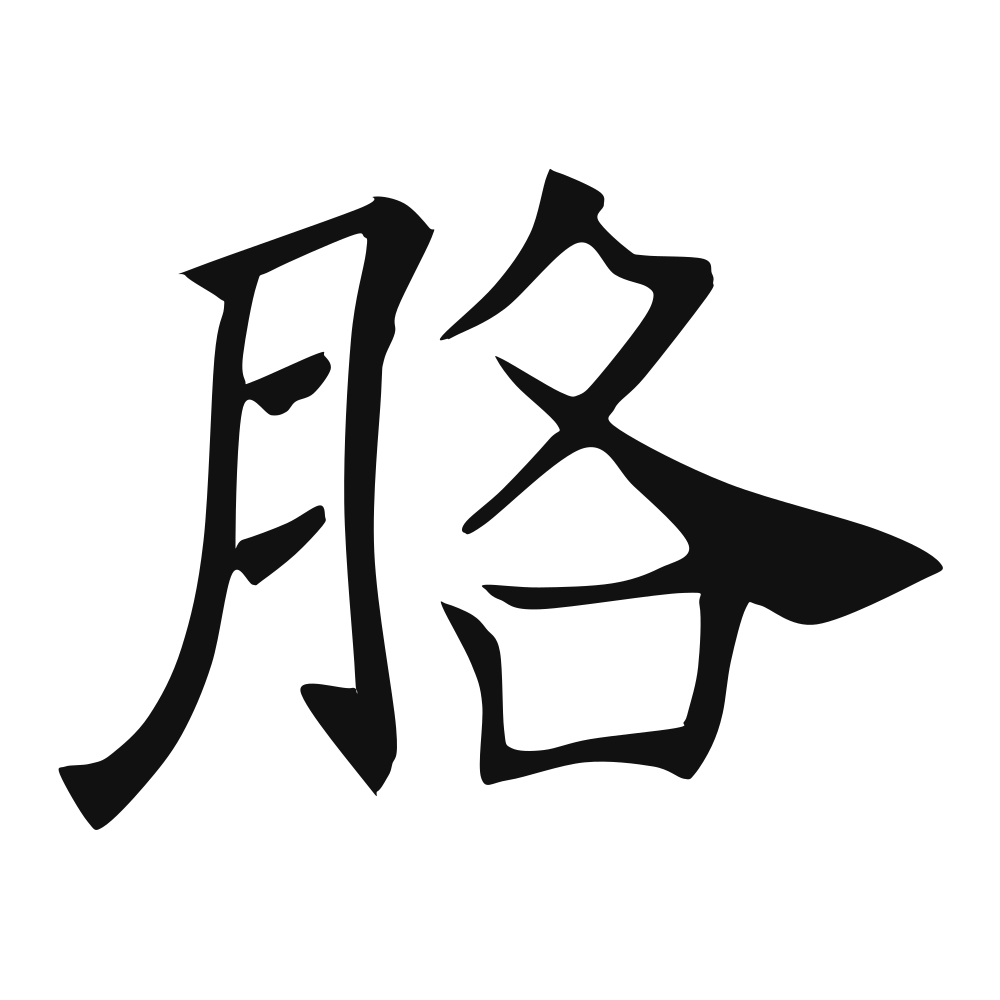
The Calligrapher — Chǔ Suíliáng 褚遂良
Tang chancellor and regular-script master of elegant, balanced strokes.
Tang calligrapher (596–658), master of regular script — Tang master of graceful, tensile regular script favored by the imperial court. Tang dynasty
Cultural Story
胳 is the arm, specifically the underside from elbow to armpit, in classical anatomy a humble word for the everyday limb that carries, hoes, writes and greets. Medical texts of the Han catalogued it precisely alongside shoulder and elbow, mapping the body as early cartographers mapped rivers.
Common words & phrases
- 胳膊 arm
- 胳臂 arm
Read the story behind the character
You offer your 胳膊 arm on a dark street so a nervous friend can hold on; a nurse ties the blood-pressure cuff around your 胳臂 arm before the checkup. Kids swing from the monkey bars until their arms ache; commuters doze with an arm bent like a pillow.
Why this character belongs on skin
The arm is the body's first language, it reaches, it shields, it gathers the child close or hurls the stone. The character 胳 names that limb in its common tongue, the 胳膊 that labors and embraces by turns. The Daoist sage let his arms hang loose, empty of force; the warrior made his a wall; the mother made hers a cradle. To know your 胳 is to know the double nature of strength, that the same limb that fights can also hold, that power is only half the story. We admire the arm that builds and forget the arm that comforts, yet both are written in the same bone. Wear this as the ink of the embracing strength, the force that knows when to close and when to open. Let it rest along your own limb, a quiet mark that you were made to both protect and receive.
Own this character
Purchase delivers the original SVG of this glyph, brushed by Chǔ Suíliáng 褚遂良, ready to place on skin, paper, or screen.