
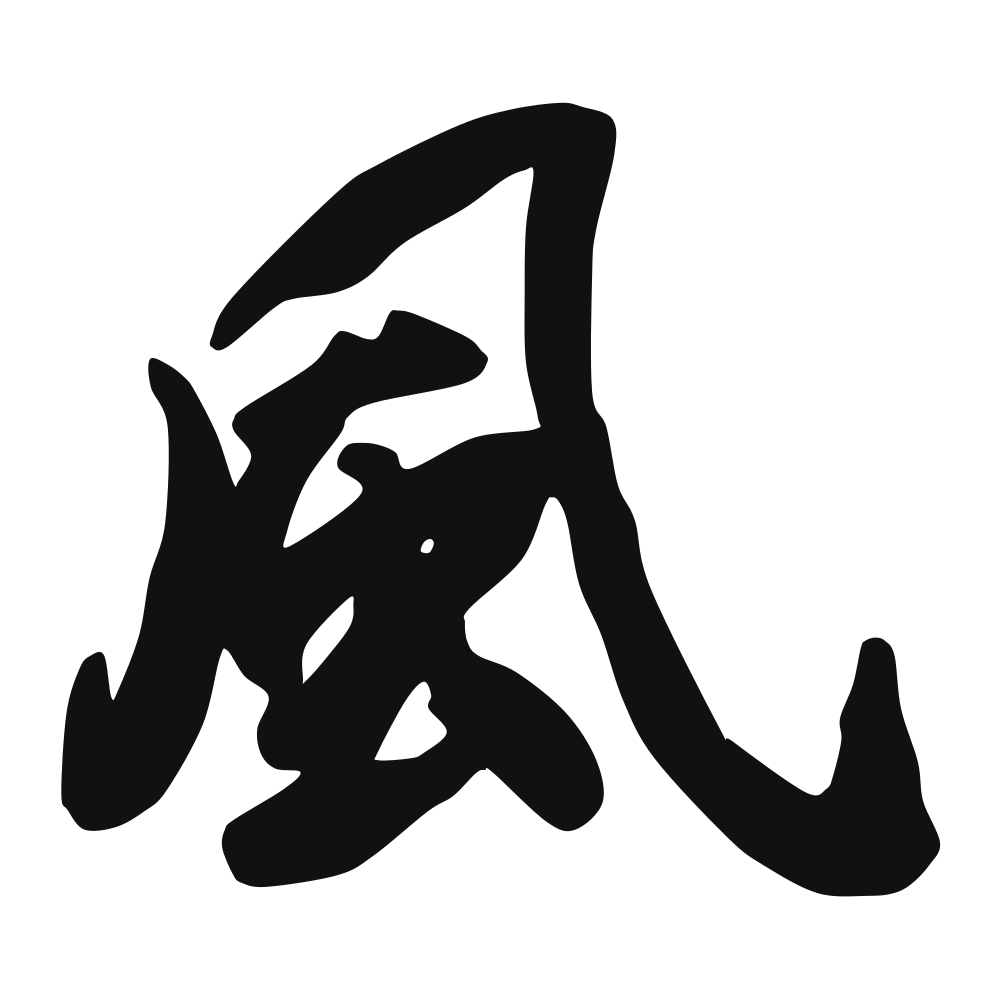
风
风 (fēng) — wind. Pictograph of a shaman/beast bearing wind. Classical life: 风骨 — 'wind-bone', the spirit and backbone of literature. Grammar: free morpheme — also: wind; news; style; custom; manner
Closest English meanings
wind·breeze·manner·custom·news
The Calligrapher — Cài Jīng 蔡京
Powerful Song statesman and gifted calligrapher once ranked among the 'Four Masters' (Su-Huang-Mi-Cai).
Song calligrapher (1047–1126), master of running script — known for 《节夫帖》. Song dynasty
Etymology & Meaning · 字义溯源
2 · The Character: 风 风 (fēng, traditional 風) is glossed by the Shuowen Jiezi (《说文解字》 風部) as '风,八风也' — the eight winds, each named by direction: the east wind 明庶, the south 景, the north 广莫. The entry adds '风动虫生' — wind moves and insects are born. The Yijing makes wind a primal force: 《易·系辞》 '风以散之' (wind disperses), and 《易·说卦》 '巽为风'. The Zhuangzi opens with it: '大块噫气,其名为风' — the great clod breathes out, and that is wind. In the Shijing the '国风' are the customs and airs of the states, while 《诗·大雅》 praises '穆如清风' (gentle as a cool wind). Liu Bang's '大风起兮云飞扬' made it the breath of empire. As a free morpheme 风 means wind, style, and custom. Honest disclosure: 风月 (romance, sometimes salacious), 风流 (dissolute charm), 风水 (geomancy) and 中风 (stroke) are live secondary readings, so context matters.
Cultural Story
風 (fēng) is built from 凡 as a phonetic and 虫, “insect.” 《説文解字》 explains that wind moves and brings insects to life, hence 八風, the eight directional winds of the year. The bronze form already carried the sense of air in motion.
Where a Western reader can stand: Where a Western reader can stand: 风 is Latin 'ventus' and 'mos' — wind, and the custom or style that spreads like weather. The Yijing makes it the trigram Xùn (57), the Gentle Wind: 隨風,巽; 君子以申命行事. Zhuangzi calls it the breath of the great mass (大塊噫氣,其名為風). The old graph 風 (with 虫) held that wind breeds creatures. Cai Jing is the court hand for it. As Huizong's favoured calligrapher, his sleek, confident running script was literally the 風 — the style, the imperial air — of the late Northern Song, the manner that moved an age of collectors and connoisseurs. His brush gives 风 the polish of a court rather than the bone of a stele. The honest catch: modern 风 also builds 风月 (romance; 风月场所 = a brothel), 风流 (dissolute charm), 中风 (a stroke), and 风水 (geomancy). Disclose those. Note too that Cai wrote the traditional 風, not the simplified 风.
Energy Reading
Wood (木)
Comparative symbology, not fortune-telling.
Common words & phrases
- 风车 windmill · pinwheel · wind wheel
- 风景 scenery · landscape · view · sight
- 风雨 wind and rain · storm · hardship
- 春风 spring breeze · gentle wind · vernal wind
- 风浪 wind and waves · storm · turbulence
- 风气 custom · atmosphere · general mood
Read the story behind the character
Modern Chinese still rides on 风. Children spin a 风车 (pinwheel) in the breeze, travelers admire 风景 (scenery), and couples brave 风雨 (wind and rain, hardship) together. A 春风 (spring breeze) soothes, while 风气 (custom) shapes a society’s mood.
Why this character belongs on skin
You never see it, only what it does — the bending grass, the closed shutter flung open, the rumor that crosses a kingdom in a night. 风 is the unseen force, the messenger and the mood of the world; the ancients spoke of a "wind of doctrine" and the "wind of an era," knowing that what moves us is rarely the thing we can point to. The calligrapher's stroke was judged by its wind — the breath of spontaneity in the line. We name our storms and think we have contained them. This character asks you to honor the ungraspable: the intuition, the influence, the spirit that passes through and changes everything without leaving a footprint. Ink it, and you carry the reminder that the most powerful things in your life were always the ones you could not hold.
Own this character
Purchase delivers the original SVG of this glyph, brushed by Cài Jīng 蔡京, ready to place on skin, paper, or screen.