
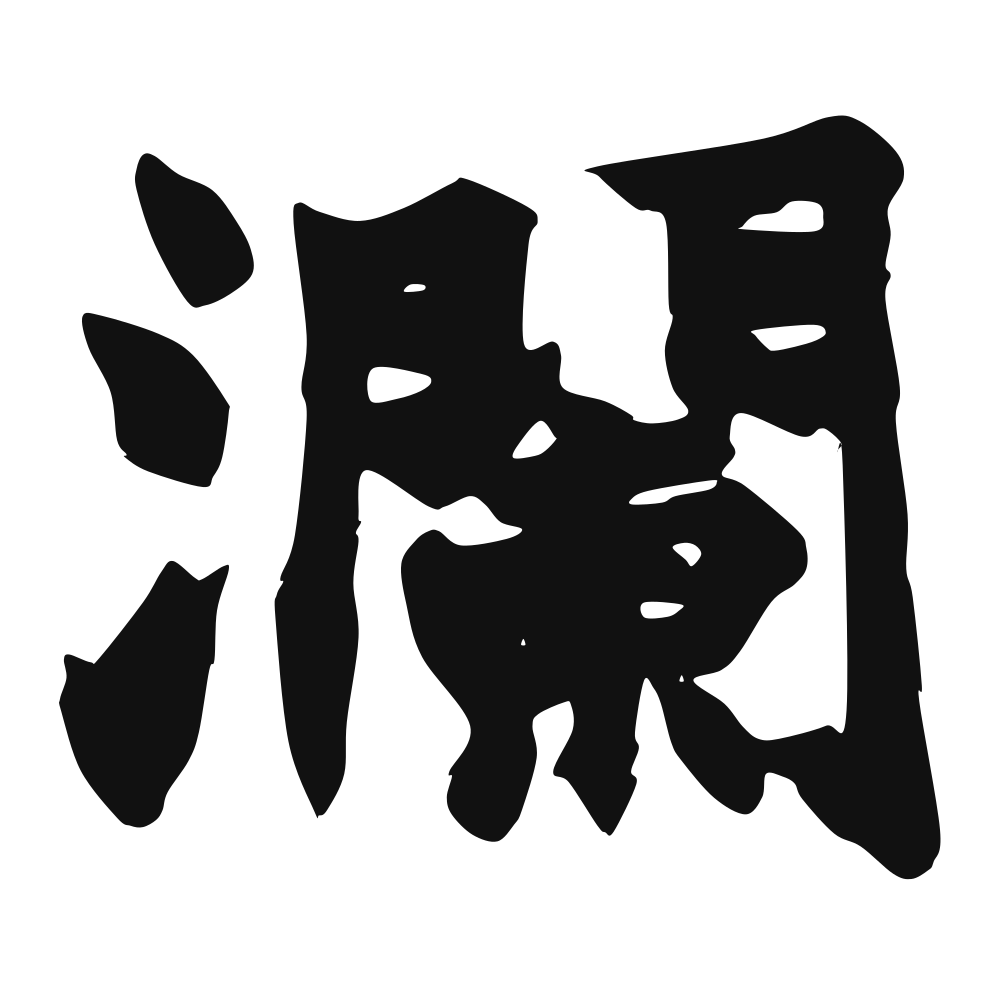
The Calligrapher — Zhào Zhīqiān 赵之谦
Qing pioneer who fused seal-script vigor into every style.
Qing calligrapher (), master of 篆隶/running script — Qing eclectic who fused seal, clerical and painting sensibilities into one bold hand. Qing dynasty
Etymology & Meaning · 字义溯源
### Soundlán — lán (2nd tone). Free-standing morpheme ### Original meaningLán (2nd tone). The Shuowen Jiezi defines it as 「大波爲瀾。从水闌聲」 — 'a great wave is called lán', with a variant form written 从連 — and the definition comes straight out of the older lexicon: 《尔雅·释水》「大波為瀾,小波為淪」 (a great wave is 澜, a small one is 沦), glossed in the 註 as 「瀾,言渙瀾也」 and in the 《释名》 as 「瀾,連也。言波體轉流,相連及也」 — the wave is called 'linked', because the body of the water turns and flows on, each crest reaching into the next. It is 形聲 — 水 for the meaning, 闌 for the sound — and the phonetic was felt to work twice over, since 澜 is also the wave that links. Mencius made it a moral image: 《孟子·尽心上》「观水有术,必观其澜」 — there is a craft to watching water: you watch its great waves (Zhao Qi's commentary: 澜,水中大波也). Han Yu gave it its most famous line, 《进学解》「回狂澜于既倒」 — to turn back the mad wave that has already broken. Kangxi counts the traditional 瀾 at 21 strokes (水部 + 17); the simplified 澜 is 15. Element: Water (水) by radical and by sense; 五格 stroke-numerology tables assign element by stroke count instead and may print another result (verify). Honest disclosure: 澜 means a great wave — it is not the sea, and it is not calm; a second, minor reading (làn) means rice-water (written 灡), which has nothing to do with the tattoo. ### The structure (形聲 · 从水,闌聲 — water for the meaning, 闌 for the sound; the Shuowen also records a variant written 从連, and the 《释名》 glosses 澜 as 連 ('linked') because the wave carries into the next)①氵shuǐwaterthe meaning half — a wave is made of water②闌lánrailing / barrierthe phonetic; the Shuowen also records the variant 从連③淪lúnsmall wave / rippleits 尔雅 opposite — 大波為瀾,小波為淪④波瀾bō lánwaves / the sweepthe compound it survives in — 波澜壮阔, 力挽狂澜 ### In use todayItemReading / meaningNoteReadinglán (2nd tone); also làn in the rice-water sensethe second reading is irrelevant to tattoo useCore sensegreat wave, billowclassical and modern, unchangedGrammarnoun, bound in modern compounds波澜 waves · 狂澜 mad wave · 力挽狂澜 to turn back the tideTattoo fityes-standalone — wide and clean, well known to Chinese readersreads as magnitude of feeling, not as weather ### Closest words in English — and what each misses - Ocean / sea — 海/洋 hold the sea; 澜 is an event on the water, not the water itself - Ripple — 淪/漪 hold ripples — the 尔雅 sets them against 澜 by size - Storm — 暴/颶 hold storms; 澜 is the wave, which may come with weather or not - Tide — 潮 holds tide and its regularity; 澜 has no clock and no cycleAn honest note on grammar. Noun; free in classical usage, bound in modern compounds (波澜, 狂澜, 漪澜); also read
Cultural Story
澜 is the great billow, water with 闌 (rail, boundary), the wave that rises high before it breaks. Classical prose and Tang poetry speak of 波澜 (waves, billows) as both the sea's majesty and the turning of fate. The phrase 力挽狂澜 (to save the critical situation) hails the hero who grasps the reins as the great wave is about to overturn the boat, a staple of loyal-minister biographies. The 澜沧江 (Lancang River) carries the name downstream, and 安澜 (peaceful waters) was the emperors' prayer for a flood-free year.
Where a Western reader can stand: 澜 (lán) means a great rolling wave — the large swell, not the foam. Its signature line is from Mencius: 'there is a method in looking at water; you must look at its waves,' meaning that a great depth becomes visible in the size of what it raises. Chinese also uses it in 力挽狂瀾, 'to pull back the raging wave' — the phrase for saving something that was almost lost. So it is a character about capacity showing itself, and about the moment someone holds a flood back.
Common words & phrases
- 波澜 waves · billows
- 澜沧江 Lancang River
- 力挽狂澜 save the critical situation
- 安澜 peaceful waters
Read the story behind the character
澜 is the wave that matters. Commentators praise a leader who 力挽狂澜 (saves the critical situation) when a company is collapsing, and a novel's 波澜 (waves, billows) keep readers up all night. The 澜沧江 (Lancang River) is a real trip destination, and the old wish for 安澜 (peaceful waters) now titles calm-living blogs. Though 澜 alone is literary, it rides in the phrases that describe big trouble, big feeling, and the relief of waters finally stilled.
Why this character belongs on skin
The character puts wide water beside a gate and means billows—the great rolling swells of 力挽狂澜, the phrase for hauling back the collapsing wave, for saving something at the very last possible moment. Chinese has always used water for history: times of crisis are 狂澜, madness-waves, and the hero is the one who plants a shoulder against them. There is also the phrase 波澜壮阔, magnificent billows—the same word used for a storm at sea and for a magnificent life. Because that is the wager here: you can live in the shallows where nothing rises, or you accept that a life worth the name will have swells that nearly end it. The veteran, the survivor, the founder who rebuilt from ash—all wear this quietly. Great waves are not weather. They are biography. Ink the swell, and stand.
Own this character
Purchase delivers the original SVG of this glyph, brushed by Zhào Zhīqiān 赵之谦, ready to place on skin, paper, or screen.