
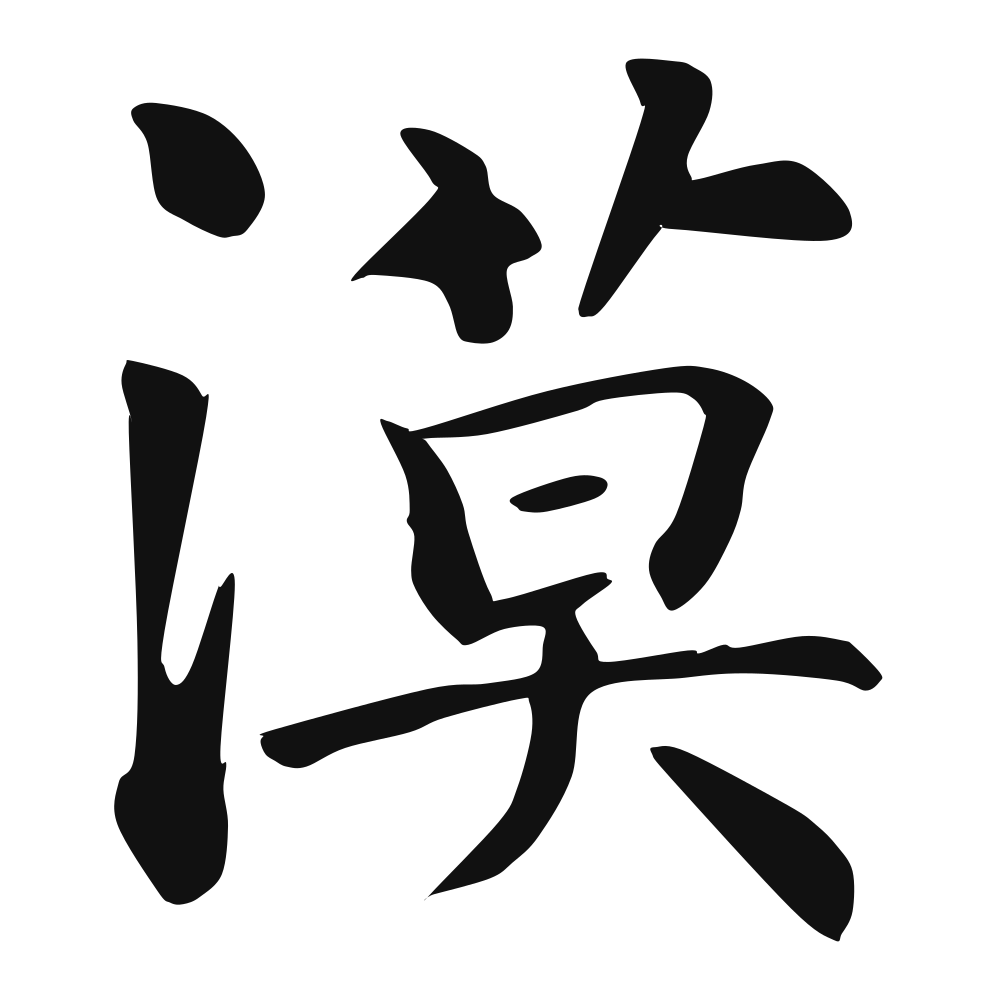
漠
desert; unconcerned
Closest English meanings
desert·indifferent·cold
The Calligrapher — Zhì Yǒng 智永
Sui monk who spread Wang Xizhi's art via his 'Thousand Characters'.
Sui calligrapher (生卒年不详(陈/隋)), master of regular script/cursive script — monk and seventh-generation descendant of Wang Xizhi who wrote a thousand copies of the Thousand Character Classic to pass the family hand down. Sui dynasty
Cultural Story
漠 joins water with 莫 (none), a character once used for marshland but which came to mean the vast, waterless waste, the desert. The 沙漠 (desert) of the northwest framed the frontier in the histories, the barrier beyond which the Han sent armies and silk caravans. Its emptiness lent 漠 a moral sense: the 冷漠 (cold, indifferent) heart is a desert within. The Zhuangzi and later essays prize the 广漠 (vast, boundless) as a space of freedom, while 漠然 (unconcerned) warns of a person who feels nothing for others.
Common words & phrases
- 沙漠 desert
- 冷漠 indifferent · cold
- 漠然 indifferent · unconcerned
- 广漠 vast · boundless
- 漠视 ignore · disregard
Read the story behind the character
漠 straddles sand and soul. Travelers cross the 沙漠 (desert) on the Silk Road, awed by its 广漠 (vast, boundless) silence. Back in the city, people complain about a 冷漠 (cold, indifferent) neighbor who never says hello, or a boss who stays 漠然 (indifferent, unconcerned) about staff burnout and simply 漠视 (ignores, disregards) their pleas. From Gobi road trips to office gossip, 漠 captures both the literal dry waste and the chill of someone who has gone emotionally dry.
Why this character belongs on skin
漠 is the desert — the character where water runs dry. Its water radical stands beside 莫, the sun sinking into grasses: water absent, light failing, the great silence of the Gobi at dusk. From that immense absence the word took all its meanings: 沙漠, the sand seas; 漠然, the coolness of a face that registers nothing; 漠视, to look through a person as though the ground between were dunes. The monks and exiles who actually crossed the 漠 describe its strange gifts — the sky enormous, the self pared to essentials, every carry of water suddenly sacred. Emptiness, the Buddhists taught, is not nothing; it is the cleared ground where everything finally shows. To wear 漠 is not to endorse the coldness the word can name, but to claim the desert's other truth: that a soul scoured of clutter can see the whole sky, and that stillness at scale is its own kind of water.
Own this character
Purchase delivers the original SVG of this glyph, brushed by Zhì Yǒng 智永, ready to place on skin, paper, or screen.