
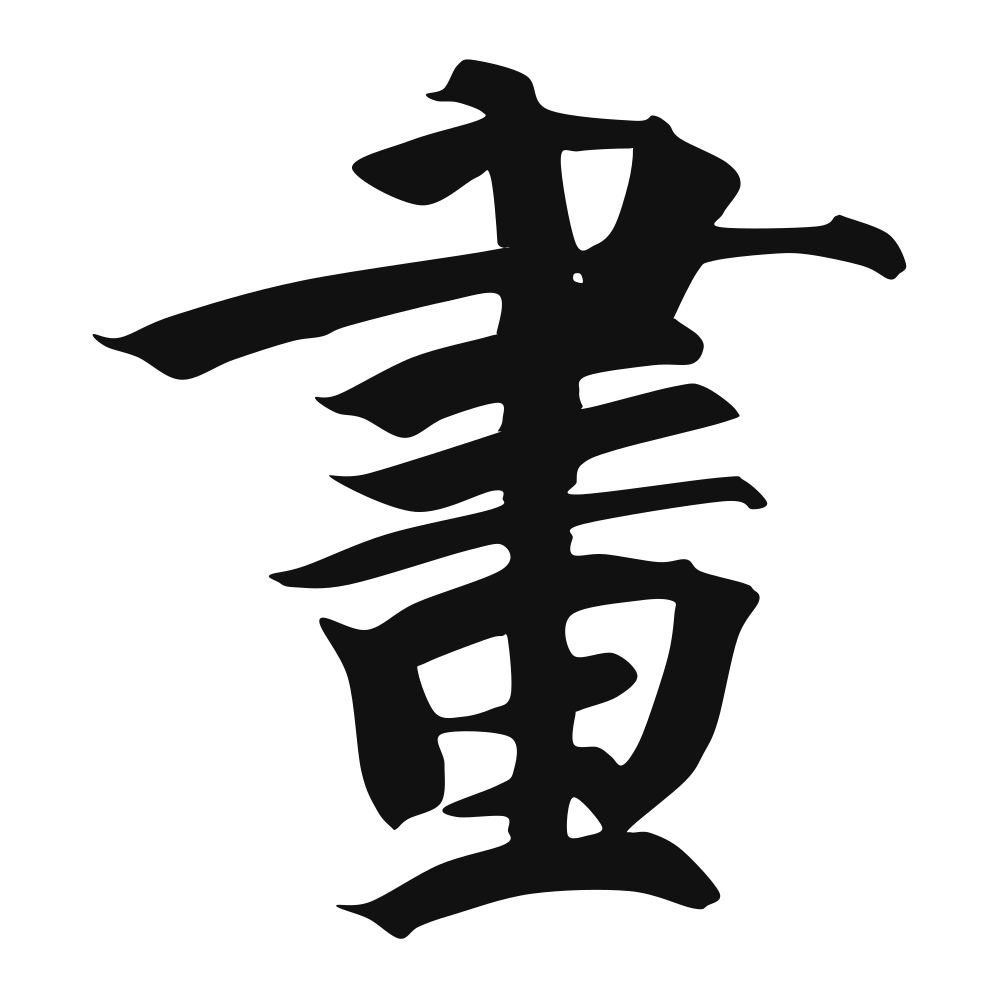
画
to draw; to paint; picture; painting (CL:幅[fu2],張|张[zhang1]); to draw (a line) (variant of 劃|划[hua4]); stroke of a Chinese character (variant of 劃|划[hua4]); (calligraphy) horizontal stroke (variant of 劃|划[hua4])
Closest English meanings
draw·paint·picture·painting
The Calligrapher — Zhì Yǒng 智永
Sui monk who spread Wang Xizhi's art via his 'Thousand Characters'.
Sui calligrapher (生卒年不详(陈/隋)), master of regular script/cursive script — monk and seventh-generation descendant of Wang Xizhi who wrote a thousand copies of the Thousand Character Classic to pass the family hand down. Sui dynasty
Etymology & Meaning · 字义溯源
2 · The Character: 画 畫 / 画 (huà, 4th tone) does not begin as 'a picture'. It begins as a boundary. The Shuowen Jiezi: 「畫,界也。象田四界,聿所以畫之」 — 'to demarcate; the graph pictures a field's four borders, and 聿 (a hand gripping a brush) is the instrument that marks them'. The earliest sense is drawing the line that says 'this far and no further'. 《周禮》 uses 畫 for laying out territory; 《論語·雍也》 supplies the sharpest use, when Ran Qiu pleads that his strength is insufficient and Confucius answers 「力不足者,中道而廢,今女畫」 — 'those who truly lack strength collapse halfway; you are drawing your own line'. From boundary came stroke, then drawing, then painting; 畫 also names the strokes of a character (筆畫). Honest disclosure: 畫地為牢 ('draw a circle on the ground and call it a prison') and Confucius's rebuke both make 畫 a word about self-imposed limits as much as about art. Simplified 画 (8 strokes) and traditional 畫 (12) look very different — choose deliberately.
Cultural Story
To draw a boundary was the character's first duty — 画 marked off land, then marked off plans, then made pictures. The old aphorism 书画同源, writing and painting share one source, is visible in the graph itself, and collectors ranked 字画, calligraphy and painting, as one pursuit.
Common words & phrases
- 画家 painter · artist
- 图画 picture · drawing · illustration
- 字画 calligraphy and painting
- 油画 oil painting
- 画面 scene · frame · picture
Read the story behind the character
It is an everyday word now: the 画家, painter, whose show you queue for; 图画 in a child's textbook; 油画, oil painting, in community classes; and 画面, the frame — how a film looks second by second. A phone camera review is judged by its 画面 quality.
Why this character belongs on skin
The first line on blank silk is an act of courage. To paint, to draw the world a second time and better — this is the character for the human itch to make a thing that outlasts the seeing. The masters left whole mountains with three strokes, trusting absence to do the work of presence; the Dao teaches that the unpainted part is the true subject. To wear this character is to claim the maker in you, the one who refuses to accept the world only as given. It is a sensual, creative mark — ink it along the forearm like a brushstroke mid-air — and let it say: I paint. I decide what the line becomes, what stays and what the emptiness praises. The skin is the silk; the life, the unfinished scroll you are still drawing.
Own this character
Purchase delivers the original SVG of this glyph, brushed by Zhì Yǒng 智永, ready to place on skin, paper, or screen.