
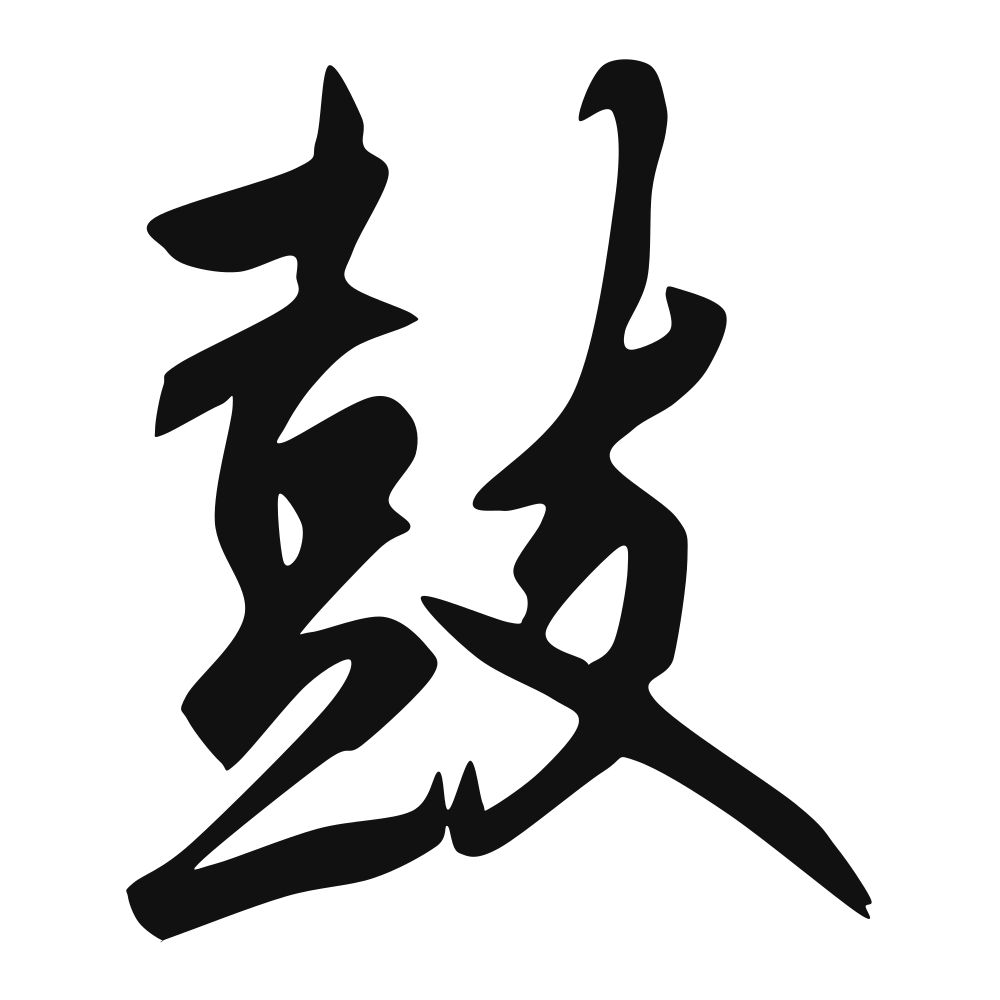
鼓
drum; to drum; to strike; to rouse; to bulge; to swell
Closest English meanings
drum·beat·boost·swell
The Calligrapher — Cài Jīng 蔡京
Powerful Song statesman and gifted calligrapher once ranked among the 'Four Masters' (Su-Huang-Mi-Cai).
Song calligrapher (1047–1126), master of running script — known for 《节夫帖》. Song dynasty
Etymology & Meaning · 字义溯源
2 · The Character: 鼓 鼓 (gǔ, 3rd tone). 《说文·卷五·鼓部》 explains the drum through a pun on 郭 (outer wall): 郭也。春分之音,萬物郭皮甲而出,故謂之鼓。从壴,支象其手擊之也 — 'the sound of the spring equinox, when all things burst their husks and come out; from 壴 (a drum on its stand), with 支 depicting the hand that strikes it.' Xu Kai adds 郭者,覆冒之意. The graph is oracle-bone old: drum on the left, hand-with-mallet on the right. 《周礼·地官·鼓人》 lists the 六鼓 — 靁鼓, 靈鼓, 路鼓, 鼖鼓, 皋鼓, 晉鼓. In the Shijing the drum is both love and war: 《周南·关雎》窈窕淑女,鐘鼓樂之, and 《邶风·击鼓》擊鼓其鏜,踊躍用兵. 《左传·庄公十年》 supplies the idiom every Chinese speaker still uses: 夫戰,勇氣也。一鼓作氣,再而衰,三而竭. 《楚辞·九歌·国殇》: 援玉枹兮擊鳴鼓. 鼓 is a free morpheme — noun 'drum,' verb 'to strike, to rouse.' Honest disclosure: as a verb 鼓动 also means 'to incite or agitate,' and 鼓胀 is a medical term for bloating or ascites. Context decides which 鼓 a reader hears.
Cultural Story
鼓 is the drum, built from 壴 (a drum on a stand) and 攴 (a hand beating), a compound ideograph of striking the instrument. 《説文解字》links it to “郭,” the swelling skin. From war to ritual, the drum set pace, roused courage, and called the people—sound made visible in the very strokes of the character.
Where a Western reader can stand: Where a Western reader can stand: 鼓 is Latin 'tympanum' and 'animare' — a drum, and to rouse, to beat, to stir. The graph is 壴 (a drum-stand) with 支 (to beat) — a drum and the hand upon it. The Zuo-zhuan (Zhuang 10) gives its motto: 一鼓作氣,再而衰,三而竭, courage rises with the first drum and is spent by the third. The Hexagram Yù (16), Enthusiasm, is thunder bursting from the earth — 先王以作樂崇德, the ancient kings made music to exalt virtue. Cai Jing is the fitting, double-edged hand. His was a court of ceremony and of war — Huizong's reign ended in the cataclysm of 1126 — and his sleek, confident running script can beat the drum with imperial assurance. The honest catches: as a verb 鼓動 means 'to incite, to agitate', a mildly political word; 擊鼓 is a war image (the Shi-jing's 击鼓 is a conscript's lament); and 鼓 also builds 鼓吹 (to advocate, but also a brass band). Disclose these so the wearer knows the drum cuts both ways.
Common words & phrases
- 鼓掌 applaud · clap
- 鼓励 encourage · urge
- 鼓舞 inspire · hearten
- 鼓动 agitate · arouse · stir
- 擂鼓 beat a drum
- 鼓膜 eardrum
Read the story behind the character
We 鼓掌 (applaud) and 鼓励 (encourage) one another, feel 鼓舞 (inspired), and 鼓动 (stir) a crowd. Drummers 擂鼓 (beat a drum) at festivals, and the 鼓膜 (eardrum) taps inside the ear. From applause to anatomy, 鼓 keeps the beat of social and bodily life.
Why this character belongs on skin
A drum is a heart you can hear from across the valley. 鼓 is the ancient Chinese drum, drawn in its oldest form as a hand with a stick beating a hide stretched over wood — war drums, festival drums, the drums of ancestor rites where the dead were summoned by rhythm. Armies marched on 鼓; the old general's text, the Art of War, lists the drum as the ear of the army, the voice that turns chaos into charge. To 鼓 is also to rouse, to embolden — 鼓舞, to lift someone's spirit like a rhythm lifting tired feet. Every culture has known that skin stretched over hollow wood can move armies, summon rain, keep night-watch around fires where stories were born. This is the character for the moment before the charge and the moment after the heartbreak — the beat that refuses to stop. Wear it and you are the drum: the hollow that makes the sound, the skin that takes the strike, the rhythm everyone else follows.
Own this character
Purchase delivers the original SVG of this glyph, brushed by Cài Jīng 蔡京, ready to place on skin, paper, or screen.