
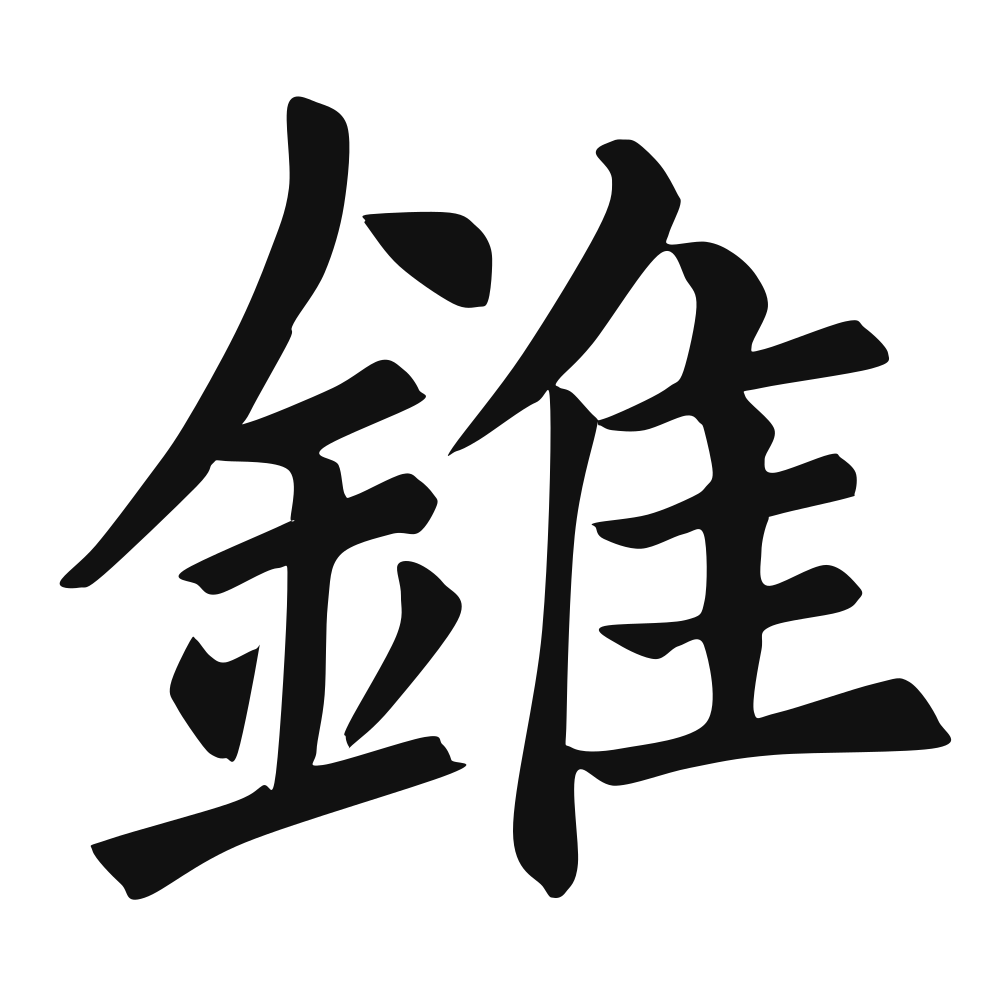
The Calligrapher — Chǔ Suíliáng 褚遂良
Tang chancellor and regular-script master of elegant, balanced strokes.
Tang calligrapher (596–658), master of regular script — Tang master of graceful, tensile regular script favored by the imperial court. Tang dynasty
Etymology & Meaning · 字义溯源
### Soundzhuī — zhuī (1st tone). Free-standing morpheme ### Original meaningZhuī (1st tone). The Shuowen Jiezi defines it as 「銳也。从金隹聲」 — 'sharp', a metal implement with 隹 for its sound; the Kangxi quotes the entry as 銳器也 and adds 《釋名》「錐,利也」. Two classical lines carry its whole reputation. The Zuo Zhuan (Zhao 6) uses it for trifles: 「錐刀之末,將盡爭之」 — 'they will fight over the very tip of an awl'. The Shiji makes it the emblem of talent that cannot stay hidden: in 《史記·平原君虞卿列傳》 Mao Sui says 「使遂蚤得處囊中,乃穎脫而出」 — 'had I been put in the bag earlier, the point would have broken clean through', the source of 脫穎而出. And 《漢書·枚乘傳》 measures poverty by it: 「舜無立錐之地,以有天下」 — Shun had not ground enough to stand an awl on, yet he held the world. 毛錐, 'hair-awl', is a contemptuous name for the writing brush (《五代史·史弘肇傳》). Kangxi 16 strokes; every naming table puts it under Metal (金). ### The structure (形聲 · 从金,隹聲 — metal (金) for the substance, 隹 (zhuī) for the sound)①金jīnmetalthe substance it is made of②隹zhuīshort-tailed birdthe phonetic, borrowed for its sound alone③囊nángbag / sack錐處囊中 — the bag that cannot hold the point in④穎yǐngthe tip of an ear of grain脫穎而出 — the point breaking clean through ### In use todayItemReading / meaningNoteReadingzhuī (1st tone)single syllableCore senseawl; any tool that pierces by a pointextended to the geometric cone (圓錐)Grammarfree morpheme, noun and verb锥子 · 圆锥 · 锥探 · 锥处囊中Tattoo fitcaution — a tool, and a byword for povertyworks only if the wearer knows 脫穎而出 ### Closest words in English — and what each misses - Spear / Lance — 矛 / 槍 hold weapons; 锥 is a hand tool for piercing leather and wood - Sharp (as a virtue) — 銳 holds sharpness of edge or mind; 锥 is the object, not the quality - Cone / Pyramid — the geometric 圓錐 is a modern extension; the old word is the tool - Drill / Bore — 鑽 is the drill; 锥 pierces by pressure, not by turningAn honest note on grammar. Free morpheme — 锥子 an awl, 圆锥 a cone, 锥探 to bore; also a verb 'to pierce with an awl' (用锥子刺), and by extension geometry's 圆锥体Where a Western reader can stand: 锥 (zhuī) means 'awl' — the small pointed tool a leather-worker pushes through hide. Its Shuowen definition is simply 銳也, 'sharp'. Two old lines give it its character: the Shiji's 錐處囊中, the awl in the bag whose point breaks through (talent that cannot be hidden), and 無立錐之地, 'not enough ground to stand an awl on' (having nothing at all). As a tattoo it is honest and unglamorous: craft, persistence, a point that finds its way. It is not a weapon word, and a wearer who expects 'spear' or 'blade' is reading the wrong character.
Cultural Story
锥 sets metal beside 隹 and names the awl, the slender pointed tool that pierces leather and cloth. Small, yet it proved a point about talent: the proverb 锥处囊中 says an awl in a bag soon pushes its tip through, and cannot be hid.
Where a Western reader can stand: 锥 (zhuī) means 'awl' — the small pointed tool a leather-worker pushes through hide. Its Shuowen definition is simply 銳也, 'sharp'. Two old lines give it its character: the Shiji's 錐處囊中, the awl in the bag whose point breaks through (talent that cannot be hidden), and 無立錐之地, 'not enough ground to stand an awl on' (having nothing). As a tattoo it is honest and unglamorous: craft, persistence, a point that finds its way. It is not a weapon word.
Common words & phrases
- 圓錐 cone
- 錐子 awl
- 毛錐 writing brush · pen
- 錐處囊中 awl in a bag (talent shows)
Read the story behind the character
A 锥子 punctures; geometry knows the 圆锥, the cone. The brush was once a 毛锥, a writer's awl. And the proverb 锥处囊中—an awl in a bag—says real talent soon pushes through, its tip impossible to hide.
Why this character belongs on skin
Awl plus metal radical equals 锥, the pointed tool—and with it, one of the fiercest stories in the language. The scholar Su Qin, mocked and failing, studied through his exhaustion by stabbing his own thigh with an awl whenever sleep came; blood ran to his feet, and he became the most feared strategist of his age. 锥刺股: the awl against the thigh, still the idiom for unbearable self-discipline. The character also gives us 锥子般的目光—a gaze like an awl, sharp enough to go through pretense—and the geometric 锥体, the cone: force gathered to a single point. That is the whole philosophy. Diffuse effort does nothing; a life focused to a point pierces anything. Everyone who ever mastered something has driven themselves a little crazy to do it. This is that instrument, that intensity, inked small and vicious: one point, total commitment, no escape from your own aim.
Own this character
Purchase delivers the original SVG of this glyph, brushed by Chǔ Suíliáng 褚遂良, ready to place on skin, paper, or screen.