
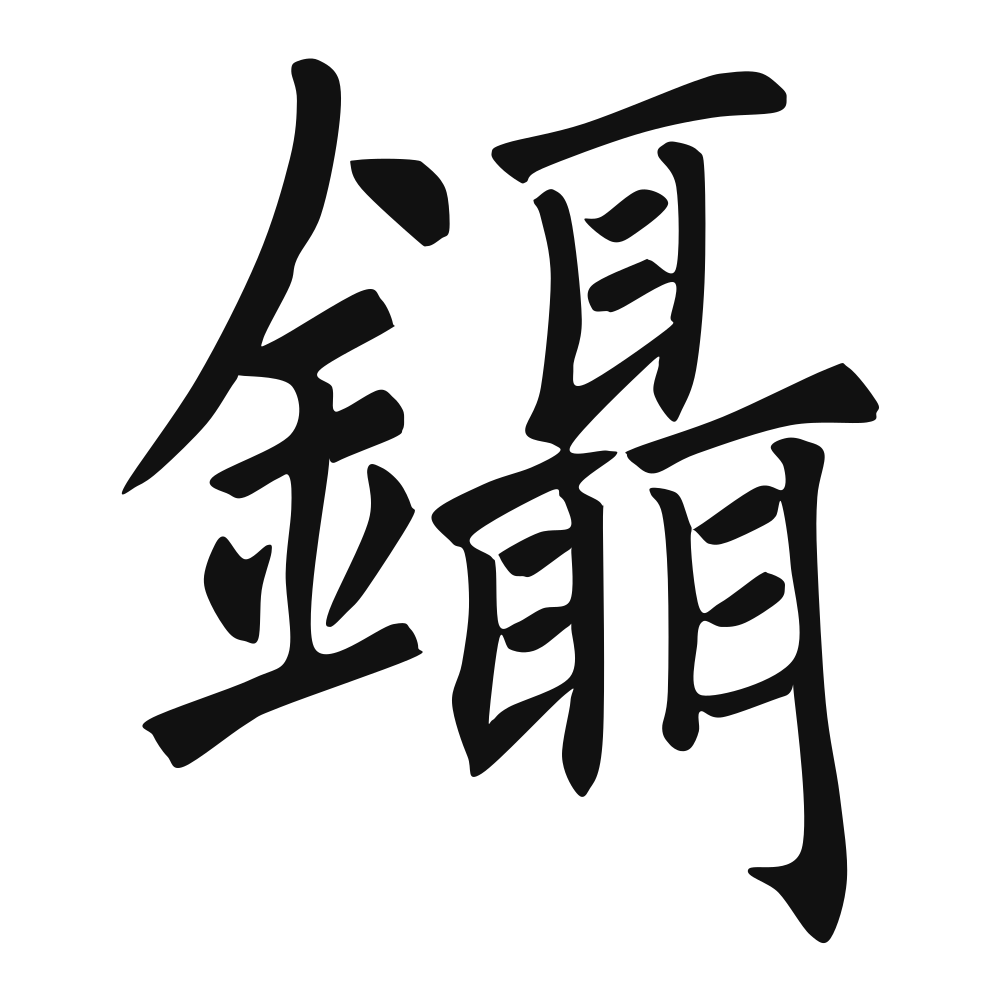
镊
(bound form) tweezers; to use tweezers (to grasp, pick up, or pull out etc, depending on whether the following resultative verb is 住[zhu4] or 起[qi3] or 出[chu1] etc)
Closest English meanings
tweezers·forceps
The Calligrapher — Chǔ Suíliáng 褚遂良
Tang chancellor and regular-script master of elegant, balanced strokes.
Tang calligrapher (596–658), master of regular script — Tang master of graceful, tensile regular script favored by the imperial court. Tang dynasty
Etymology & Meaning · 字义溯源
### Soundniè — niè (4th tone). Free-standing morpheme ### Original meaningNiè (4th tone). There is no Shuowen entry for 鑷 itself: the instrument was originally written 籋, and that is the character Xu Shen defines — 「籋,箝也。从竹爾聲」 — 'tongs', with Duan Yucai's note 「夾取之器曰籋。今人以銅鐵作之,謂之鑷子」: the gripping tool called 籋 is what people now make of copper and iron and call 鑷子, tweezers. So the word is real and old, but the metal form is a later re-writing, and it is a bamboo implement promoted to bronze. The Kangxi gives 鑷 26 strokes and quotes 《釋名·釋首飾》「鑷,攝也。攝取物也」 — the tweezer is named from 攝, 'to take up'. Its most charming appearance is in Zuo Si's 《白髮賦》「願戢子之手,攝子之鑷」 — 'would that you would stay your hand and put down your tweezers', a plea against plucking out one's grey hairs; 《雲仙雜記》 has Wang Sengqian, hating his white hair in old age, being handed bronze tweezers before his guests and calling them 卻老先生, 'Mr Keep-Old-Age-Away'. In 《後漢書·輿服志》 黃金鑷 is the gold pendant hanging from the end of a hairpin. 五行 Metal; Kangxi 26. ### The structure (形聲 · 从金,聶聲 — metal (金) because the later tool was bronze; the Shuowen's own form is 籋 (bamboo), 箝也)①金jīnmetal / bronzethe later material, copper and iron②聶nièto whisperthe phonetic half, borrowed for sound③籋nièbamboo tongsthe Shuowen form — 箝也, gripping tongs④攝shèto take up《釋名》「鑷,攝也」 — the name comes from taking hold ### In use todayItemReading / meaningNoteReadingniè (4th tone)single syllableCore sensetweezers; to pluck out镊子 · 镊白 (pull out white hairs)Grammarfree morpheme, noun and verb用镊子夹出来 — pick it out with tweezersTattoo fitno — a toilet implement, comical in classical use26-stroke traditional form is also impractical ### Closest words in English — and what each misses - Grip / Grasp — 攝 / 執 hold 'to take hold'; 鑷 is the little tool, named from but not equal to 攝 - To seize / Capture — 擒 / 獲 hold seizure; 鑷 takes up a hair or a thorn, nothing more - Steel / Metal — 鋼 / 金 hold metal as a substance; 鑷 merely wears the radical - Precision / Craft — 精 / 工 hold craft and precision; 鑷 carries no such abstract senseAn honest note on grammar. Free morpheme — 镊子 tweezers; also a verb 'to pluck with tweezers' (镊白 to pull out white hairs, 镊胡子); in classical use also the gold pendant at a hairpin's endWhere a Western reader can stand: 镊 (niè) means tweezers. The Shuowen has no entry for it — the old form is 籋, bamboo tongs, 箝也 — and the bronze version is a later re-writing; 《釋名》 derives the name from 攝, 'to take up'. In literature it is almost always comic or rueful: Zuo Si begs someone to put the tweezers down, and Wang Sengqian call
Cultural Story
镊 joins metal with 聂 and names the tweezers, the slender pincers that lift what fingers cannot. It is precision held at the tip; a 镊子 pulls a splinter, surgical 镊钳 seize a vessel, and we 镊取 a tiny part under the lens of the watchmaker's eye.
Where a Western reader can stand: 镊 (niè) means tweezers. The Shuowen has no entry for it — the old form is 籋, bamboo tongs — and the bronze version is a later re-writing; the Mingshi derives the name from 攝, 'to take up'. In literature it is almost always comic or rueful: Zuo Si begs someone to put the tweezers down, and Wang Sengqian calls his 'Mr Keep-Old-Age-Away'. As a tattoo we do not recommend it: the meaning is a toilet implement, the classical mood is about plucking out grey hairs, and the traditional form runs to 26 strokes.
Common words & phrases
- 镊子 tweezers
- 镊钳 forceps
- 镊取 pick up with tweezers
Read the story behind the character
A 镊子 pulls a splinter or places a lash; 镊钳 are surgical forceps, and we 镊取 a tiny part under the lens. The character belongs to the delicate work of the clinic and the jeweller's bench alike.
Why this character belongs on skin
Two arms of metal, joined at one end, made for grasping what fingers cannot: a splinter, a sliver of glass, a single thread, a hair from a lover's collar. The metal radical tells you the material; the rest is precision — the smallest tool in the kit, useful only because it refuses to be general. Chinese surgeons and needleworkers knew this implement centuries ago, and there is a quiet philosophy folded into its jaws: great force is common, found in every fist and flood; great delicacy, applied exactly, is rare as grace. The soul's work is mostly tweezer-work — extracting one thorn, one lie, one memory from the wound, without tearing anything around it, the whole operation conducted at the edge of sight. Anyone who has ever held steady through such a minute knows it is harder than any hammering. Ink the instrument of careful removal. Some tattoos declare. This one tends.
Own this character
Purchase delivers the original SVG of this glyph, brushed by Chǔ Suíliáng 褚遂良, ready to place on skin, paper, or screen.