
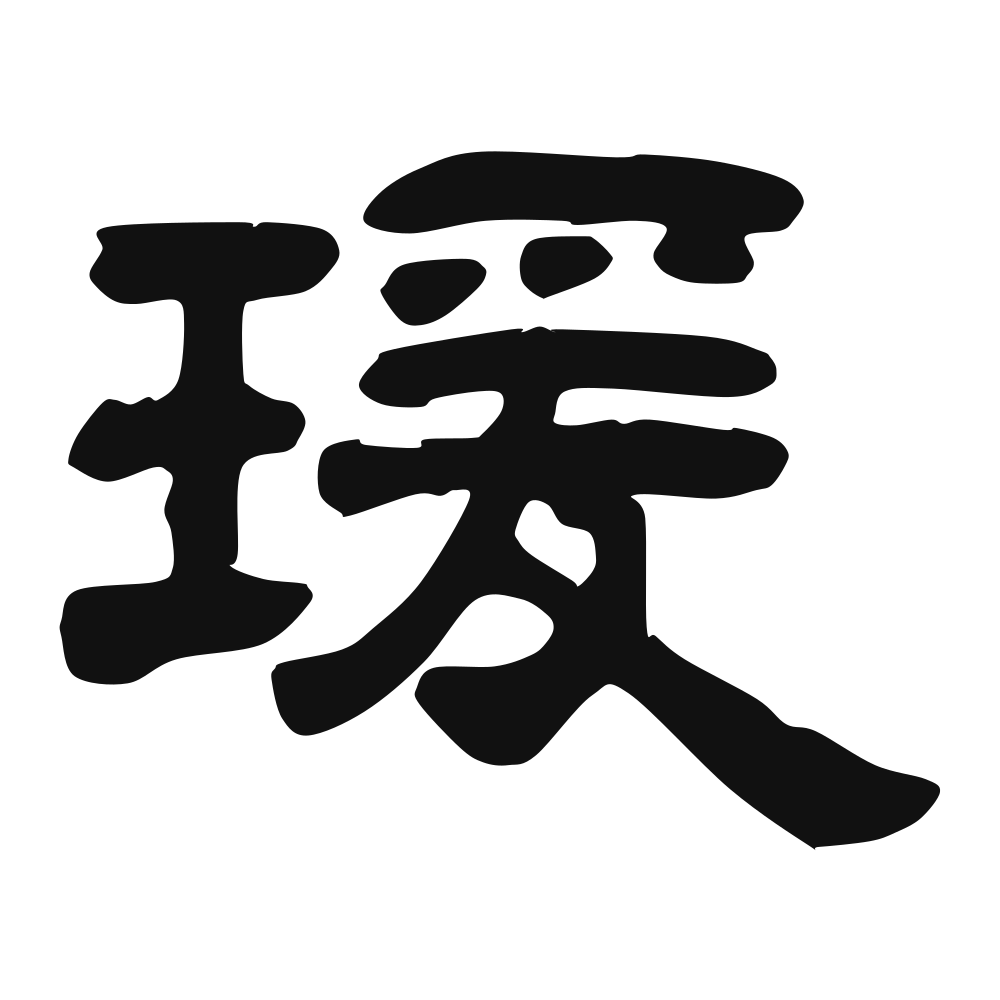
The Calligrapher — Dèng Shírú 邓石如
Qing revivalist who restored seal and clerical script to prominence.
Qing calligrapher (), master of seal script/clerical script — Qing self-taught reviver of seal and clerical script, carved energy in every stroke. Qing dynasty
Cultural Story
The yuan was a jade ring with an unusually large central opening — the ancient Erhya defines it precisely: when the hole doubles the ring's width, it is a yuan. Tradition says its wide bore let attendants grip it to help a lord rise or lead him by hand, jade serving courtesy.
Common words & phrases
- 瑗环 jade ring
- 玉瑗 jade ring
Read the story behind the character
No one carries a 玉瑗 now except museums and auction catalogues, where the 瑗环, jade ring, appears among Neolithic treasures. The character survives mostly in scholarship and in the occasional given name, a quiet relic of an age when rings governed etiquette.
Why this character belongs on skin
The ancient jade workers made a family of circles: bi, the disc; huan, the ring; and 瑗, the great-holed ring—the hole so wide the jade is a moving border rather than a body. The ritual code says the yue was made that way so a hand could grip it, so two people could both hold it, so it could be offered across a distance. Every other jade insists on its mass; the yuan insists on its opening. That is a rare kind of beauty—the beauty of what is missing on purpose. Consider how much of what you cherish is defined by absence: the doorway, not the wall. The pause between two notes. The room a loved one leaves that lets you both keep moving. A heart is a yuan—a ring of muscle built around a hollow, and it works because of the hollow. Ink this circle where a bracelet would sit, this jade with its generous emptiness, and let it hold your wrist the way it held an ancient hand: loosely, deliberately, leaving room for whatever comes.
Own this character
Purchase delivers the original SVG of this glyph, brushed by Dèng Shírú 邓石如, ready to place on skin, paper, or screen.