
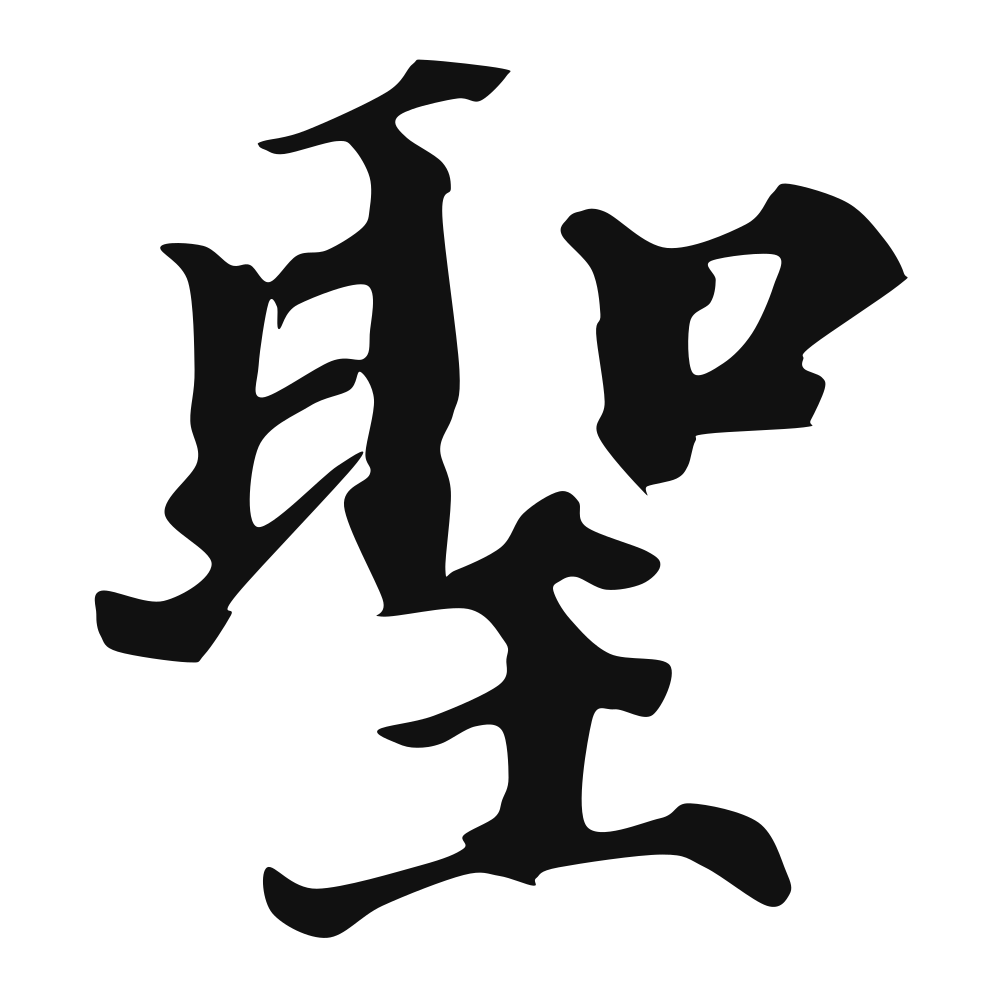
圣
(literary) to dig with persistent effort (e.g. to gather wild vegetables); (bound form) peerless (in wisdom, moral virtue, skill etc); (bound form) peerless individual; paragon (sage, saint, emperor, master of a skill etc); (bound form) holy; sacred
Closest English meanings
sage·saint·holy·sacred
The Calligrapher — Dèng Wényuán 邓文原
Yuan scholar-official calligrapher of classical regular script.
Yuan calligrapher (1258–1328), master of running script/cursive script — known for 《急就章》. Yuan dynasty
Etymology & Meaning · 字义溯源
2 · The Character: 圣 The simplified 圣 stands for 聖. 《說文解字》:"聖,通也。从耳,呈聲。" The sage is one who 'hears through' — whose ear is attuned so nothing is blocked; 聖 is 通 (penetrating, unobstructed understanding). The《書·洪範》defines it: "睿作聖" (depth of insight becomes sagehood); the《易·乾》"聖人作而萬物覩" (the sage arises and all things are seen). The《詩·邶風》calls a mother "聖善" (sagely good). The Buddhist and imperial registers broadened it to 'holy' (神聖, 聖地). For a tattoo it is a high, luminous word — wisdom, clarity, the sacred. Honest notes: the old graph 圣 (kū) was a separate dialect word meaning 'to dig into the ground' (汝潁之間謂致力於地曰圣), now merged into the simplified form; and claiming 聖 outright can read as grandiose (自稱聖人). Wear it as aspiration, not self-title. The meaning is safe and positive; just let it point upward, not at the self.
Cultural Story
Confucius was called 圣人 only centuries after his death, when the Han made his word 圣经 for the exams. The 圣地 of Qufu drew pilgrims to his birthplace. Buddhist 圣贤 filled the cave-temples at Dunhuang. The character once showed a man with a listening ear and a speaking mouth — one who hears heaven.
Where a Western reader can stand: Sage — the mind that hears all the way through: 圣 in Deng Wenyuan's revivalist hand. Western readers should know the religious weight and the folded archaic graph; the hand is authentic.
Common words & phrases
- 神圣 sacred · holy · divine
- 圣人 sage · wise man · saint
- 圣贤 sages · wise men
- 圣地 holy land · sacred place
- 圣洁 holy · sacred · pure
- 圣经 the Bible · scripture
Read the story behind the character
The 圣经 sits on the hotel nightstand. A tour groups queues at the 圣地 of the revolution. The 圣人 of the self-help shelf promises calm for a fee. The 神圣 oath opens the ceremony. A child is told the 圣洁 snow on the peak must not be touched.
Why this character belongs on skin
The sages of old were not born knowing. They were the ones who listened until they understood — the character itself is built from ears and from a hand reaching toward what is true. Shèng is the sacred made human: not a distant god on a throne but a person so attuned to the world that the world spoke through them. To be holy, in this older sense, was to be awake. We chase the profane because it is loud, but the mark we keep closest is the one that reminds us we are capable of stillness. Carrying shèng is a quiet arrogance and a quiet humility at once — the claim that you, too, might hear something beneath the noise and answer it. Let this character rest where your pulse is nearest the surface, a small wager that the sacred is not elsewhere but here, waiting to be lived.
Own this character
Purchase delivers the original SVG of this glyph, brushed by Dèng Wényuán 邓文原, ready to place on skin, paper, or screen.