
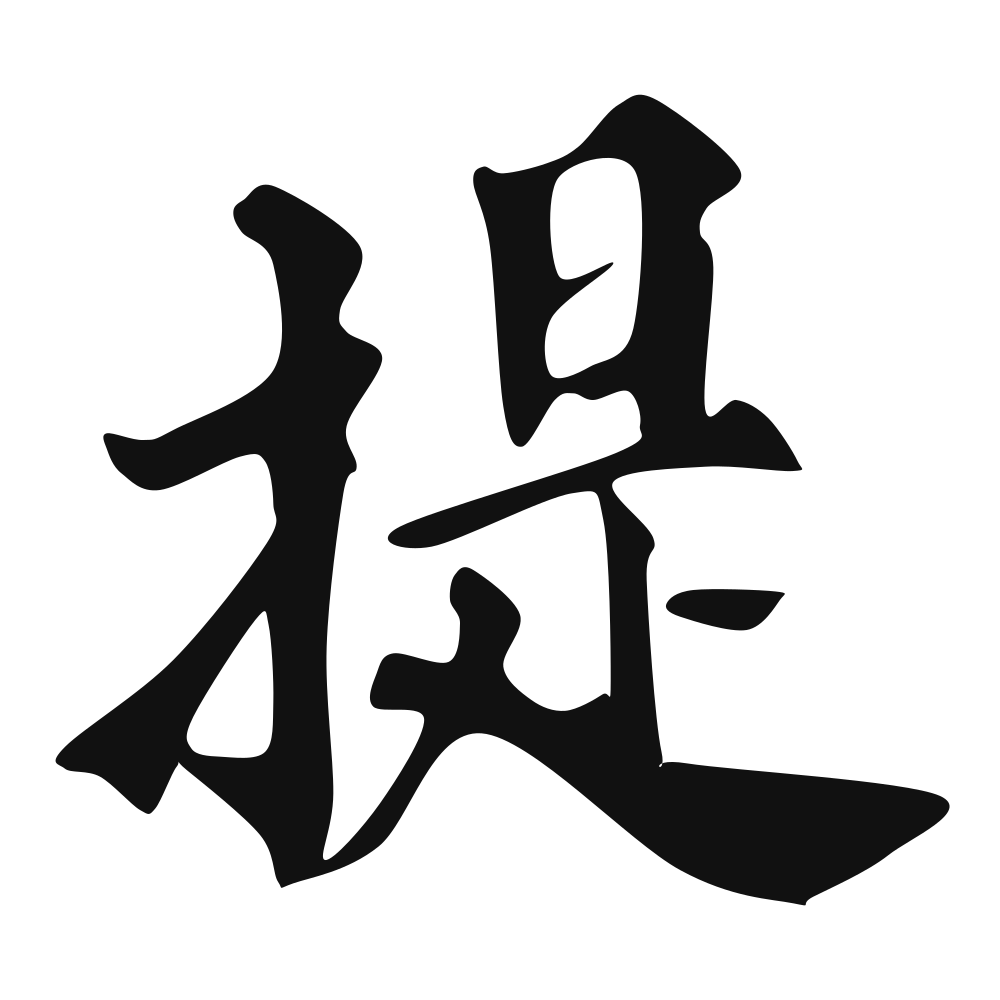
提
to carry (hanging down from the hand); to lift; to put forward; to mention; to raise (an issue); upwards character stroke; lifting brush stroke (in painting); scoop for measuring liquid
Closest English meanings
to carry·to raise·to mention
The Calligrapher — Dèng Wényuán 邓文原
Yuan scholar-official calligrapher of classical regular script.
Yuan calligrapher (1258–1328), master of running script/cursive script — known for 《急就章》. Yuan dynasty
Etymology & Meaning · 字义溯源
2 · The Character: 提 Tí (2nd tone). 《说文》: 「提,挈也。从手是聲」 — 'to lift by holding; from 手 with 是 as phonetic.' 挈 means to carry something suspended, so 提 is specifically the raise-by-the-handle, not the shoulder-heave. Its most famous classical appearance is 《诗经·大雅·抑》 「匪面命之,言提其耳」 — 'not merely instructed to his face, but taken by the ear,' the source of the idiom 耳提面命, teaching so urgent that it grips the student's head. 《礼记·曲礼》 gives the gentler 提携, the elder's hand offered to a child. From physical lifting came the abstract senses that dominate modern Chinese: 提出 (to raise a proposal), 提高 (to raise a standard), 提醒 (to lift someone's attention). Yijing parallel: Shēng 升 (46), Pushing Upward, 「柔以時升」 — the yielding rises in its season. Honest disclosure: in everyday Mandarin 提 is a plain utility verb — 'to carry a bag,' 'to mention in passing' — so it reads mundane unless paired (提升, 提携). Kangxi: 12 strokes. Wuxing: Fire (火).
Cultural Story
To 提 is to lift and to raise, the lantern 提 in the dark, the name 提ed in the petition. The histories show the counselor who 提 the point the throne would rather not hear. The character is the upward draw of hand and of attention, and the counselor who lifted the unwelcome point usually lifted himself straight out of the court the following morning.
Where a Western reader can stand: Where a Western reader can stand: 提 is the verb of the carried thing — to lift by the handle, to raise, to bring up — and its noblest register is the Book of Songs' 耳提面命, instruction so urgent it takes the student by the ear, and the Liji's 提携, the elder's hand offered to a child. Deng Wenyuan, one of the three great Yuan calligraphers, is the ideal biography for it: his restrained classical hand helped revive the Jin–Tang models the Song had set aside — an act of 提携 across centuries. Honest caveat: standalone 提 in modern Mandarin is an everyday utility verb — carry the bag, mention it — so pair it (提升, 提携) or quote the classical line; the character carries no risk beyond reading plain, and 提防 is read dī.
Common words & phrases
- 提高 to raise · improve
- 提出 to propose
- 提醒 to remind
- 提纲 outline
- 提前 ahead of time
Read the story behind the character
You 提高 the price; a friend 提出s a plan; an alarm 提醒s you; a writer makes an 提綱; a train leaves 提前. The lantern is a reminder now. The upward draw is the same, whether it lifts a light, a point, or merely the starting time of a day you meant to sleep through, and the reminder is only the lantern, glowing on a phone instead of in a hand.
Why this character belongs on skin
A lantern held at arm's length turns a dark path into a sentence you can finally read. To lift is the first mercy—the hand that raises the fallen cup, the voice that raises a forgotten name in a crowded room. The teachers of old said that to mention is to lift into light, to carry a thing from the buried drawer of the world into the open air where it can be seen. We spend our lives lowering and lifting: the weight set down at night, the child lifted at dawn. There is a dignity in the arm that does not tire of raising what matters. The warrior lifts his fallen brother; the poet lifts a moment before it drowns. Wear this as the record of every time you refused to let something precious stay on the ground. The light is only the hand that carries it.
Own this character
Purchase delivers the original SVG of this glyph, brushed by Dèng Wényuán 邓文原, ready to place on skin, paper, or screen.