
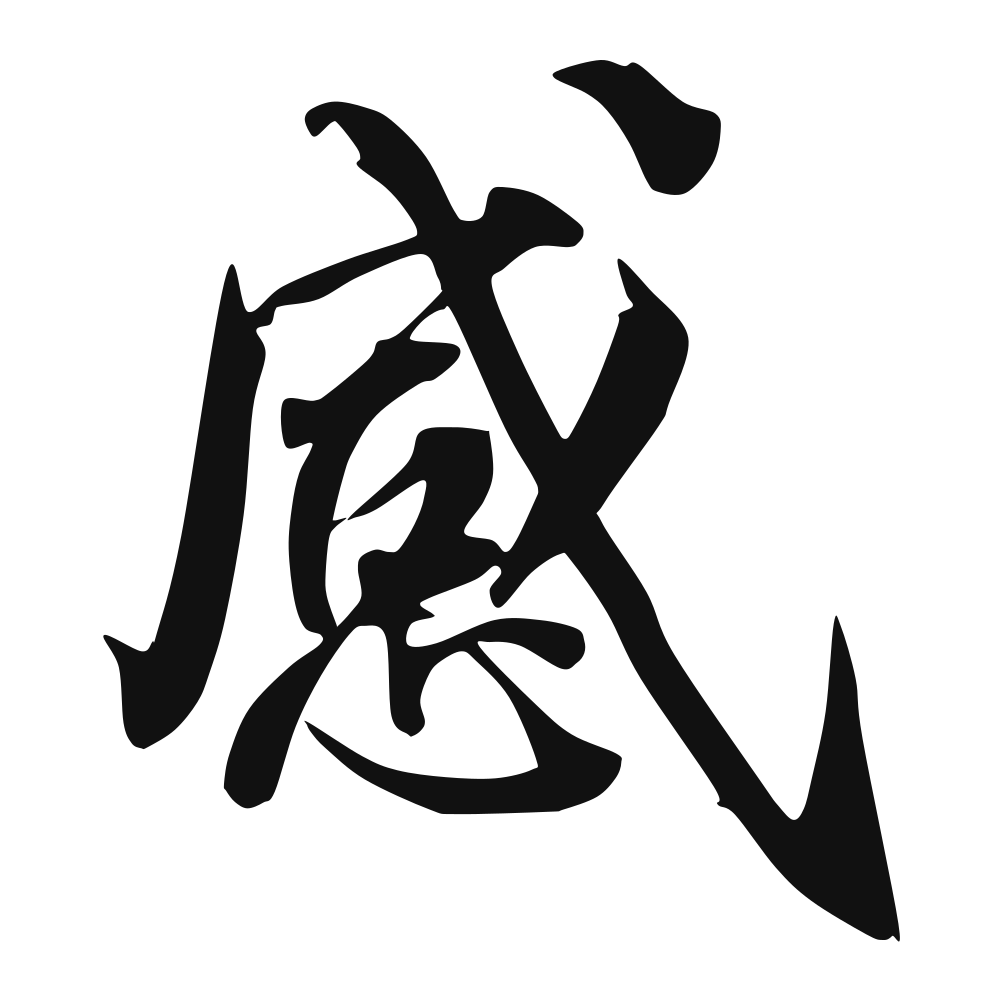
感
to feel; to move; to touch; to affect; feeling; emotion; (suffix) sense of ~
Closest English meanings
to feel·to sense·emotion
The Calligrapher — Cài Xiāng 蔡襄
One of the Four Song masters, known for graceful regular and running script.
Song calligrapher (1012–1067), master of regular script/running script — Song master of warm, disciplined regular script, the most 'proper' of the Song Four. Song dynasty
Etymology & Meaning · 字义溯源
2 · The Character: 感 Gǎn (3rd tone). Shuowen Jiezi defines 感 as 動人心也 — 'that which moves the human heart', from 心 (heart) and 咸 (all, mutual). The 易經·鹹卦 (31) turns on exactly this: the 彖傳 says 鹹,感也。柔上而剛下,二氣感應以相與 — 'Xián means mutual influence; soft above, firm below, the two forces respond and join'. The 禮記·樂記 adds 感於物而動,故形於聲 — 'moved by things without, it stirs within, and takes shape as sound'. Kangxi counts thirteen strokes. Honest disclosure: 感 also builds 感傷 (sorrowful) and 感嘆 (a sigh); in modern spoken Chinese 感冒 literally means 'to catch a cold' (感 + 冒). None of these is taboo, but a Chinese-literate friend may first read 感 as 'to feel' rather than 'to move'. Safe alone as empathy, resonance, being-moved; pair with 恩 (gratitude) or 應 (response) for a fuller frame.
Cultural Story
感 is the stir that passes between things. The 易經 speaks of 感应, the resonance of heaven and earth, and the word always implies one body moving another. The heart with 咸, all, is feeling that reaches everywhere at once. It is influence felt rather than reasoned.
Where a Western reader can stand: Where a Western reader can stand: 感 is 'to be moved' in the resonant sense of the hexagram Xián — two forces answering each other, like a plucked string that sounds another. In Cai Xiang's disciplined hand it is the Latin 'sympathia' held in measure, not the Romantic swoon. Stand with it as empathy as an art: being stirred, and answering with poise. A Westerner might call it 'resonance' — and note that the literal 'catch a cold' (感冒) is a joke to pre-empt, not a meaning.
Common words & phrases
- 感觉 feeling · sensation · to feel
- 感情 emotion · feeling · affection
- 感谢 to thank · gratitude · thanks
- 感动 moved · touched · to affect
- 感受 to feel · experience · impression
- 感叹 to sigh · to lament · exclamation
Read the story behind the character
感 is the whole emotional circuit: 感觉 the touch, 感情 the bond, 感谢 the thanks you owe. 感动 is the ad that wants your tears, 感受 the review's verdict. It names both the prick of sensation and the debt of gratitude, often in the same grateful sentence.
Why this character belongs on skin
Under the heart radical, a mouth; above it, a hand—this character is the whole apparatus of being moved. 感 is not passive feeling; the classics use it for resonance, like a bell sounding when its twin is struck across a valley. The Doctrine of the Mean says sincerity moves heaven and earth, and this is the word it uses: 感, things answering things. You have felt it—that sudden aching quickening when music finds the bruise, when a stranger's grief becomes yours. To wear 感 is to declare yourself porous, alive, struck and sounding. It is the opposite of armor, and braver. Place it over the chest, where the heart radical belongs. Let the world strike you. The Chinese medical classics went further, insisting that emotion is not private weather but resonance—between your body and the season, the hour, the people in the room. Nothing, they warn, ever feels alone. Answer.
Own this character
Purchase delivers the original SVG of this glyph, brushed by Cài Xiāng 蔡襄, ready to place on skin, paper, or screen.