
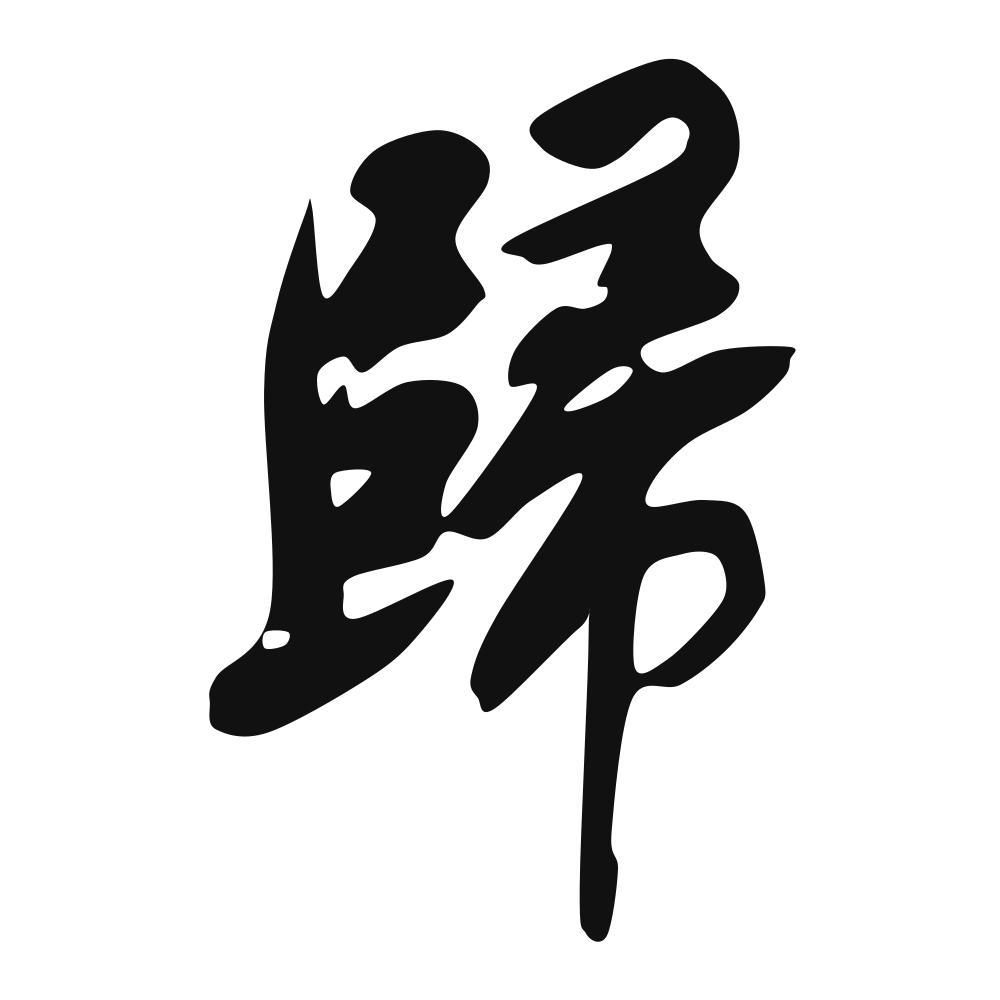
归
surname Gui; to return; to go back to; to give back to; (of a responsibility) to be taken care of by; to belong to; to gather together; (used between two identical verbs) despite; to marry (of a woman) (old); division on the abacus with a one-digit divisor
Closest English meanings
to return·to belong to·to revert
The Calligrapher — Dǒng Qíchāng 董其昌
Late-Ming theorist and running-script master who shaped later taste.
Ming calligrapher (1555–1636), master of running script/regular script — late-Ming connoisseur-critic of understated, misty elegance. Ming dynasty
Etymology & Meaning · 字义溯源
2 · The Character: 归 归 (guī, 1st tone), traditional 歸, is glossed in the Shuowen Jiezi as 女嫁也。从止从婦省,𠂤聲 — 'a woman marries out,' the graph built on 止 (foot, going) and an abbreviated 婦 (wife). Kangxi files 歸 at 18 strokes under the 止 radical. From that gendered origin the word widened into the great Chinese verb of return. 《詩·周南·桃夭》 gives the marriage sense directly: 之子于歸,宜其室家 — 'this girl goes to her home; she will do well by that house.' The Yijing devotes hexagram 54 to it, 歸妹, the Marrying Maiden. And Tao Yuanming's 《歸去來兮辭》 — 歸去來兮,田園將蕪胡不歸 — turned 归 into the word for walking away from office and back to your own fields. Honest disclosure: 归 is also funerary euphemism. 归天, 归西 and 归土 all mean 'to die', and the modern 回归 is politically loaded. Handle the word knowingly.
Cultural Story
归 is to go home with the spoil — a woman wed, a general returned, the bundle brought back to the hearth. 陶淵明 wrote 歸去來兮, let me go back, and walked out of office for good. The character is the long walk ending at the same door you left, lighter or wiser.
Where a Western reader can stand: Where a Western reader can stand: 歸 is nostos — the return that is the point of the whole voyage — and in Tao Yuanming's hands it became the West's Cincinnatus gesture: leaving office for your own fields (歸去來兮). Honest caveat: it is also the Chinese requiescat (归天, 归西, 归土 all mean to die; 魂归故里 repatriates remains), its oldest sense is a woman married out, and 回归 carries political weight. Dong Qichang's airy, deliberately plain brush lands it firmly on the retirement reading — just keep the white space, and never send it to a sickbed.
Common words & phrases
- 归来 to return · to come back
- 回归 to return · to revert · regression
- 归还 to return · to give back · restitution
- 归途 way home · return journey
- 归类 to classify · to categorize
- 归并 to merge · to incorporate
Read the story behind the character
归还 is the library book slid across the desk, 回归 the handover a city marks with fireworks, 归类 the folder a clerk drops a file into, 归途 the train you catch at midnight. The spoil is data and a district now; the door is still the point, and the relief of reaching it.
Why this character belongs on skin
Everything that leaves comes back, if only in memory. 归 is the return—the traveler sighted on the road, the wife who waited, the thread wound back onto the spool. The old character shows a knife and a border, the moment of cutting ties and then the longer moment of reknitting them. To wear 归 is to admit you are the kind of person who comes back, to the town, the faith, the love you thought you'd outgrown. The West sings of homecoming in every ballad; the Taoist trusts the cycle that always bends homeward. A tattoo of 归 is for the one who has wandered and chosen return over the glamour of the road. Carry it over the heart, the one organ that never really leaves, and let it mean you found your way. The journey was real; the coming back is the part you keep.
Own this character
Purchase delivers the original SVG of this glyph, brushed by Dǒng Qíchāng 董其昌, ready to place on skin, paper, or screen.