
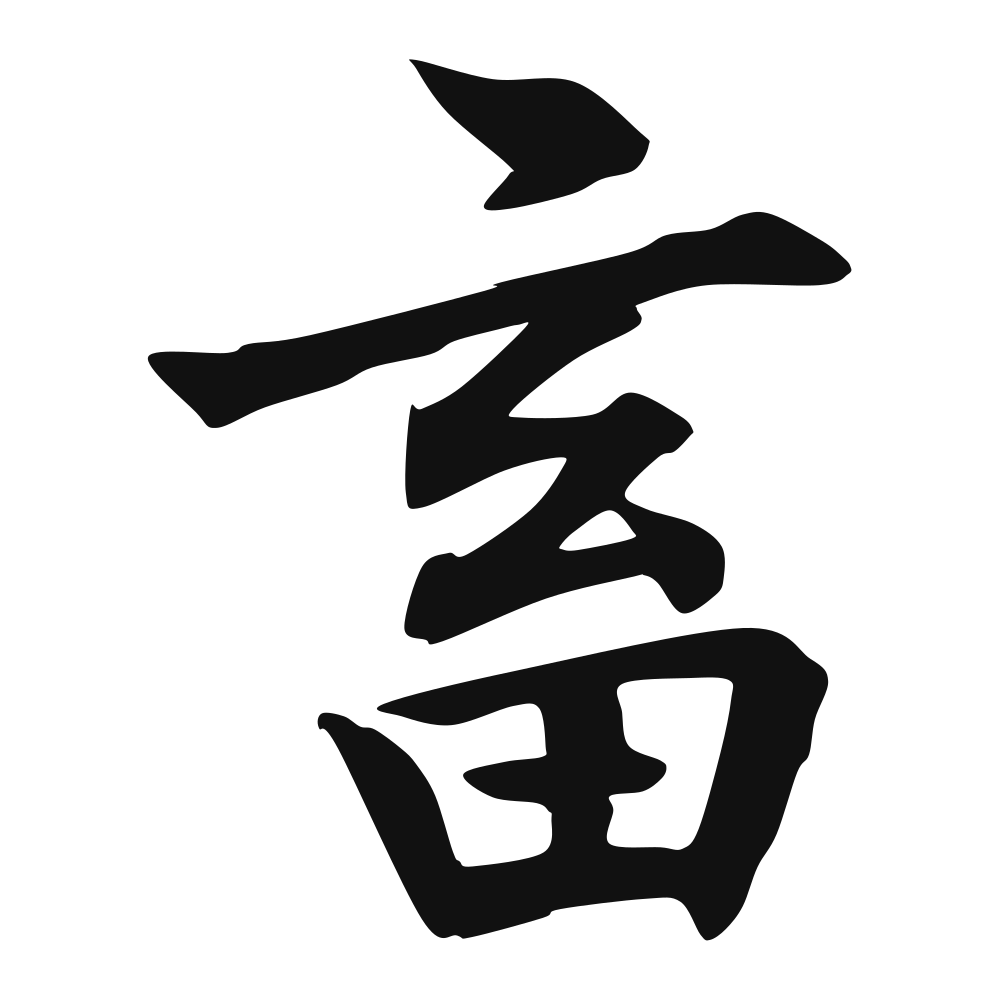
畜
livestock; domesticated animal; domestic animal; to raise (animals)
Closest English meanings
livestock·domestic animal·raise
The Calligrapher — Dǒng Qíchāng 董其昌
Late-Ming theorist and running-script master who shaped later taste.
Ming calligrapher (1555–1636), master of running script/regular script — late-Ming connoisseur-critic of understated, misty elegance. Ming dynasty
Etymology & Meaning · 字义溯源
### Soundchù / xù — chù (4th tone) / xù (4th tone). Free-standing morpheme ### Original meaningChù / xù (4th tone both). The Shuowen Jiezi defines it as 「田畜也。《淮南子》曰:玄田爲畜」 — 'the store of the fields', and Xu Shen adds the old Lu-jiao-li form: 「𤲸,《魯郊禮》畜从田从兹。兹,益也」 — field (田) plus 'to increase' (茲), i.e. what the field yields and you keep. Read chù it is the kept animal, livestock; read xù it is the verb, to rear, to keep, to store. The Zuo Zhuan fixes the divide: 《左傳·僖十九年》疏 「養之曰畜,用之曰牲」 — 'rearing it is xu, using it is sheng (a sacrificial beast)'. In the Changes it is the name of two hexagrams, 大畜 (26) and 小畜 (9), and the Daxu Xiang-zhuan gives it its moral weight: 「天在山中,大畜;君子以多識前言往行,以畜其德」 — 'the gentleman stores up the words and deeds of the past, and so accumulates his character'. Honest disclosure: to a modern Chinese reader the free-standing character reads 'livestock', and the compound 畜生 is a common insult ('brute', literally 'born a beast'). Its dignity is classical and agricultural — storing, keeping, rearing — not heroism. Kangxi naming tables assign Fire (火); the character's own field (田, 蓄, stored grain) argues Earth or Wood (verify). ### The structure (會意 · 从田从茲(小篆省作玄) — field (田) + to increase (茲); 說文「田畜也。《淮南子》曰:玄田爲畜」; 甲金文本从幺(繩)从田/囿,象繫獸而養之)①田tiánfieldthe ground that yields the store②茲zīto increase兹,益也 — the increase that accumulates③畜chù / xùlivestock / to rearnoun and verb in one shape④蓄xùto store upthe later character that took the 'store' sense (从艸, the gathered end) ### In use todayItemReading / meaningNoteReadingchù (noun) / xù (verb)same tone, different word-classCore sensedomestic animal; to rear and keep養之曰畜,用之曰牲Grammarbound morpheme in speech六畜 · 畜牧 · 畜養 · 畜生Tattoo fitcaution — classical dignity, modern plainnesswrite 大畜 if you want the hexagram ### Closest words in English — and what each misses - Beast / Brute — 畜生 (chù sheng) holds the insult; 畜 alone is the animal, but invites the reading - Wealth / Store — 蓄 holds 'to store up' and 財/富 hold wealth; 畜 is the older form, now narrowed to animals - Farm / Field — 農/田 hold farming and the field; 畜 is what the field keeps - Nurture — 養 holds 'to raise, to nourish'; 畜 xù is narrower — to keep and rear beastsAn honest note on grammar. Bound morpheme in modern Mandarin — never free-standing in speech (六畜, 畜牧, 畜養, 畜生); free in classical usage, where it also means 'to stop' and 'to love / to be good to' (《孟子》「畜君何尤」, 畜 = 好)Where a Western reader can stand: 畜 has two jobs. Read chù it is 'livestock' — the kept animal; read xù it is 'to rear and keep'. Its oldest picture is a tethered beast gr
Cultural Story
Chu are the domesticated animals that made settled life possible — the six livestocks, 六畜, of horse, ox, sheep, chicken, dog and pig, tallied in harvest prayers and market ledgers alike. Read xu, the verb means to raise: 畜养, rearing stock, and by extension nurturing people and virtue.
Where a Western reader can stand: 畜 has two jobs. Read chù it is 'livestock' — the kept animal; read xù it is 'to rear and keep'. Its oldest picture is a tethered beast grazing inside the field, and the Shuowen glosses it as what the field yields and you store. In the I Ching it names the hexagram 大畜, Great Accumulating, whose image is the gentleman hoarding the words and deeds of the past to build his character. The blunt sense is also real: alone, this character reads 'livestock', and 畜生 is a Chinese insult. For the hexagram, write both characters.
Common words & phrases
- 牲畜 livestock
- 家畜 domestic animal
- 畜牲 beast · brute
- 畜養 raise · breed
Read the story behind the character
The countryside keeps the word busy: 牲畜, livestock, grazing on hillsides; 家畜, domestic animals, in schoolbook diagrams of the farm. Urban Chinese mostly meet it in dialect scolding — 畜牲 hurled at someone behaving worse than a beast — the ancient barnyard surviving as insult.
Why this character belongs on skin
There is a beast in every honest man, and the question was never whether it lives but whether it is tended. The old word for the creatures we keep draws the sign for mysterious power beneath the sign for a mouth that feeds — as if to domesticate were simply to choose what you nourish. The stallion broken to the saddle is not less a horse; he is a horse with a purpose past his own hunger. We cage and we free, and the wise tend the animal without killing it. Wear it where your own wildness was trained into something usable and kind. Let the ink be the kept beast — proof you mastered the creature without forgetting it was alive.
Own this character
Purchase delivers the original SVG of this glyph, brushed by Dǒng Qíchāng 董其昌, ready to place on skin, paper, or screen.