
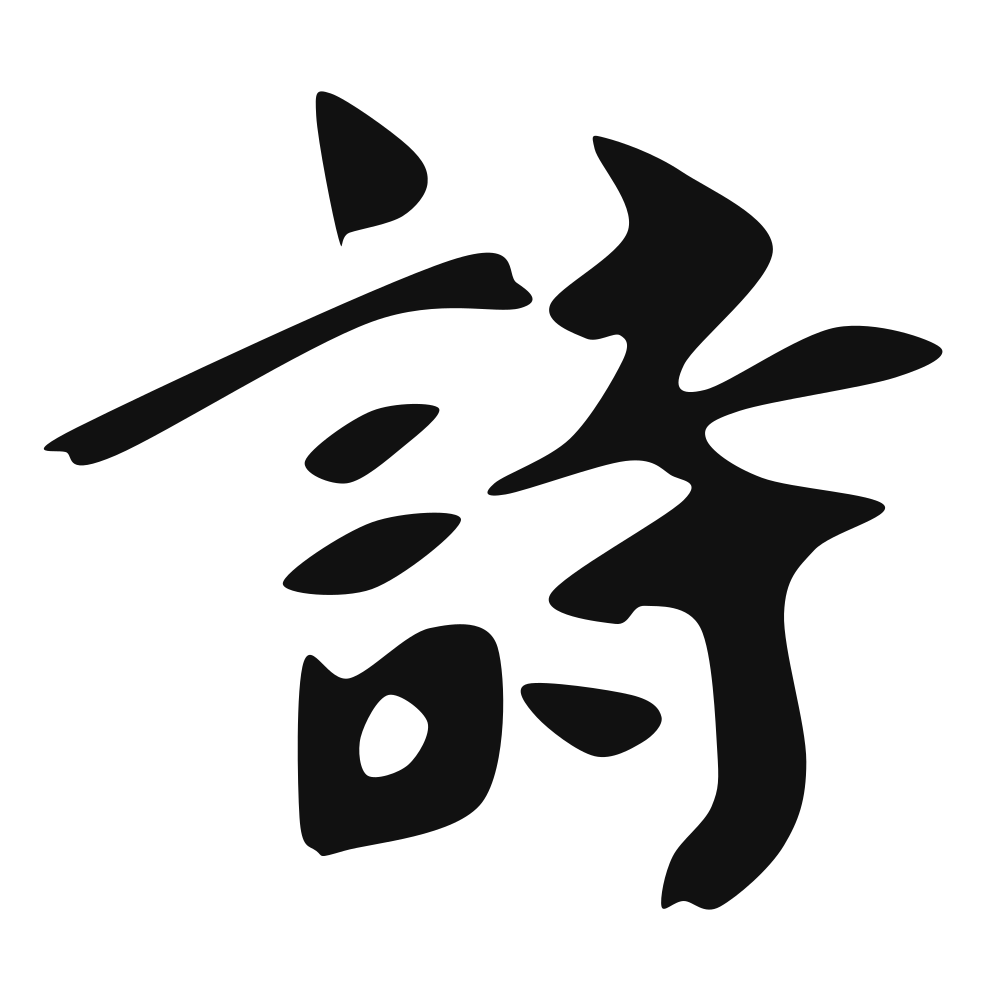
诗
poem; poetry; verse
Closest English meanings
poem·poetry·verse·stanza
The Calligrapher — Cài Xiāng 蔡襄
One of the Four Song masters, known for graceful regular and running script.
Song calligrapher (1012–1067), master of regular script/running script — Song master of warm, disciplined regular script, the most 'proper' of the Song Four. Song dynasty
Etymology & Meaning · 字义溯源
2 · The Character: 诗 Pinyin shī (1st tone). The Shuowen Jiezi (《說文解字》, 卷三·言部) defines 詩 as 志也。從言寺聲 — 'poetry is intention / where the will resides'. Fanqie 書之切 (之地切). As a free morpheme 诗 means 'poem, poetry' — the spoken mind made art. Classical citation: the 《詩·大序》 opens 詩者,志之所之也;在心為志,發言為詩 — 'poetry is where intent goes; in the heart it is intent, spoken it is poem'. The Analects 《論語·為政》 sums the Canon: 詩三百,一言以蔽之,曰 思無邪 — 'the three hundred poems, in one phrase: think without deviance'. Honest note: 诗 is the simplified form of 詩 (13 Kangxi strokes, Wuxing Metal). It is wholly auspicious — a favorite for literary tattoos — but disclose the simplified/traditional split if a calligrapher writes 詩. Western astrology below is a parallel map, not identity.
Cultural Story
The Book of Songs, the Shijing, gathered three hundred poems, the hymns, the airs, the elegies, and became the first of the Five Classics, the foundation every educated person memorized. The character shi joins words to a temple, the utterance set apart. To write shi was to speak in the register the culture reserved for what mattered most: love, loyalty, loss. It is the word for the language that outlasts ordinary talk.
Where a Western reader can stand: Where a Western reader can stand: 诗 is not 'poetry' as a genre but 'where the heart's intent goes' (诗言志) — utterance as the outward form of will, the Greek 'logos' made lyrical. In Cai Xiang's hand it is the Analects' '思无邪' (think without deviance): sincerity as style. Stand with it as the spoken mind made art. A Westerner might call it 'the word made song' — and note the honest split: a carved, classical piece should use the traditional 詩, not the simplified 诗.
Common words & phrases
- 诗歌 poem · poetry · verse
- 诗人 poet
- 古诗 ancient poem · classical poetry
- 诗词 poetry · poems and lyrics
- 诗集 poetry collection · anthology
Read the story behind the character
A reader loves shi ge, poetry; a nation honors a shi ren, a poet; a class recites gu shi, ancient poems; a shelf holds shi ci, the collected verse; a press issues a shi ji, a poetry collection. The character lives on the page and the stage, the lyric, the anthology, the spoken line. It names the elevated register we reach for when plain speech will not carry the weight, the old human insistence that some moments deserve to be made into song.
Why this character belongs on skin
Before there were headlines, there were lines carved to be carried in the heart. 诗 is poetry — the compressed truth that says more by saying less, the art the Tang masters practiced as devotion. A single poem could hold a whole autumn, a lifetime of longing, in twenty characters. To wear this character is to admit that facts are not the whole of reality; that beauty, rhythm, and the right word at the right moment are themselves a kind of knowledge. You are not only a worker of schedules. You are a creature who aches for meaning metered like music. Ink 诗 and you carry the claim that your life is worth rendering, that the ordinary day deserves the line that makes it eternal. The poem is not escape from life. It is life, seen clearly enough to sing.
Own this character
Purchase delivers the original SVG of this glyph, brushed by Cài Xiāng 蔡襄, ready to place on skin, paper, or screen.