
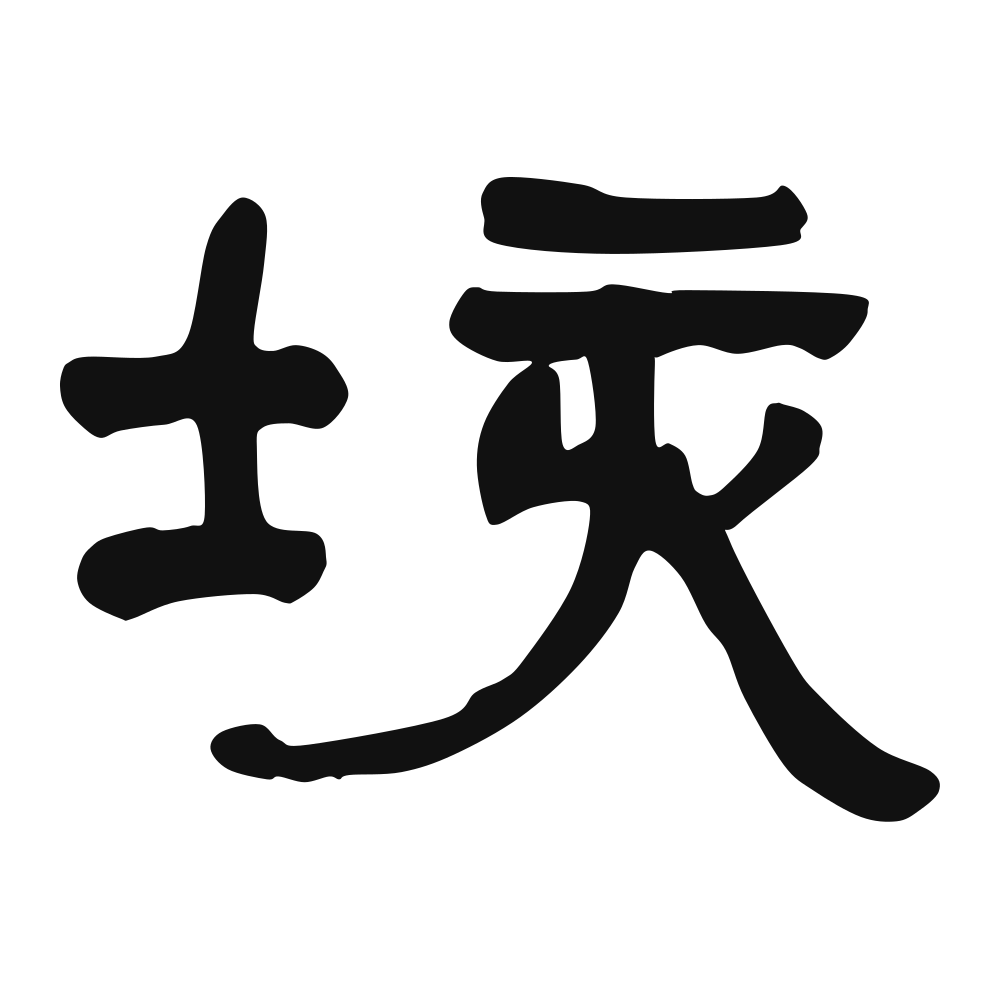
The Calligrapher — Hé Shàojī 何绍基
Qing master blending stele strength into running script.
Qing calligrapher (), master of running script/regular script — Qing master who wrote cursive with a sideways-held brush, all stele flavor. Qing dynasty
Cultural Story
:At 垓下, on the bank of the Wu River, Xiang Yu heard the Chu songs from the enemy camp and knew his cause was lost — the moment the Chu songs broke the last 垓 of his army's heart. The 八垓 named the world's eight bounds. The character is earth and a counted frontier.
Common words & phrases
- 垓下 Gaixia (place name)
- 八垓 the eight boundaries (world)
- 垓心 center of battle
Read the story behind the character
The 垓下 story opens the history lesson. The 八垓 of the old cosmology map the world. The 垓心 of the battle is where Xiang Yu stood. A textbook maps the 垓 where the kingdom ended. The word now appears mostly in the tale of that last night by the river.
Why this character belongs on skin
The ancients needed a word for numbers too large to imagine, and they chose 垓—ten to the twentieth power, a figure that swallows stars and still asks for more. Yet the same character means a boundary, the rim where the earth ends and the maps go blank. Xiang Yu made his last stand at Gaixia, hemmed in on every side by darkness, singing his farewell to his horse and his woman while the fires of the enemy closed in—a boundary that was also an ending, sung. So this single glyph holds infinity and termination in the same hand: the number too big to count, the edge you cannot cross. The mystics always knew these were the same horizon. You finally see clearly only at the rim of everything, where the counting stops and the light runs out. Wear 垓 where you can find it in the dark. It marks your edge, and your edge is the view.
Own this character
Purchase delivers the original SVG of this glyph, brushed by Hé Shàojī 何绍基, ready to place on skin, paper, or screen.