
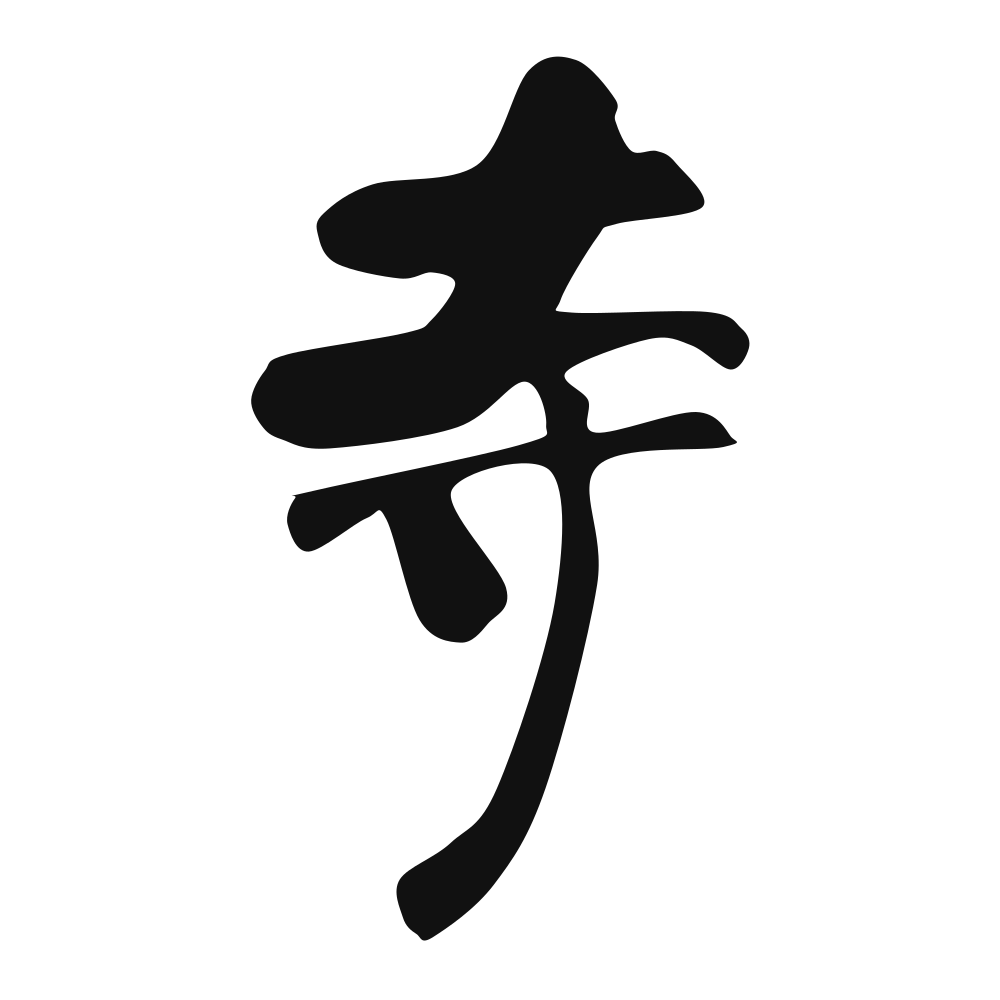
寺
Buddhist temple; mosque; government office (old)
Closest English meanings
temple·monastery
The Calligrapher — Hé Shàojī 何绍基
Qing master blending stele strength into running script.
Qing calligrapher (), master of running script/regular script — Qing master who wrote cursive with a sideways-held brush, all stele flavor. Qing dynasty
Cultural Story
寺 originally meant a government office; the Han court lodged Buddhist monks in the Honglu 寺, and the name stuck to their dwelling. Soon 寺 meant a Buddhist temple, and 寺院 (monasteries) dotted the hills. The 少林寺 (Shaolin Temple) became legendary for its monks and martial arts, while 佛寺 (Buddhist temples) offered prayers for the dead.
Common words & phrases
- 寺庙 temple · monastery
- 寺院 temple · monastery
- 佛寺 Buddhist temple · temple
- 少林寺 Shaolin Temple · temple
Read the story behind the character
Tourists flock to the 少林寺 (Shaolin Temple) to watch monks train, and locals burn incense at a neighborhood 佛寺 (Buddhist temple). A quiet 寺院 (temple, monastery) makes a peaceful weekend escape from the city noise. Wedding photos are shot in temple courtyards, blending old 寺 architecture with a modern celebration.
Why this character belongs on skin
Step through the gate and the noise falls away — sì is the temple, the monastery, the ground set apart where the ordinary clock is suspended. The character joins earth with a hand that serves, the place where devotion has a roof. We build temples because we need a room the world cannot enter, a silence we can stand inside. To carry sì is to carry your own quiet room under the skin, a spot you can retreat to when the city gets loud. It is not escape; it is the centering that lets you go back out. Let this mark rest where you can touch it in the dark, the small architecture of peace you chose to keep with you, portable as breath, older than any wall.
Own this character
Purchase delivers the original SVG of this glyph, brushed by Hé Shàojī 何绍基, ready to place on skin, paper, or screen.