
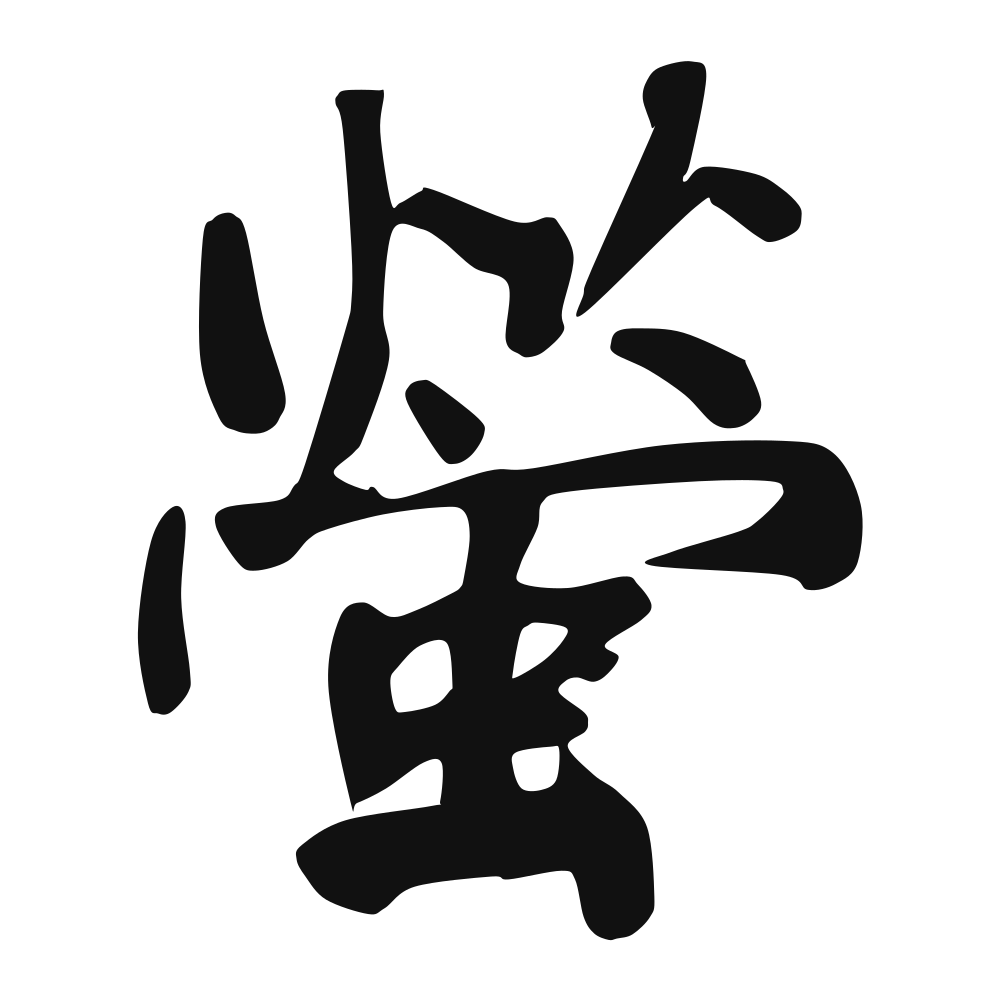
萤
firefly; glow-worm
Closest English meanings
firefly·glowworm
The Calligrapher — Hé Shàojī 何绍基
Qing master blending stele strength into running script.
Qing calligrapher (), master of running script/regular script — Qing master who wrote cursive with a sideways-held brush, all stele flavor. Qing dynasty
Etymology & Meaning · 字义溯源
### Soundyíng — yíng (2nd tone). Free-standing morpheme ### Original meaningYíng (2nd tone). Written 螢 in traditional script. The Shuowen Jiezi does not contain this character — Xu Shen has no entry for 螢, and the earliest form of the idea is the related graph 熒, which he does define: 「熒,屋下鐙燭之光」 — the light of a lamp under a roof, formed from 焱 (blaze) beneath 冂. The insect-word is built on top of that: grass-shaded 熒 above, 虫 (insect) below, and this is why Kangxi files the traditional form under 虫部 rather than under grass. The canonical belief about fireflies was not poetry but natural history: 《禮記·月令》 records for the last month of summer 「腐草爲螢」 — rotten grass becomes fireflies, which was offered as a description of the season's transformation, not a metaphor. The Erya classifies the insect and describes its light accurately: 《爾雅·釋蟲》「螢火,卽炤」, with the commentary 「夜飛,腹下有火」 — flying at night, fire beneath the belly. 古今注 lists its folk names — 耀夜, 景天, 熠燿, 丹良, 燐, 丹鳥, 夜光, 宵燭 — and 埤雅 adds the odd note 「螢無胃而育」 (the firefly has no stomach, yet it lives). Its best-known human story is the poor scholar: 《晉書·車胤傳》「家貧不常得油,夏日則練囊盛數十螢火以照書」 — Che Yin, too poor for lamp oil, filled a white silk bag with dozens of fireflies and read by them. Honest disclosure: there is nothing spooky or sacred here — this is an insect, and the classical culture around it is about study, poor scholars and late summer, not about omens or the soul. ### The structure (後起形聲 · 从虫,熒省聲 — insect (虫) with 熒 ('lamplight under a roof') as phonetic; note that Shuowen has no 螢 entry and that Kangxi therefore files it under 虫部, not under grass)①熒yínglamplight under a roofthe Shuowen word the insect-word is built from②虫chónginsectthe radical — which is why Kangxi files it here and not under grass③腐草爲螢fǔcǎo wéi yíngrotten grass becomes firefliesthe Liji's plain description of the last summer month④囊螢nángyínga bag of firefliesChe Yin's lamp; study in poverty ### In use todayItemReading / meaningNoteReadingyíng (2nd tone)one syllable; homophonous with 迎, 盈, 莹, 营Core sensefirefly; faint cold lightalso 萤石, the mineral fluoriteGrammarfree morpheme, noun萤火 · 流萤 · 萤囊 · 萤石Tattoo fityes-standalone — immediately readable and well-lovedreads as self-reliant light, not as magic ### Closest words in English — and what each misses - Light / Bright — 光/明 hold light generally; 萤 is specifically cold light that comes from living things - Soul / Spirit — 魂/靈 hold soul; the firefly's transformations in the Liji are natural history, not metaphysics - Star — 星 holds star; a firefly is low, near and brief — that nearness is t
Cultural Story
Fireflies flicker through Chinese letters and legend alike. 萤 takes the insect radical and a phonetic of gleaming movement: summer's drifting sparks over marshes and rice paddies. The most famous tale is 车胤 of the Jin dynasty, too poor for lamp oil, who caught fireflies in a thin silk bag — 囊萤 — and read by their cold green light; joined with 孙康's snowlight, it became the proverb of studying against poverty. Tang poets watched 流萤, drifting fireflies, weave through palace courtyards in autumn and made them emblems of lonely, glittering melancholy.
Where a Western reader can stand: In Chinese tradition the firefly is tied to study, not to magic. The standard story is the scholar Che Yin, too poor to buy lamp oil, who read at night by the light of dozens of fireflies in a cloth bag. 萤 therefore reads as a small, earned light.
Common words & phrases
- 螢火蟲 firefly
- 流螢 drifting fireflies
- 螢光 fluorescence · glow
- 囊螢 bag of fireflies (study)
Read the story behind the character
Fireflies still glow in modern language. A parent takes children to the countryside to see 螢火蟲, fireflies, drifting over a summer pond; a poet remembers 流螢, drifting fireflies, from childhood holidays at grandma's village. Chemists borrowed the glow for 螢光, fluorescence — highlighter pens, safety vests, glow sticks at a concert. Students facing exam costs joke grimly about 囊螢, the bag of fireflies: studying by whatever light you can afford.
Why this character belongs on skin
In the hot dark after the rice is cut, the 萤 lift from the grass — small cold stars with no sun to authorize them, blinking their private gospel of light against the enormous night. The child chases them; the poet Li Shangyin wept to see them, knowing the brief glow was kin to every unrecorded life. To be 萤 is to shine without permission, to give light you cannot keep, to be brilliant for an hour and vanish without complaint. The Buddhists saw in them the fleeting self; the lover sees the signal sent across the dark to say I am here, briefly, and watching. Ink this where it would catch the eye at night — the collarbone, the wrist — and let it name the part of you that glows though it owns nothing, proves nothing, and asks only to be seen before the light goes out.
Own this character
Purchase delivers the original SVG of this glyph, brushed by Hé Shàojī 何绍基, ready to place on skin, paper, or screen.