
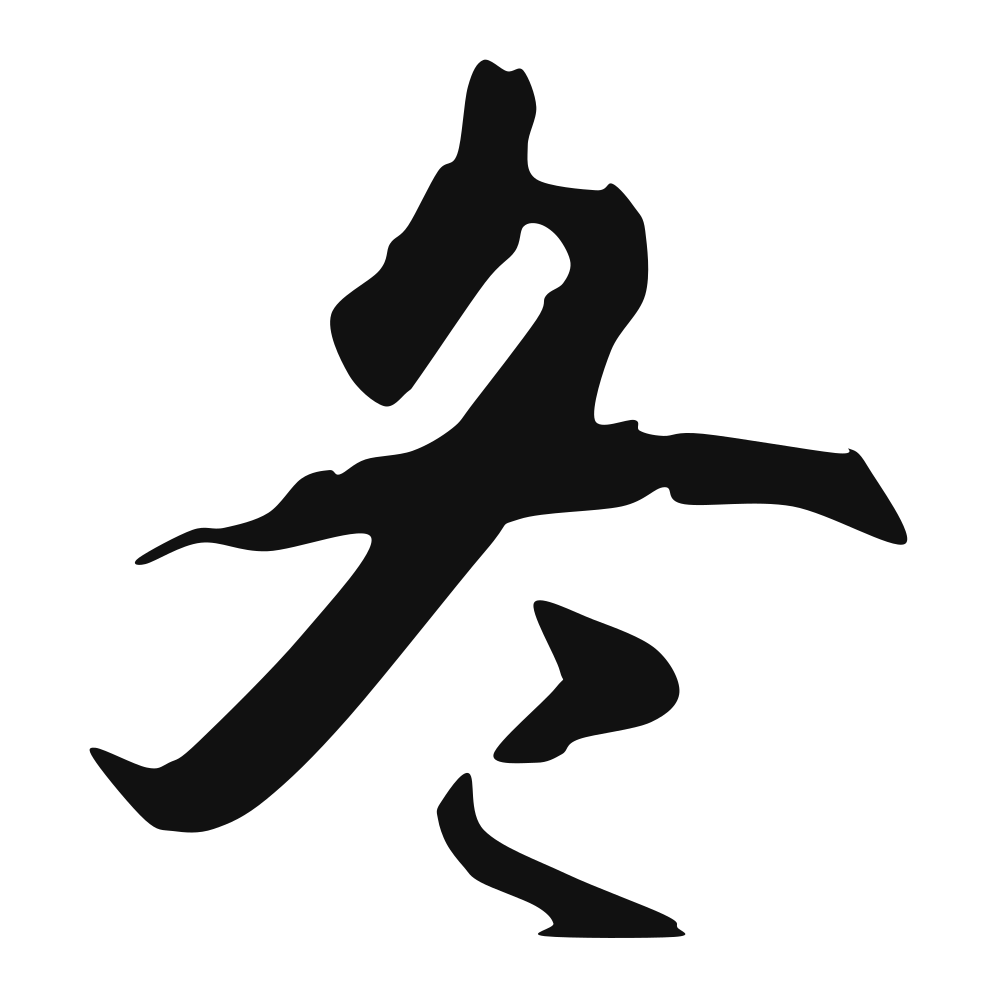
冬
surname Dong; winter; (onom.) beating a drum; rat-a-tat
Closest English meanings
winter·wintertime·the winter season·cold time
The Calligrapher — Hè Zhīzhāng 贺知章
Tang poet-calligrapher celebrated for his cursive inscriptions.
Tang calligrapher (659–744), master of cursive script — known for 《孝经》. Tang dynasty
Etymology & Meaning · 字义溯源
2 · The Character: 冬 Dōng (1st tone). The Shuowen Jiezi defines it as 「四時盡也。从仌从夂」 — 'the exhausting of the four seasons', built from 仌 (ice) and 夂, which Xu Shen identifies as the old form of 終, 'to end'. Winter is literally the character for ending with ice added. 《诗经·豳风·七月》 tracks the whole year to it: 「九月肃霜,十月涤场…嗟我农夫,我稼既同,上入执宫功」, and 《小雅·四月》 laments 「冬日烈烈,飘风发发」 — the winter days are fierce, the whirlwind roars. The Liji gives winter its ritual character: 《礼记·月令》 「孟冬之月…水始冰,地始冻」. The classical Wuxing pairing is 冬 = 水 (winter is Water, north, the storing phase, 藏). 冬 is a free morpheme (冬天, 寒冬, 立冬, 冬至). Honest disclosure: 冬 is neutral-to-austere, never funerary, but it is not 'cozy' — its Shuowen root is 'the end'. Kangxi naming tables oddly assign it Fire (火); classical season-mapping gives Water (verify).
Cultural Story
The form closed a rope's end, 冬, the stop of the year. The Odes gather 冬 snow for the thaw. The histories note 寒冬 when the Yellow River froze and the army crossed on ice. A 冬季 feast closed the almanac. To reach 冬 was to arrive at the still point of the turn.
Where a Western reader can stand: Where a Western reader can stand: 冬 (dōng) means 'winter' — the cold, quiet close of the year, and its old written form is the same as 終 ('end'), because winter was the year's ending. As a tattoo it reads as stillness, rest, and patient discipline: calm and uncontroversial. Here it is set in the cursive of He Zhizhang (659–744), the High Tang poet-calligrapher whom a Tang critic ranked among the 'sages of the brush' — the senior statesman who, on meeting the young Li Bai, called him 'an exiled immortal.' Be clear: no securely attributed original of He Zhizhang survives; he is known through Tang criticism and later copies, so this glyph is rendered in his attributed cursive style, not from a verified original.
Common words & phrases
- 冬天 winter · the winter season · wintertime
- 冬季 winter · winter season · the winter
- 冬雪 winter snow · snow in winter · winter snowfall
- 寒冬 cold winter · severe winter · bitter winter
- 冬瓜 winter melon · white gourd · wax gourd
- 初冬 early winter · first part of winter · early wintertime
Read the story behind the character
A 冬天 brings the heater out; the 冬季 sale fills the mall. The 冬雪 shuts the pass; a 寒冬 keeps the old indoors. The 冬瓜, wax gourd, simmers in the soup. The 初冬 park is thin and gold; the word on the forecast means a coat, not a poem, for most who read it.
Why this character belongs on skin
The cold comes not to punish but to cull — and in the bare tree, the shut field, the early dark, winter tells the truth that summer hides. 冬 is that season, the end of the cycle, the long rest before anything begins again. Its old form carried the sense of ending, of things finished and put by. To wear it is to make peace with the fallow time, the year when nothing grows and the soil is only gathering itself. We fear the winter in our own lives — the loss, the pause, the silence we mistake for death. But 冬 knows the root is alive underground. Carry this character as a vow against panic, a reminder that stillness is not absence and cold is not the end. Some marks celebrate the bloom. This one honors the season that makes the bloom possible, and the patience to wait it out.
Own this character
Purchase delivers the original SVG of this glyph, brushed by Hè Zhīzhāng 贺知章, ready to place on skin, paper, or screen.