
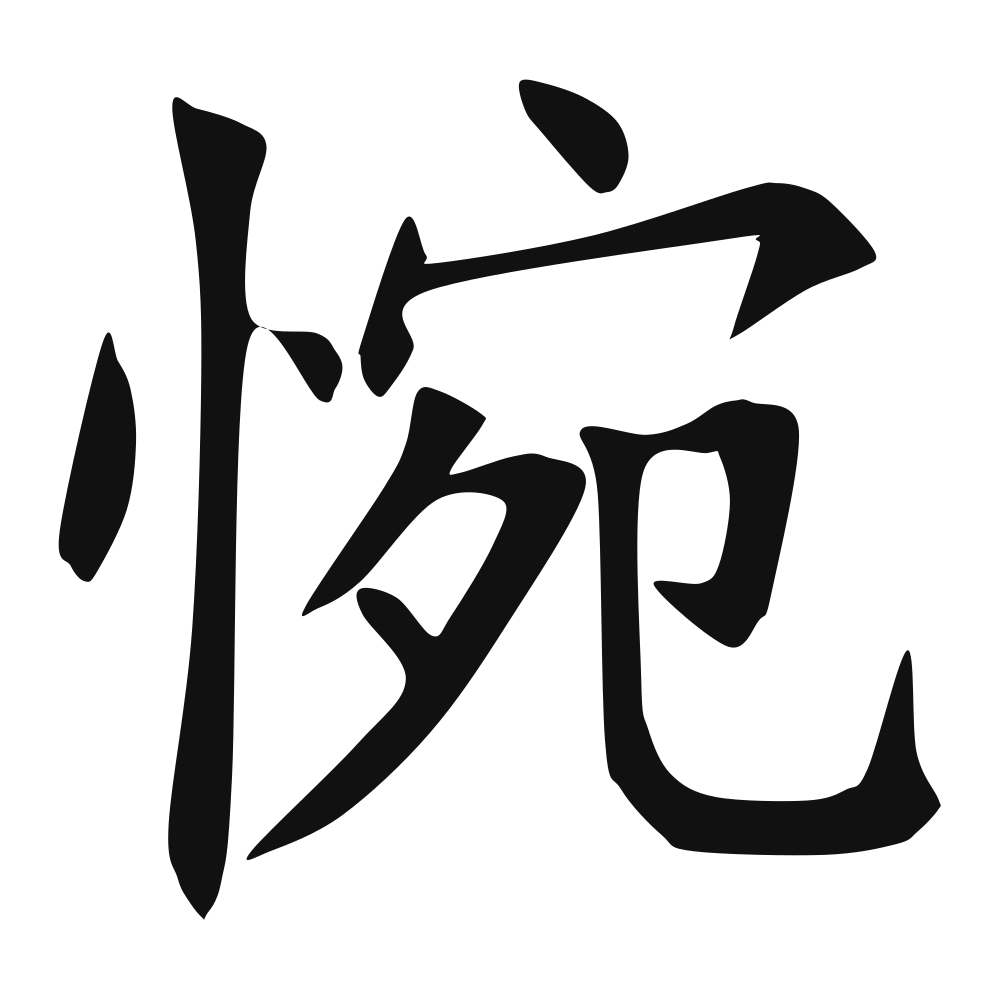
惋
to sigh in regret or pity; Taiwan pr. [wan4]
Closest English meanings
sigh·regret
The Calligrapher — Huáng Bósī 黄伯思
Song calligrapher and theorist renowned for his seal and clerical script.
Song calligrapher (), master of seal script/clerical script — known for 《东观余论》. Song dynasty
Cultural Story
惋 is regret with a sigh built in. The old tale collections use 叹惋 for the sound a listener makes at a story's sad turn — part breath, part word. The heart with 宛, a bending, is a feeling that curves back on itself. It is lighter than grief, the ache of the near-miss rather than the loss.
Common words & phrases
- 惋惜 regret · feel sorry
- 叹惋 sigh with regret
- 怅惋 disappointed and regretful
Read the story behind the character
惋 is the polite sorrow: 惋惜 the colleague who almost got the job, 怅惋 the plan that fell through. You offer it to soften a no, or hear it when someone tells you about the apartment they lost by a day. It is the register of disappointment that still has good manners.
Why this character belongs on skin
Regret is love with nowhere to land. The word sets the heart against 'to bend, to be graceful,' and so 惋惜 is that soft sorrow when something good is lost not by cruelty but by the simple turning of the world — a missed chance, a friendship that faded, a road not taken. The Greeks gave us a word for this ache too, the pity that is also admiration. Unlike sharp remorse, 惋 is tender; it does not condemn, it only grieves the wasted beauty. We hoard our might-have-beens like letters never sent, and perhaps we should. To feel 惋 is to have a heart still shaped for what is precious. Wear this ink as a memorial to the paths you did not walk, the proof that you noticed they were beautiful. It is not weakness to mourn a lost possibility; it is the signature of a person who wanted more from life than mere survival. Let it teach you, quietly, to choose better next time — and to forgive the younger self who could not yet see.
Own this character
Purchase delivers the original SVG of this glyph, brushed by Huáng Bósī 黄伯思, ready to place on skin, paper, or screen.