
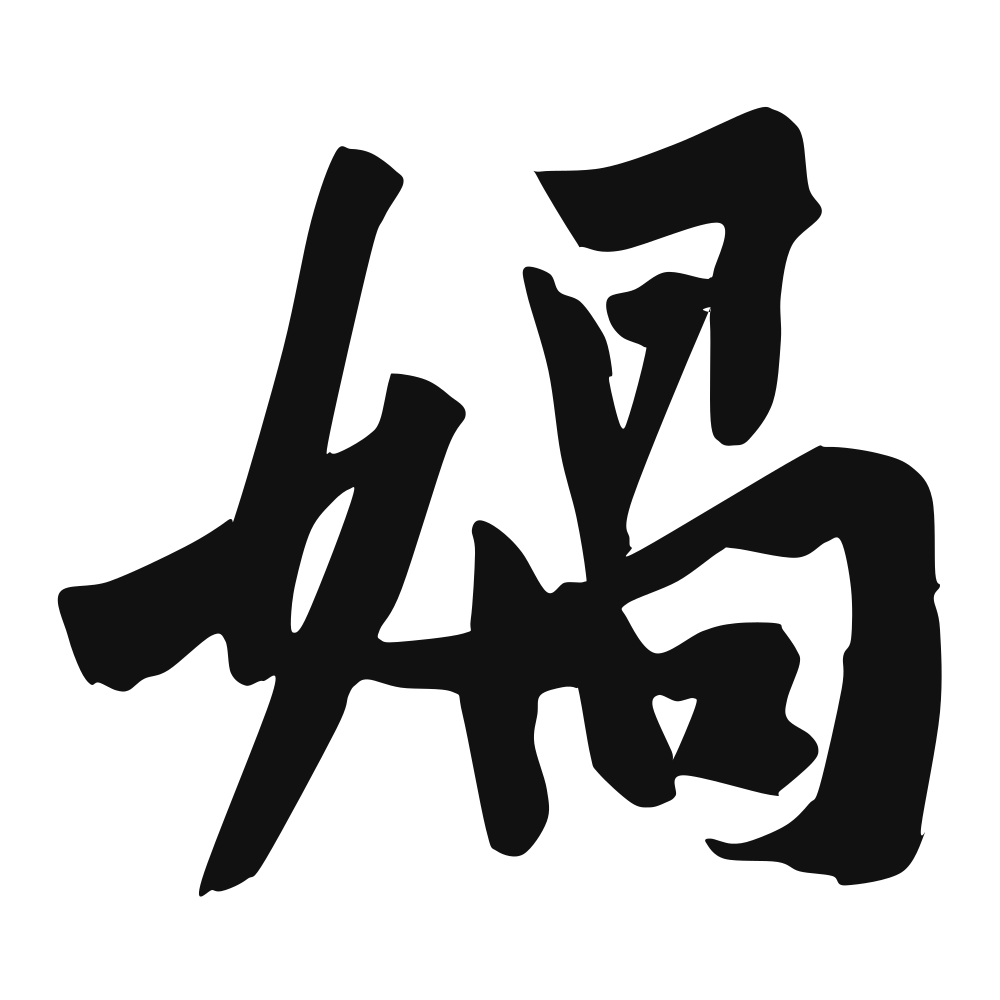
娲
surname Wa; sister of legendary emperor Fuxi 伏羲[Fu2 xi1]
Closest English meanings
Nüwa·goddess
The Calligrapher — Huáng Tíngjiān 黄庭坚
Song master of elongated, radical running and cursive script.
Song calligrapher (1045–1105), master of running script/cursive script — Song master of long, sweeping, deliberately stretched running strokes. Song dynasty
Cultural Story
In the classical tradition 娲 is 女媧, the goddess who molded humans from yellow clay and, when the sky cracked, melted stones to mend it and cut a turtle's legs to prop the heavens. The 淮南子 tells her deeds; later piety called her 媧皇, a sovereign mother of humankind.
Common words & phrases
- 女媧 Nüwa (goddess)
- 媧皇 Empress Nüwa
Read the story behind the character
In the modern world 女媧 remains a cultural icon. A children's book retells how she made people; a game features 女媧 as a creator-heroine, and the title 媧皇 appears in temples dedicated to her. Her myth surfaces in art and animation, a goddess who still "mends" the world in stories parents tell their kids.
Why this character belongs on skin
Before anything had a name, there was a woman kneeling at the edge of a yellow river, pressing mud into the shape of a child and laughing when it opened its eyes. Nüwa is the mother in the character 娲 — the goddess who mended a broken sky with five-colored stones, who made human beings from riverbank clay because the silence of the world bothered her. Every tattoo is a small act of that creation: pigment pressed into skin until something new looks back at you from the mirror. The ancients gave the female radical to this name because creation, in their telling, was never a thunderclap. It was patient, feminine work — mending, shaping, refusing to let the heavens leak. Carry 娲 and you carry the premise that you were kneaded on purpose, by hands that loved the material. Let it sit close to the pulse, where the first heartbeat of a clay child might have started.
Own this character
Purchase delivers the original SVG of this glyph, brushed by Huáng Tíngjiān 黄庭坚, ready to place on skin, paper, or screen.