
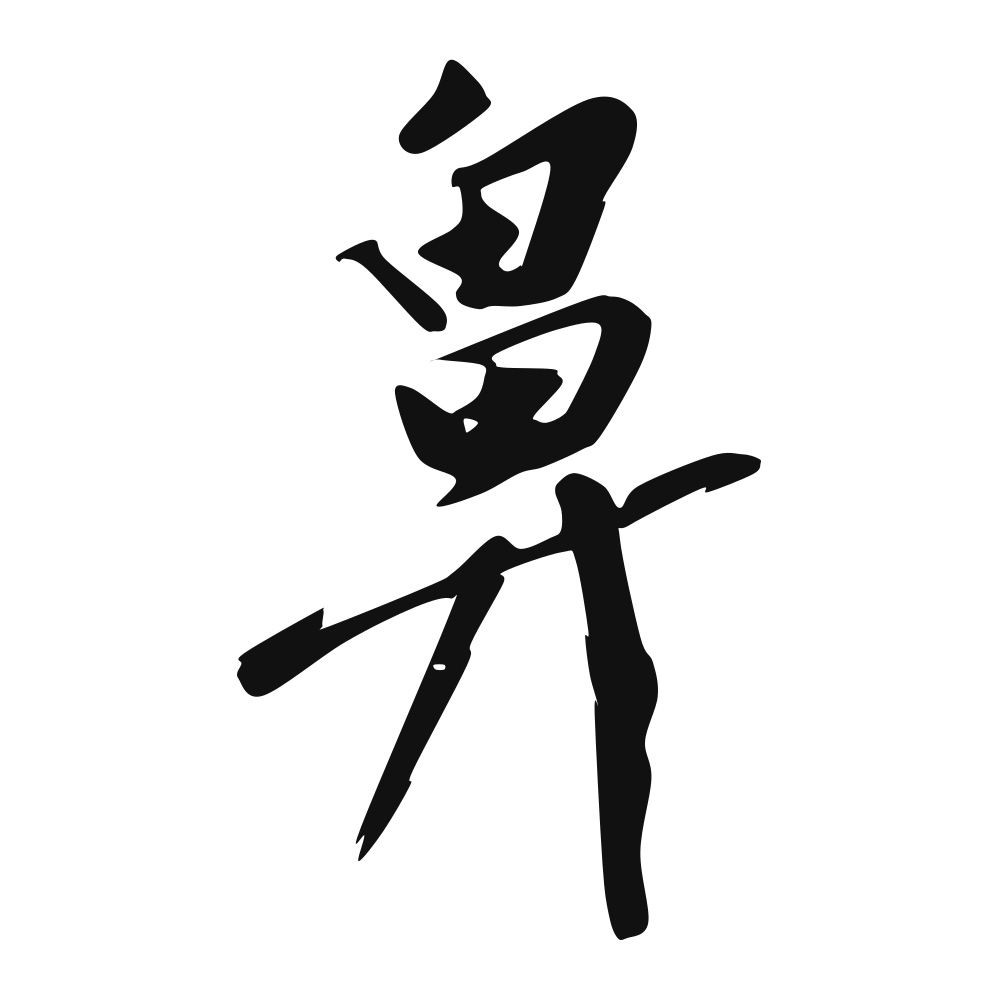
The Calligrapher — Huáng Tíngjiān 黄庭坚
Song master of elongated, radical running and cursive script.
Song calligrapher (1045–1105), master of running script/cursive script — Song master of long, sweeping, deliberately stretched running strokes. Song dynasty
Cultural Story
The ancient form of 鼻 plainly depicts a nose, with nostrils outlined at the base. Remarkably, early texts used 鼻 for the self — the gesture of pointing at your own nose to mean 'me' survives in speech. The Shuowen links it to the first breath of a newborn, when the nose begins life's work.
Common words & phrases
- 鼻子 nose
- 鼻涕 nasal mucus
- 鼻孔 nostril
- 鼻音 nasal sound
- 鼻塞 stuffy nose
Read the story behind the character
A child wipes a runny 鼻涕 on a sleeve before dinner, a swimmer tilts back to clear her 鼻子, and winter cold brings 鼻塞, a stuffy nose that muddles every word. Linguists even speak of a 鼻音 — a nasal sound like the m in 'mom' — produced right there in the nostrils.
Why this character belongs on skin
The nose is the self's most honest feature — you cannot hide it, it announces you in every portrait, and 鼻 draws it plainly: the bridge, the nostrils, self above breath. Yet the ancients made this the character for origin: 自 means self, and it began as a drawing of the nose, because in old China you pointed to your nose to say I — not the heart, not the head, the breath. That is the philosophy hiding in anatomy: what you are, most basically, is breathing. Meditation masters made the nose the gateway; count the breath at the nostrils, the Buddha said, and the mind will follow. Scent too is memory's sharpest courier — rain on stone, a lover's skin, your grandmother's kitchen — all of it arriving through this small monument on your face. To tattoo 鼻 is a wink and a creed: I know what I am made of — air, appetite, arrival. Ink it small and private, somewhere near the pulse, and breathe.
Own this character
Purchase delivers the original SVG of this glyph, brushed by Huáng Tíngjiān 黄庭坚, ready to place on skin, paper, or screen.