
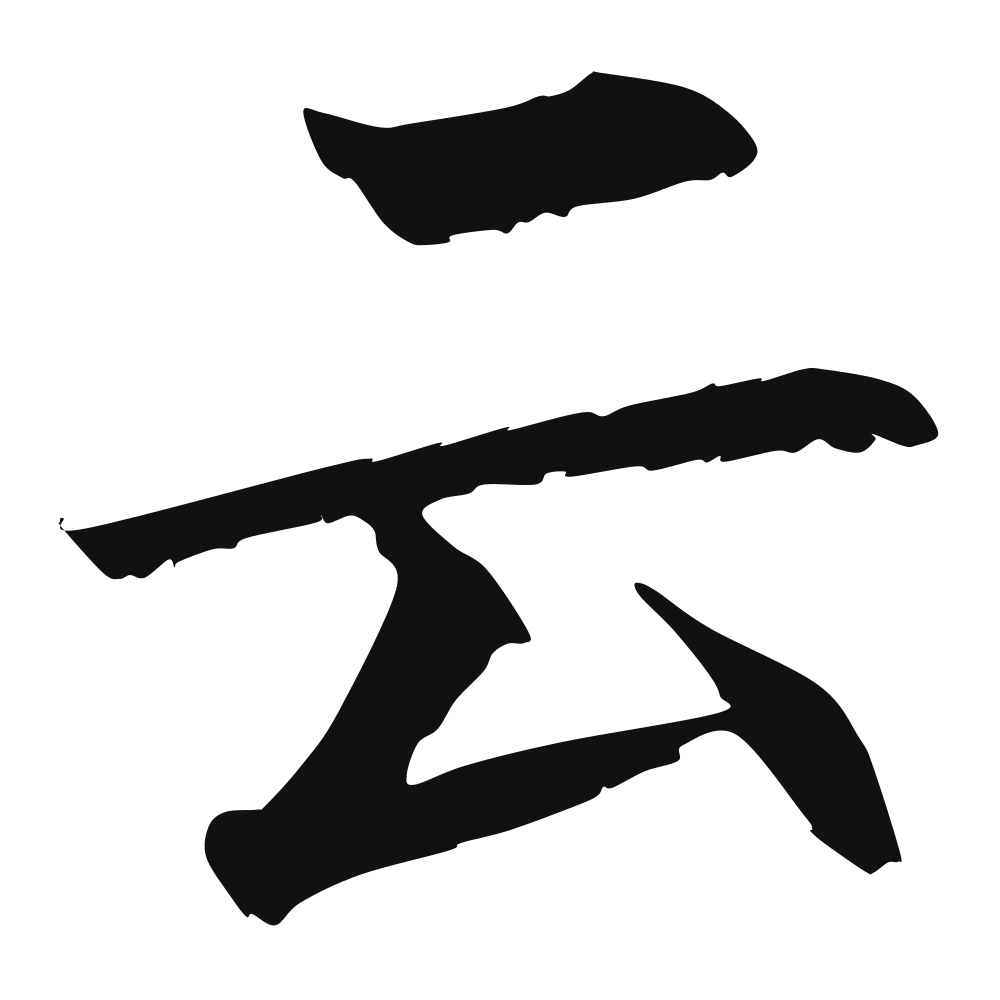
云
云 (yún) — cloud. Pictograph of a swirling cloud. Classical life: 云淡风轻 — light clouds, gentle wind (easy mind); 云 is the wanderer's companion. Grammar: free morpheme — also: (classical) to say; surname Yun; short name for Yunnan 雲南|云南[Yun2 nan2]; cloud
Closest English meanings
cloud·clouds·cloudiness·to say
The Calligrapher — Huáng Xiàng 皇象
Wu-kingdom master of 'chapter cursive' (zhangcao); his Jijiu Zhang is its standard model.
三国吴 calligrapher (生卒年不详(三国吴)), master of clerical cursive — known for 《急就章》松江本. Wu kingdom (Three Kingdoms)
Etymology & Meaning · 字义溯源
2 · The Character: 云 云 (yún, 2nd tone; traditional 雲) is, in Xu Shen, vapour given form: 山川气也。从雨,云象雲回轉形 — 'the vapour of mountains and rivers; from 雨 (rain), and 云 pictures the cloud's coiling shape.' The ancient form 云 was later given a rain-head as 雲. The classics float it high: the Yijing (乾卦) '雲行雨施' (clouds move and rain falls); the Shijing (大雅) '倬彼雲漢' (that bright Milky Way); the Zhouli honours '雲門大卷' (the Cloud Gate dance); the Erya and Chuci (九歌·云中君) '靈皇皇兮既降,猋遠舉兮雲中' place gods in the clouds. As a free morpheme 云 means 'cloud,' and is wholly auspicious — 云霄, 云淡风轻. Honest disclosure: simplified 云 doubles as the classical particle 'to say' (as in 子曰詩云); on skin it is airy and reads well. Pair it with 霄 or 中 if you want 'sky' explicit; in Japanese it is kumo. The Wuxing attribution is confident: 云 is Water (水), the vapour that becomes rain — and note plainly: 水 here is the elemental water of Wuxing, not a 'water sign' of astrology.
Cultural Story
雲 showed a curl of vapor above the rain radical, the cloud, and, because messengers spoke from the sky, the verb to say in the oldest texts, 詩云, the poem says. The 說文 keeps both. A 雲海 is the sea of clouds a Tang poet watched from Huangshan. The character is the weather and the word, the vapor that carries both rain and report.
Where a Western reader can stand: Huang Xiang (皇象), a calligrapher of the Three Kingdoms Wu kingdom, was renowned for zhangcao (章草) — the squared, archaic draft-cursive that links clerical script to true cursive, his 急就章 still studied as a model. His 云 is a cloud held in that early-cursive grid: vapour given discipline and order. To a Western reader he is the early master of a script halfway between print and flight — cloud caught at the moment writing first learned to run. (Note: distinct from the Eastern Han filial son 黄香, who was no calligrapher.)
Energy Reading
Water (水)
Comparative symbology, not fortune-telling.
Common words & phrases
- 白云 white cloud · white clouds · white clouds
- 云彩 clouds · cloud formations · cloud shapes
- 乌云 dark clouds · black clouds · storm clouds
- 云海 sea of clouds · cloud sea · cloud sea (scenic)
- 风云 wind and cloud · events · storm
- 云朵 clouds · cloud puffs · cloud tufts
Read the story behind the character
白云 is the postcard sky; 云彩 and 云朵 the soft things kids draw. 乌云 is the storm and the mood; 云海 the view you paid to climb for. 风云 is the wind and cloud of politics and sports. And 云 is the tech word, cloud storage, the 云端 where your photos live. The old vapor now names the server farm; the saying-sense survives only in 詩云 and quotations.
Why this character belongs on skin
The Chinese poets loved 云 more than the sky itself, because the cloud is the mind set loose — drifting, unbothered, belonging to no province. To be like a cloud is to be untethered from the need to arrive. Zhuangzi watched clouds and saw the wandering sage, the man who answers to weather and nothing else. Ink this on your body and you are telling the world you refuse to be pinned. Clouds do not argue with the wind; they are changed by it and remain, somehow, exactly themselves. There is a freedom here that has nothing to do with running away and everything to do with never being owned. Let your life be weather. Let it move. A cloud leaves no footprint, and that is its perfection — present, then gone, and the sky was never emptier for it.
Own this character
Purchase delivers the original SVG of this glyph, brushed by Huáng Xiàng 皇象, ready to place on skin, paper, or screen.