
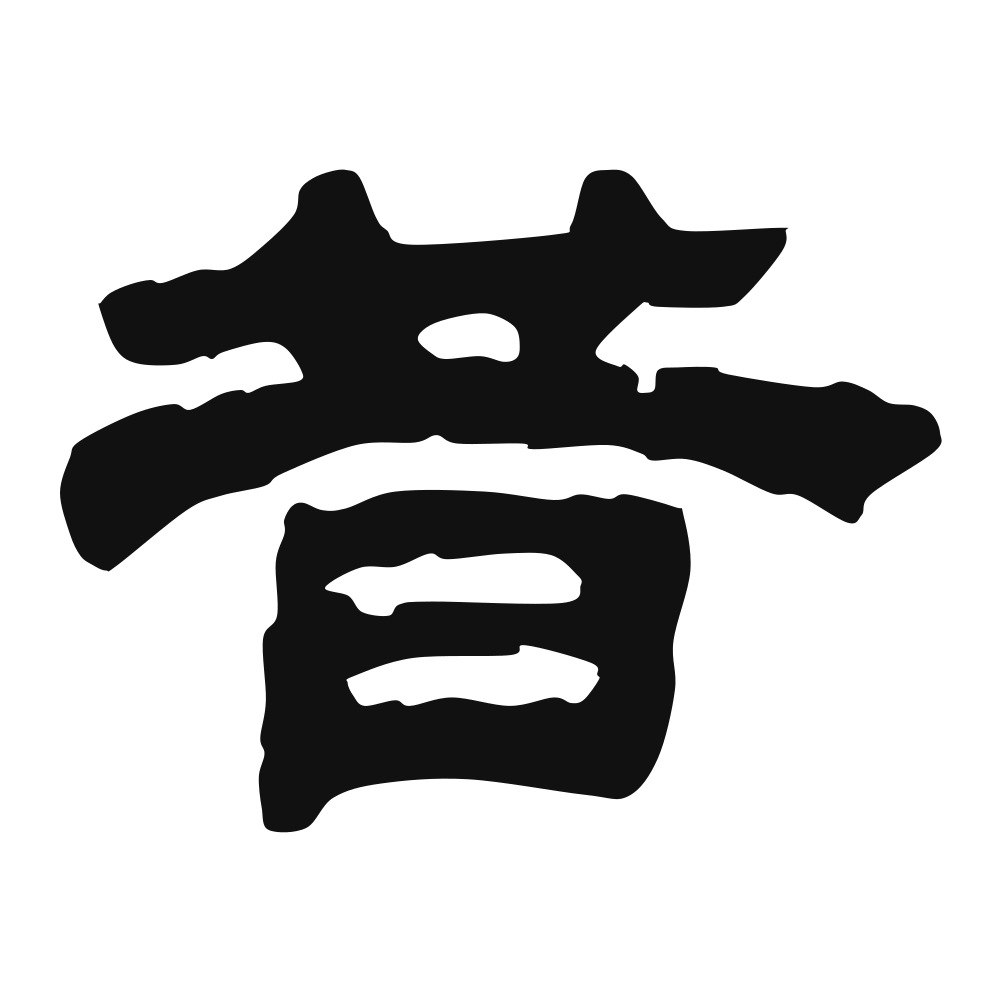
昔
surname Xi; former times; the past; Taiwan pr. [xi2]
Closest English meanings
past·former·ancient times·old days·bygone
The Calligrapher — Huáng Xiàng 皇象
Wu-kingdom master of 'chapter cursive' (zhangcao); his Jijiu Zhang is its standard model.
三国吴 calligrapher (生卒年不详(三国吴)), master of clerical cursive — known for 《急就章》松江本. Wu kingdom (Three Kingdoms)
Etymology & Meaning · 字义溯源
2 · The Character: 昔 Xi (1st tone). The Shuowen Jiezi reads 「昔, 乾肉也; 从残肉, 日以晞之」 — dried flesh; from leftover meat, dried by the sun. The graph shows meat under a sun, the ancient method of preservation. From 'dried' came 'former times, the past': the Odes, Cai Wei, open 「昔我往矣, 杨柳依依」 (long ago I went, the willows were soft); the Documents, Yao Dian, say 「昔在帝尧」 (in former times, Emperor Yao). Name-lore splits between Metal (金) and Fire (火); Kangxi eight strokes (日部). As a free morpheme 昔 means 'of old, once'. Honest route: 昔 is gentle nostalgia, not sorrow; pair it with 今 or 往 (今昔) to frame the piece as the honored past, a source, not a loss.
Cultural Story
昔 is the far behind. 昔日 the days of the lost capital; 往昔 the poet's 'former times.' 今昔 is the contrast the exile draws — then and now, the same river, the different man. The word is memory with a long lens, the bygone the chronicler sets against the present to measure what the years took.
Where a Western reader can stand: Where a Western reader can stand: 昔 is meat dried in the sun — the Latin vetus, the kept and bygone. This piece carries the brush of 汉隶 (Han clerical script) for virtue and 德行, but '黄香' here is the Han paragon of filial piety, not a signing master; any 黄香碑 attribution is traditional and disputed. Wear it for the past you honour, ideally paired with 今 'now' so the memory holds a frame.
Common words & phrases
- 昔日 former days · in the past · bygone days
- 往昔 past · former times · yesteryears
- 今昔 past and present · then and now · present and past
- 昔年 former years · years gone by · former year
- 古昔 ancient times · olden days · the past
Read the story behind the character
昔日 is the throwback post; 往昔 the memoir. 今昔 the reunion's ache; 昔年 the old song. 古昔 the sage's 'in olden days.' The word frames the before — the town before the dam, the you before the city. From the album to the eulogy, 昔 is the past we set beside the now to see how far the light has moved.
Why this character belongs on skin
Sunken below the present, xī is the former day, the time that shaped the one you stand in now. The character holds a sun and something washed away—the ancient knowing that the past is what the water has already carried past your knees. We ache toward xī: former lovers, former selves, the empire that fell so cleanly. The Daoist watches it flow; the mourner wades back in. To mark yourself with xī is to honor the current you cannot see but are swept by—the grandmother's hands, the war, the childhood room. Let it sit near the heart, where memory pools. You are not only now. You are the residue of every yesterday that refused to let go of you. The past is not behind. It is beneath, bearing you up.
Own this character
Purchase delivers the original SVG of this glyph, brushed by Huáng Xiàng 皇象, ready to place on skin, paper, or screen.