
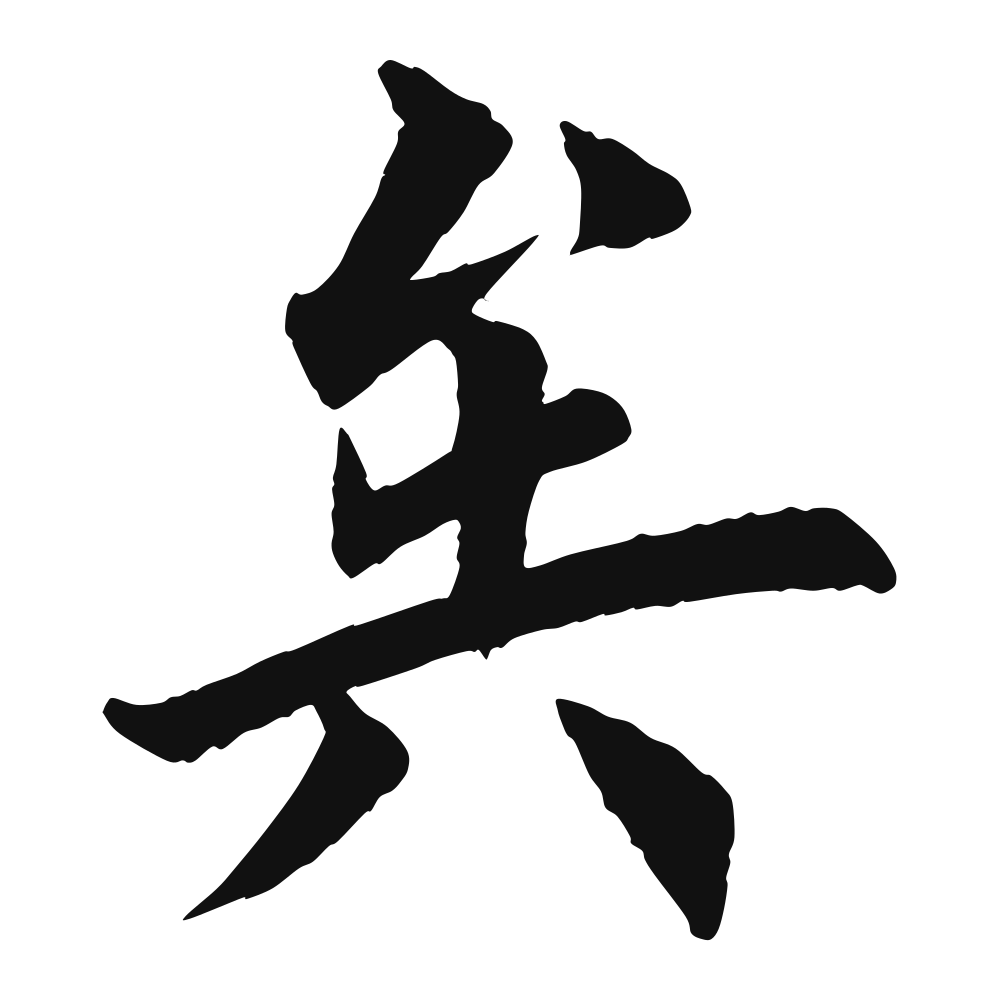
矣
classical final particle, similar to modern 了[le5]
Closest English meanings
final particle
The Calligrapher — Huáng Xiàng 皇象
Wu-kingdom master of 'chapter cursive' (zhangcao); his Jijiu Zhang is its standard model.
三国吴 calligrapher (生卒年不详(三国吴)), master of clerical cursive — known for 《急就章》松江本. Wu kingdom (Three Kingdoms)
Cultural Story
矣 is classical Chinese exhaling — the particle that drops the curtain on a clause with a sigh of completion or feeling. Confucius groans 甚矣,吾衰也!久矣,吾不复梦见周公 — 'How far gone I am! Long it has been since I dreamed of the Duke of Zhou.' In the Odes, the histories, and the philosophers, 矣 marks what is settled, finished, or felt.
Common words & phrases
- 久矣 for a long time
- 矣哉 emphatic particle
Read the story behind the character
The particle never died; it moved into ceremony. Mottos, eulogies, and graduation speeches still end clauses with its finality; classics students recite 久矣 (for a long time) from the Analects with a grin at its stiffness, and exams ask what the emphatic 矣哉 (how ... indeed!) adds to a line. Online, writers reach for it half-jokingly — '朕倦矣' — because three thousand years of settledness still lands as deadpan humor.
Why this character belongs on skin
There comes a breath when the thing is simply done. 矣 is the old sigh at the end of a sentence, the particle the ancients set down to say: it has become so. Not maybe, not tomorrow — already. The historian closed his chapter with 矣, and the reader knew the dynasty had fallen and nothing could uncall it. To live with 矣 is to stop bargaining with what has happened, to let the past be past and stand in the clean shock of the after. We cling to the almost, the if-only; 矣 cuts the string. Wear it and you honor the finalities that shaped you — the leave-taking, the loss, the door that shut. Let it mark your skin as the period you stopped fighting. The ink is the peace of the finished.
Own this character
Purchase delivers the original SVG of this glyph, brushed by Huáng Xiàng 皇象, ready to place on skin, paper, or screen.