
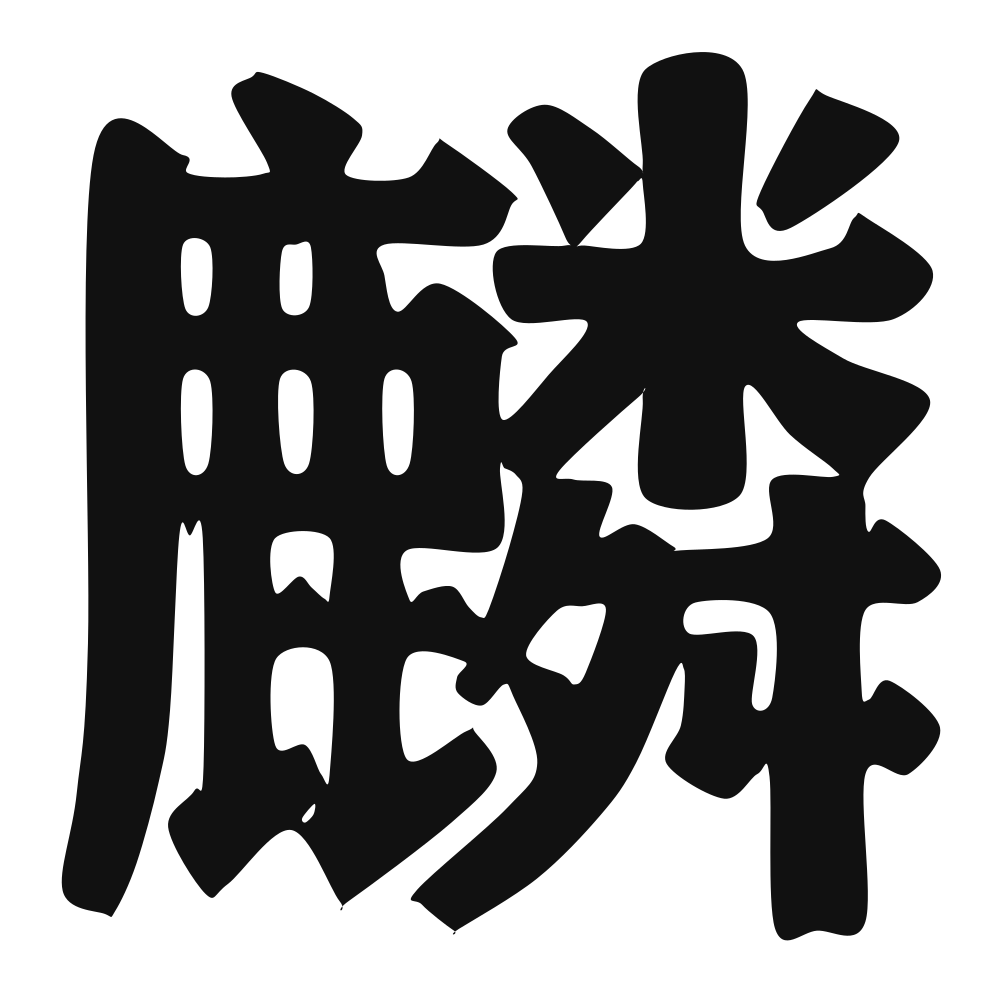
麟
usually seen in: Tang Yulin (1871-1937), minor warlord in northeast China, sometime governor of Chengde 承德, mostly poor in battle but very successful at accumulating personal wealth (汤玉麟); Zhang Taiyan 章太炎 (1869-1936), scholar, journalist, revolutionary and leading intellectual around the time of the Xinhai revolution (章炳麟); Samotherium (early giraffe) (萨摩麟); Alan Tam (1950-), Hong Kong Canto-pop singer and actor (谭咏麟)
Closest English meanings
unicorn·qilin·auspicious beast
The Calligrapher — Huáng Xiàng 皇象
Wu-kingdom master of 'chapter cursive' (zhangcao); his Jijiu Zhang is its standard model.
三国吴 calligrapher (生卒年不详(三国吴)), master of clerical cursive — known for 《急就章》松江本. Wu kingdom (Three Kingdoms)
Cultural Story
《説文解字》lists 麟 as “大牝鹿也,” the female qilin, built from the deer radical with the sound 粦. Paired with 麒, the 麒麟 became the supreme auspicious beast of Chinese myth, appearing in eras of peace. Its rare, benign visits marked heavenly favor upon a virtuous ruler and realm.
Common words & phrases
- 麒麟 qilin · unicorn
- 麟儿 son · precious child
- 凤麟 phoenix and qilin · rare talent
Read the story behind the character
The 麒麟 (qilin, unicorn) appears on festive banners and bank logos as fortune made flesh, a 麟儿 (precious child) is a cherished son, and 凤麟 (phoenix and qilin) praises rare talent. From birth announcements to company names, 麟 still signals the auspicious and the exceptionally gifted.
Own this character
Purchase delivers the original SVG of this glyph, brushed by Huáng Xiàng 皇象, ready to place on skin, paper, or screen.