
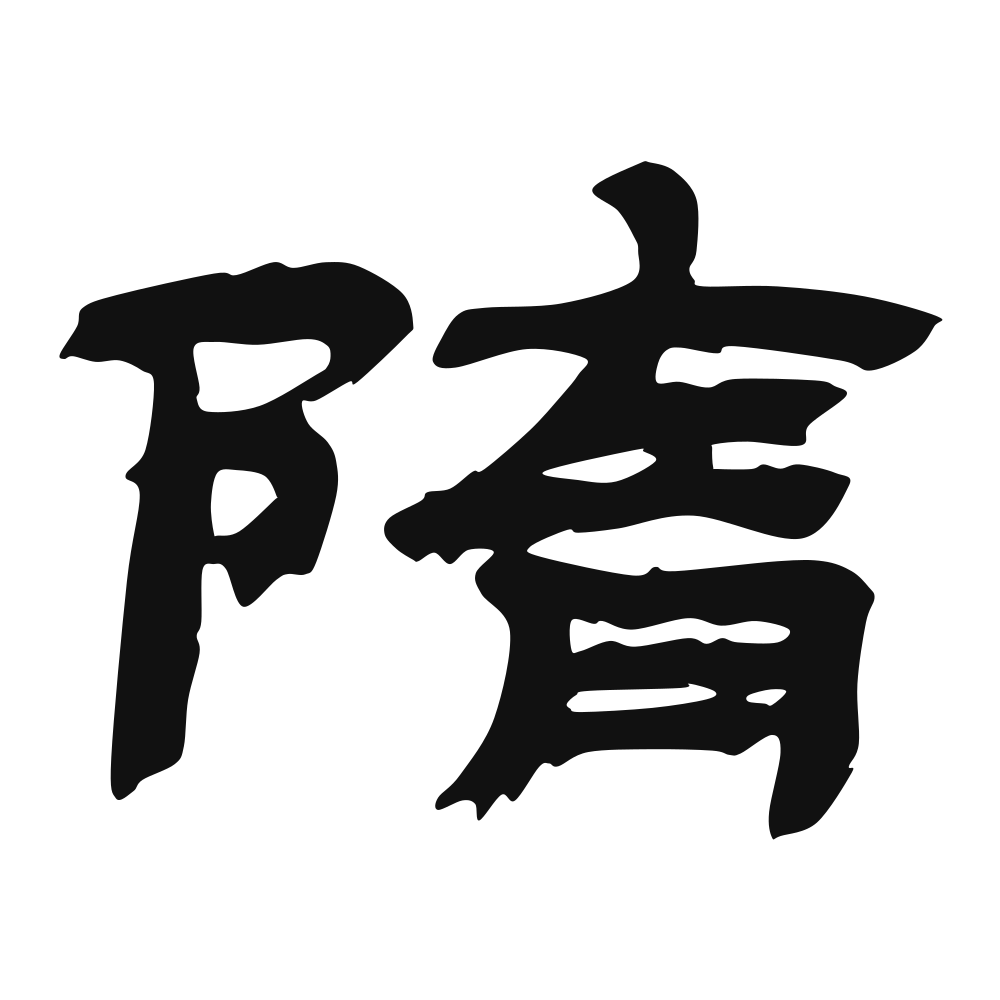
隋
the Sui dynasty (581–617 AD); surname Sui
Closest English meanings
Sui dynasty·surname
The Calligrapher — Jīn Nóng 金农
Qing 'Eight Eccentrics' master of archaic clerical script.
Qing calligrapher (), master of clerical script/regular script — Qing lacquer-script original, blunt brush, unmistakable. Qing dynasty
Cultural Story
隋 derives from an ancient state and the 隋 dynasty, 581 to 618, that reunified China and built the Grand Canal. The character pairs 阝 with 左. Historians write 隋朝 and 隋代 for that brief, pivotal era, ended by the extravagance of 隋炀帝.
Common words & phrases
- 隋朝 Sui dynasty
- 隋代 Sui period
- 隋书 Book of Sui (history)
- 隋炀帝 Emperor Yang of Sui
Read the story behind the character
Students learn the 隋朝 (Sui dynasty) founded the canal system, and read the 隋书 (Book of Sui). The 隋代 (Sui period) bridges north and south, while 隋炀帝 (Emperor Yang of Sui) warns of excess. The surname 隋 persists in phone books.
Why this character belongs on skin
A dynasty rose on the ruins of chaos and fell before it could finish its sentence — the Sui, brief as a struck match, yet it lit the canal that still carries water a thousand years later. History remembers the long empires and forgets the short ones that did the hard building. The character is a name, but names are where we bury our ancestors' ambitions. We are all a little Sui — intense, unfinished, dismissed by the chroniclers who come after. The Christian knows a kingdom not of this world; the Daoist knows the useful failure, the vessel broken that feeds the field. To ink this surname-word is to claim the glory of the incomplete, the bridge half-built that others will walk. Let it rest on your skin as a quiet pride: I was here, I made the channel, even if the dynasty did not survive to praise me. The water still flows.
Own this character
Purchase delivers the original SVG of this glyph, brushed by Jīn Nóng 金农, ready to place on skin, paper, or screen.