
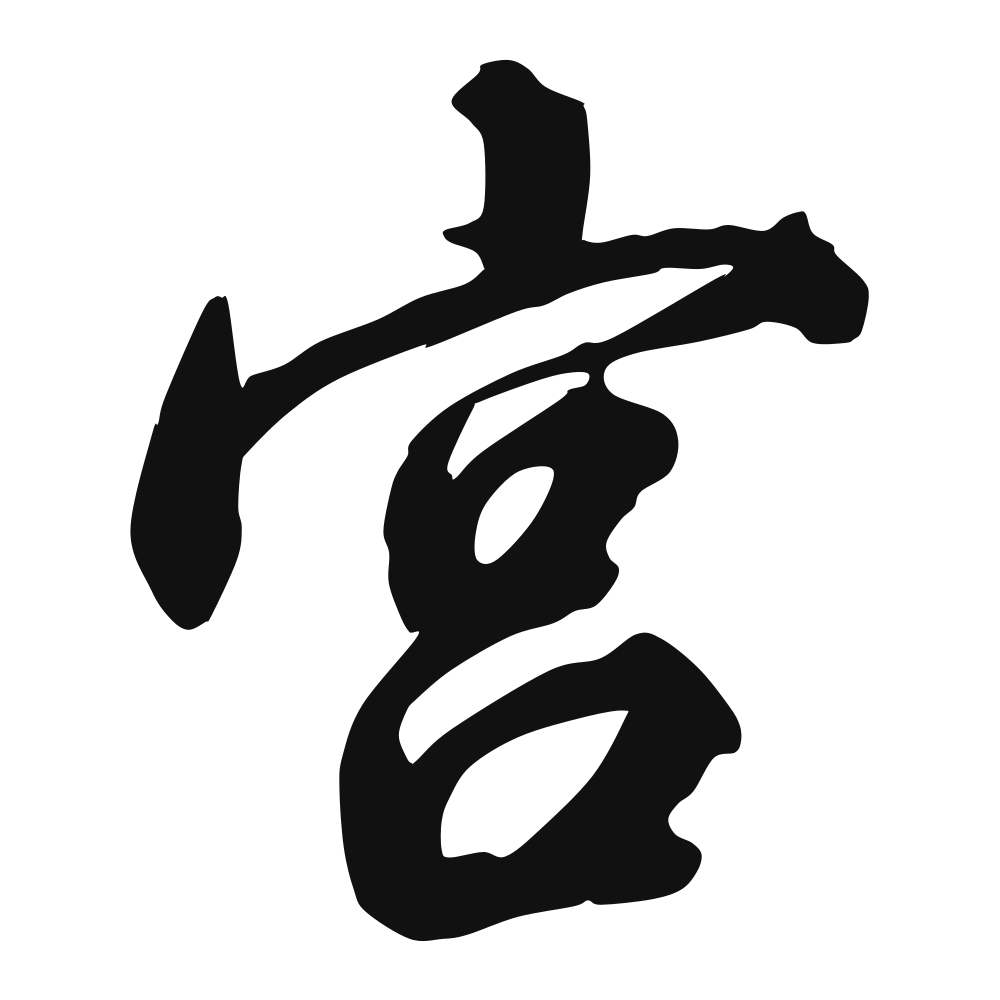
宫
surname Gong; palace; temple; castration (as corporal punishment); first note in pentatonic scale
Closest English meanings
palace·temple
The Calligrapher — Cài Yōng 蔡邕
Han scholar who perfected clerical script and invented flying-white.
Han calligrapher (133–192), master of clerical script/飞白书 — known for 《熹平石经》/ 飞白书. Han dynasty
Etymology & Meaning · 字义溯源
2 · The Character: 宫 Gōng (1st tone). The Shuowen reads 宫 (宮) as 「室也。从宀,躬省声」 — 'a chamber; from 宀 (roof), with 躬 abbreviated as phonetic.' It is the enclosed dwelling, and by rank the palace — the many-roofed seat of power. The 易经 turns it ominous: 《易经·困卦》 「入于其宫,不见其妻,凶」 — 'enter his palace and not see his wife — misfortune.' So 宫 is the enclosed seat, intimate but also isolating. Grading: a free, grand morpheme — palace, chamber, the body's cavities (五宫). No negative sense in itself, but disclose that 宫 also means 'castration' (宫刑) in antiquity — a rare, grave reading to name so it isn't mistaken for 'palace' alone. As a musical term 宫 is the first of the five tones (宫商角徵羽), the key-note all others hang from — so 宫 also means 'key / centre'. The tattoo can read as palace, as the body's chamber, or as the root tone; name which you mean.
Cultural Story
Du Mu's 'Efang Palace' rhapsodies the Qin's vast halls, and Beijing's 紫禁城, built in 1420, enclosed the 皇宫. 天宫 is the heaven of 'Journey to the West,' 子宫 the medical womb. The graph stacks two roofs — the doubled dwelling, sacred, imperial, or bodily.
Where a Western reader can stand: Where a Western reader can stand: 宫 is 'the palace' — Latin palatium — but the graph shows a roof over linked chambers, so it is an enclosure rather than a façade: closer to 'the residence' or even 'the court.' Two further readings a Western wearer should own. First, 宫 is the tonic of the Chinese pentatonic scale, the keynote all pitches hang from — a gift of a meaning for a musician. Second, in antiquity 宫刑 named the castration penalty. Grand, resonant, and not without a shadow.
Common words & phrases
- 宫殿 palace
- 皇宫 imperial palace
- 天宫 heavenly palace
- 宫廷 court · palace
- 子宫 uterus · womb
- 迷宫 maze · labyrinth
Read the story behind the character
Tourists flood the 故宫, and OB wards scan the 子宫. Playgrounds maze children in a 迷宫, while the 天宫 space station orbits above. The doubled roof now means a ticket line, an ultrasound, and a launch — palace, body, and orbit under one ancient, repeated eave.
Why this character belongs on skin
Stone upon stone, the 宫 rises — not a home but a universe enclosed by walls, where the son of heaven sleeps and the seasons are negotiated indoors. The character repeats the roof over roof, a doubling that meant a vast, many-chambered dwelling long before it meant the forbidden city. To carry 宫 is to name the architecture of ambition: the rooms we build to keep the world out, the throne we erect in our own chests. Emperors believed their palaces mirrored heaven; lovers know a smaller version — the body as a 宫, entered only by the worthy. Ink it as a reminder that you are both the builder and the bound. The walls protect and the walls confine. Which 宫 you raise, and who you let past the gate, is the only question the character leaves for you to answer.
Own this character
Purchase delivers the original SVG of this glyph, brushed by Cài Yōng 蔡邕, ready to place on skin, paper, or screen.