
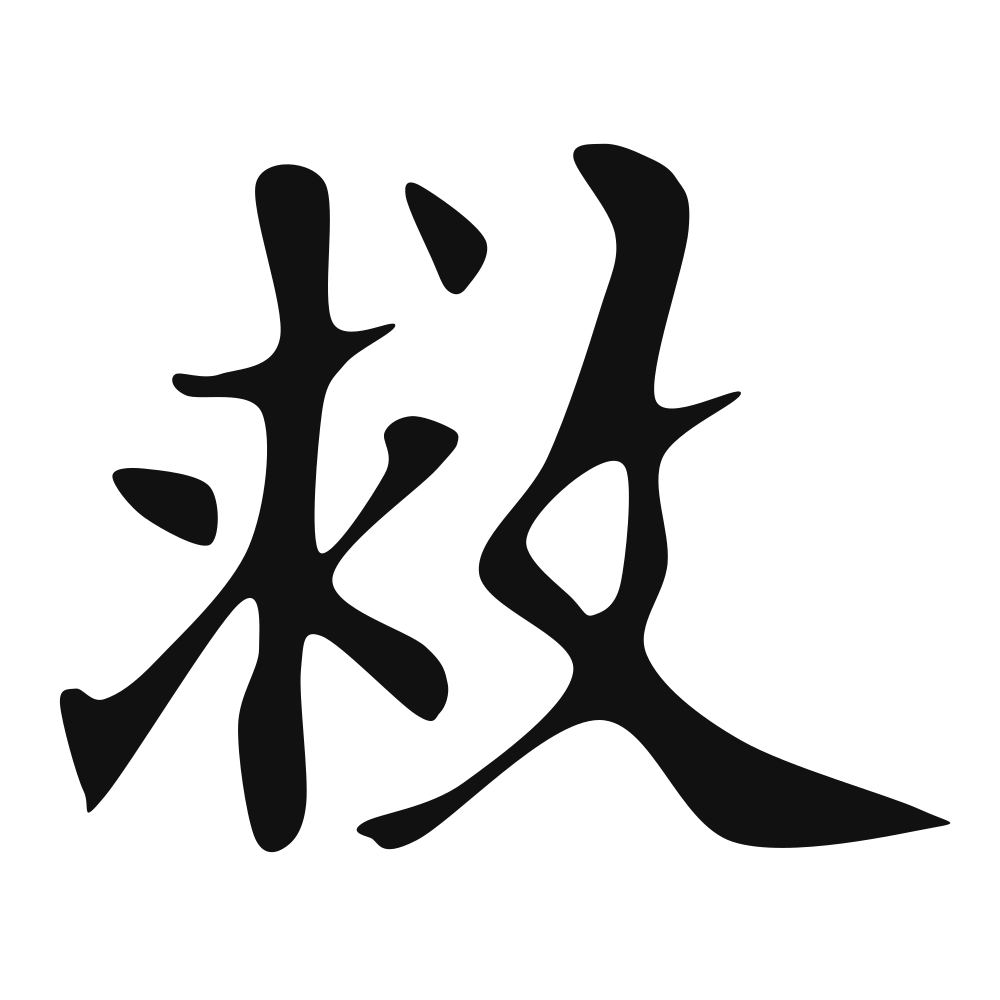
救
to save; to assist; to rescue
Closest English meanings
save·rescue·help·relieve
The Calligrapher — Kānglǐ Náonáo 康里巎巎
Yuan cursive master of Kipchak origin, paired with Zhao Mengfu as 'North-Nao, South-Zhao.'
Yuan calligrapher (1295–1345), master of cursive script — known for 《谪龙说》. Yuan dynasty
Etymology & Meaning · 字义溯源
2 · The Character: 救 Jiu (4th tone). The Shuowen Jiezi gives 「救, 止也」 — to stop, to halt. The Guangya adds 「助也」 (to help), and the Zhou Rites, Officer of Rescue, defines it as forbidding excess 「以礼防禁人之过」. The Book of Songs, Major Odes, pleads 「式救尔后」 (thus rescue your descendants); the Documents, Tai Jia, praises 「匡救之德」 (the virtue of correction and rescue). Name-lore assigns Wood (木) and eleven Kangxi strokes. As a free morpheme 救 is unequivocally positive — succor, relief, saving — though it presupposes a distress to relieve, so it carries quiet weight rather than lightness. Honest route: to a Western reader 救 can look like 'save' in a religious frame; disclose the classical sense is stopping harm and helping the afflicted, a virtue of action, not doctrine.
Cultural Story
救 is the hand into the fire. The Mohists made 救 the core of duty — 救 the drowning, 救 the besieged city. 救命 is the oldest shout; 急救 the physician's first cut. The word is urgency made moral: not pity at a distance but the body leaning in, pulling the other from the water before the river takes him.
Where a Western reader can stand: Where a Western reader can stand: 救 is the rod that stays harm — the Latin subvenire, aid laid upon a thing in distress. It presupposes trouble to relieve, so it is not the religious 'save' of the soul; it is help with hands. Worn alone it reads as rescue, and that is honest and good.
Common words & phrases
- 救援 rescue · relief
- 救命 save a life · help
- 急救 first aid · emergency treatment
- 救济 relieve · aid
- 救助 help · succor
Read the story behind the character
救援 reaches the quake town; 急救 the kit on the train. 救命 is the meme and the real cry; 救济 the aid parcel; 救助 the hotline. The word runs from the lifeguard's whistle to the donation ticked on the tax form — the reflex we fund, train for, and hope never to need. The whistle, the box, the same word.
Why this character belongs on skin
There is a moment in every life when the hand reaches down into the pit—not because it is paid, not because it is seen, but because something in the rescuer is also rescued by the reaching. Jiù is to save, to pull back from the edge, the most original act of love we have. The Christians call it grace; the farmers call it a neighbor with a rope; the mother calls it simply her arms. I have watched a stranger stop for a stranger and felt the ancient wiring of the species assert itself over every cynical doubt. To bear jiù is to swear you will be the one who stops, who bends, who carries the other a little further than comfort allows. The ink lands like an open palm on the skin—proof that your hand was made to descend, and that in saving another you have, quietly, saved yourself.
Own this character
Purchase delivers the original SVG of this glyph, brushed by Kānglǐ Náonáo 康里巎巎, ready to place on skin, paper, or screen.