
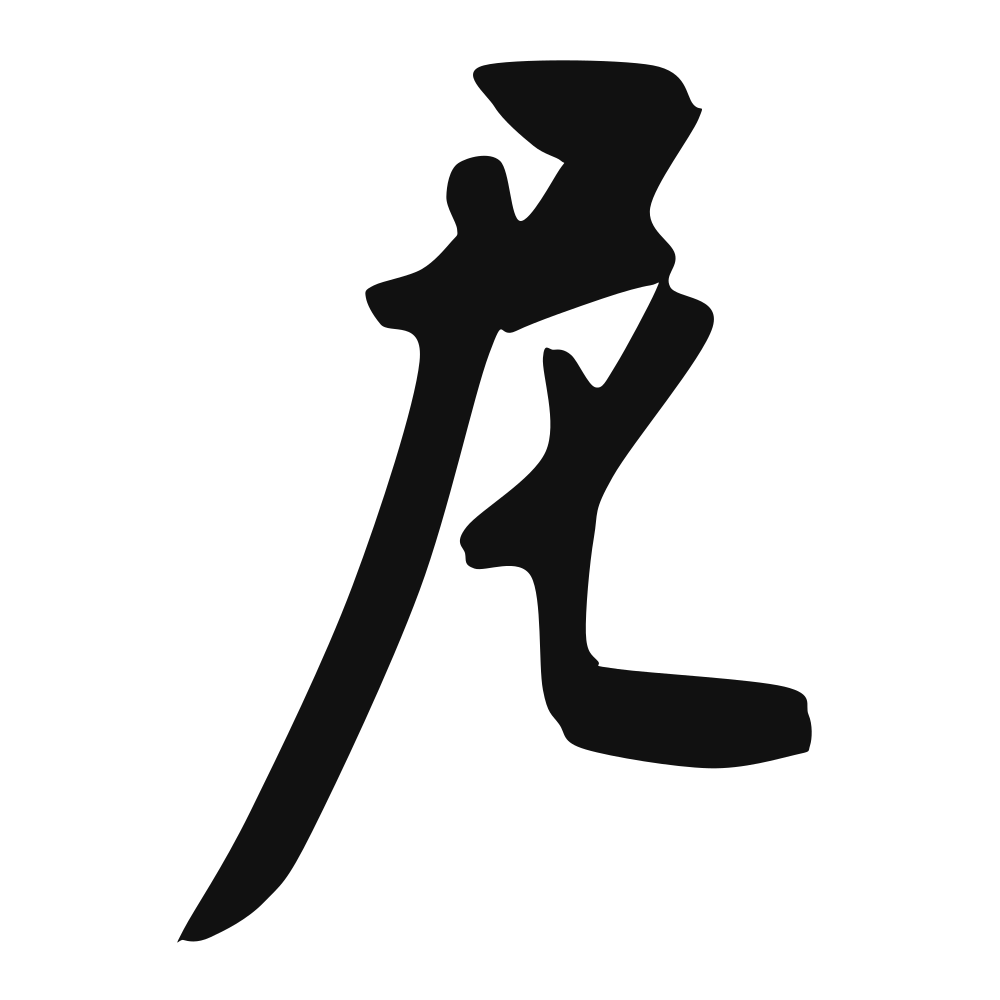
尼
Buddhist nun; (often used in phonetic spellings)
Closest English meanings
nun·Sanskrit·monastic·Buddhist
The Calligrapher — Cài Yōng 蔡邕
Han scholar who perfected clerical script and invented flying-white.
Han calligrapher (133–192), master of clerical script/飞白书 — known for 《熹平石经》/ 飞白书. Han dynasty
Etymology & Meaning · 字义溯源
2 · The Character: 尼 Ní (尼) means a Buddhist nun (僧尼) and, in classical use, close or intimate. It is the near, the adjacent.
Cultural Story
尼 derives from Sanskrit bhikṣuṇī, a Buddhist nun; the Shuowen notes it for the 尼姑 (nun). 僧尼 (monks and nuns) kept the monasteries, and 尼 temples offered women a religious life apart from the home. Later loanwords like 尼龙 (nylon) and 尼古丁 (nicotine) use 尼 purely for sound, not sense.
Where a Western reader can stand: Where a Western reader can stand: 尼 is a syllable more than a word — 'ni' carries no fixed weight by itself. In classical Chinese it meant 'near / intimate' (the Shuowen gloss 近也); today it surfaces in 比丘尼 (a Buddhist nun), 尼泊尔 (Nepal), 尼采 (Nietzsche), and 仲尼 (Confucius's courtesy name). Cai Yong's Eastern Han stood at the very edge of Buddhist contact, so in his century the character was still the near one, not yet the nun. On skin it is a quiet mark of closeness — best worn small and paired, honestly light.
Common words & phrases
- 尼姑 Buddhist nun · nun
- 尼龙 nylon
- 尼古丁 nicotine
- 僧尼 monks and nuns
Read the story behind the character
A 尼姑 (Buddhist nun) tends a hillside temple, and 僧尼 (monks and nuns) chant at dawn. Your jacket is 尼龙 (nylon) and your patch a 尼古丁 (nicotine) patch to quit smoking. The character bridges sacred and secular — from a shaven-headed nun to a synthetic fiber — without losing its calm hush.
Why this character belongs on skin
Before it named the nun, 尼 meant to stop — to halt, to settle, to draw the rushing world to a standstill. The Buddhist sister took the name because she had stopped: stopped the chase, the grasping, the endless want. We pity stillness, call it retreat, mistake the quiet for a failure of nerve. But 尼 knows the stop is the achievement. To carry it is to honor the one who said enough — not from weakness, but from having arrived. It is a contemplative mark, almost countercultural against our gospel of more. On the skin it reads as a pause button worn permanently, a small rebellion against the speed that wants your soul. You do not have to enter a convent. You only have to know the value of the halt, the dignity of the woman who sat down and would not be hurried. 尼 remembers the stop for you.
Own this character
Purchase delivers the original SVG of this glyph, brushed by Cài Yōng 蔡邕, ready to place on skin, paper, or screen.