
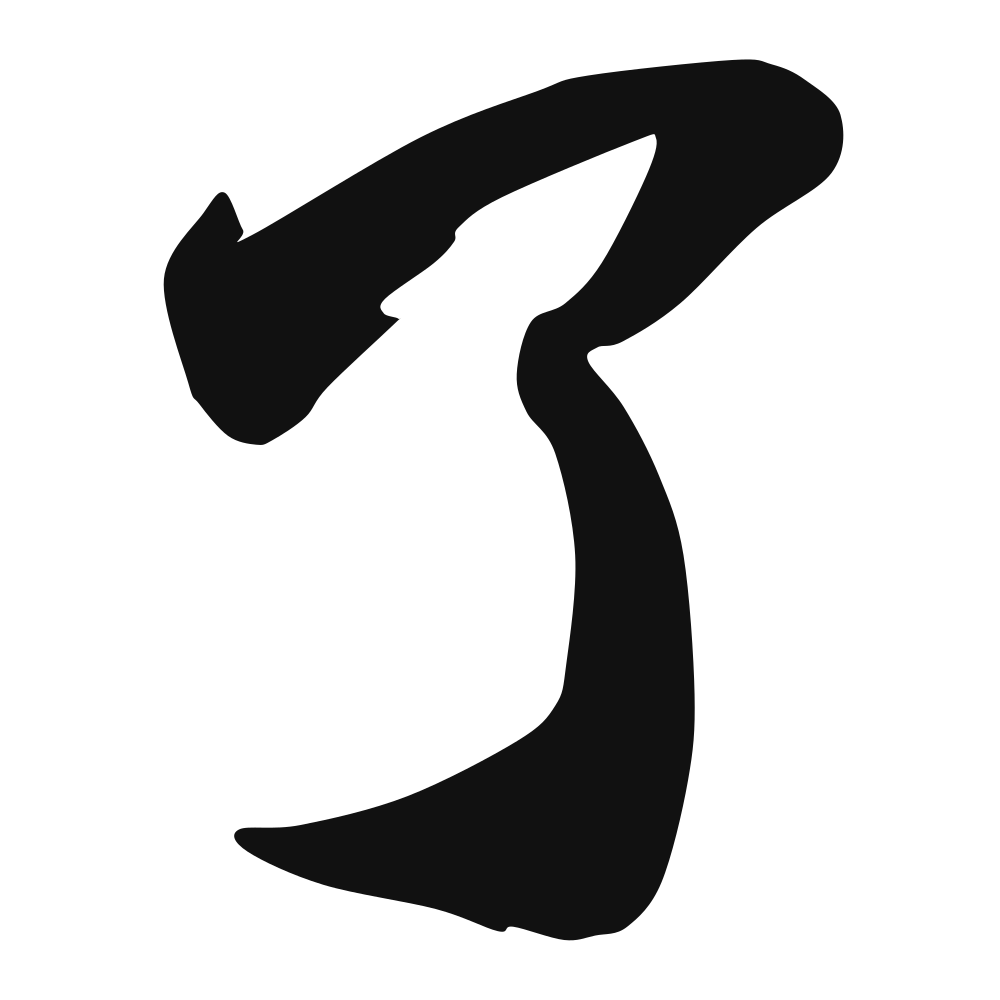
了
(completed action marker); (modal particle indicating change of state, situation now); (modal particle intensifying preceding clause); to finish; (used with 得[de2] or 不[bu4] after a verb to express (im)possibility, as in 忘不了[wang4 bu5 liao3] "cannot forget"); (literary) (usually followed by a negative such as 無|无[wu2] or 不[bu4]) completely (not); entirely (not); (not) in the least; (bound form) clear in one's mind; to understand clearly; unofficial variant of 瞭[liao4]
Closest English meanings
finished·complete·done
The Calligrapher — Kǒng Línzhī 孔琳之
Liu Song calligrapher famed with Yang Xin as 'Yang-true, Kong-grass'; master of cursive script
南朝宋 calligrapher (), master of running script — known for 《日月帖》. Liu Song dynasty (Southern Dynasties)
Cultural Story
了 showed a child's arm bending at the elbow, the limb that bends to complete a motion, hence done, finished. Buddhism brought 了 to mean awakening's completion, 了生死, done with birth and death. The 說文 reads it as to understand, to end. It is the close of an action and the close of a life, the bend that brings a thing to its full stop.
Common words & phrases
- 了解 understand · know
- 了结 settle · end
- 了事 finish matter
- 明了 clear · understand
- 了得 terrible · formidable
Read the story behind the character
了解 is what the survey wants and what you think you do; 了结 the debt and the affair. 了事 is getting it over with; 明了 the clear-eyed verdict. 了得 is the terrible in 那还了得, that would be dreadful. The character is the full stop of Chinese verbs, eat了, go了, finished. You tack it on constantly, the small word that tells the listener the action has landed and the page is turned.
Own this character
Purchase delivers the original SVG of this glyph, brushed by Kǒng Línzhī 孔琳之, ready to place on skin, paper, or screen.