
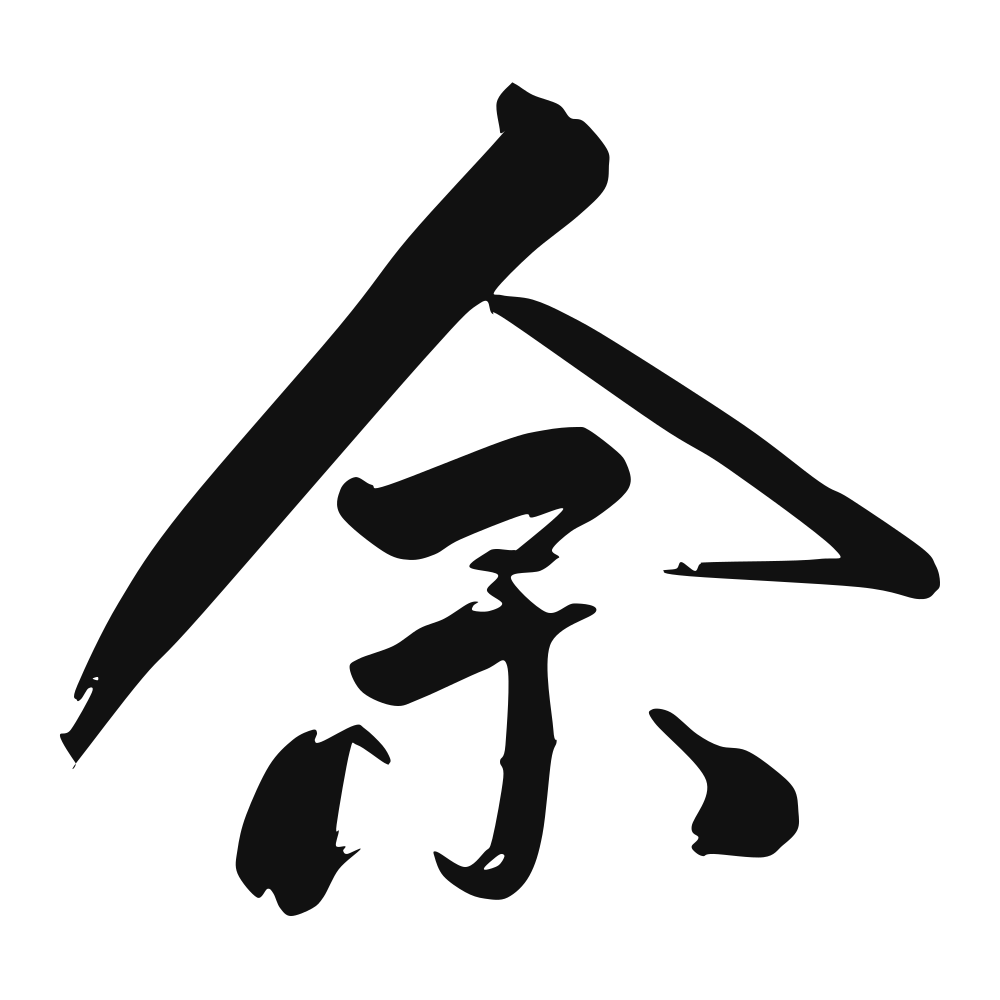
余
surname Yu; (literary) I; me; extra; surplus; remaining; remainder after division; (following numerical value) or more; in excess of (some number); residue (math.); after; I; me
Closest English meanings
I·me·surplus·remaining·more
The Calligrapher — Kǒng Línzhī 孔琳之
Liu Song calligrapher famed with Yang Xin as 'Yang-true, Kong-grass'; master of cursive script
南朝宋 calligrapher (), master of running script — known for 《日月帖》. Liu Song dynasty (Southern Dynasties)
Etymology & Meaning · 字义溯源
2 · The Character: 余 余 (yú, 2nd tone) hides a merger. Shuowen Jiezi, chapter 2, 八部: 余,語之舒也。从八,舍省聲 — 'the ease of speech; from bā, with shè abbreviated as phonetic.' Duan Yucai's note cites 《左傳》 小白余敢貪天子之命 as exactly that unhurried speech, and 《爾雅·釋詁》 余,我也, with Sun Yan glossing it 舒遲之身 — 'the unhurried self.' Duan adds a philological fact worth carrying: 《詩》《書》 use 予 and not 余; the Zuo Zhuan uses 余 and not 予. Palaeographers read the oracle-bone graph as a post-and-thatch shelter, cognate with 舍; the pronoun is a loan onto a house. Qu Yuan speaks as 余 all through the Li Sao — 余既滋蘭之九畹兮,又樹蕙之百畝. 《爾雅·釋天》 even names the fourth month 余月. Kangxi: 7 strokes, 人部. Honest disclosure, and this is the important one: simplified 余 absorbs two separate characters. 余 is 'I'; 餘 is 'surplus, what is left over'. The auspicious 年年有餘 — surplus every year, punned on 魚, fish — is written 年年有余 today, but a Han brush would have drawn 餘 there. 余 is also a common surname.
Cultural Story
余 is the humble "I" of the exiled poet. Su Shi signs letters 余 when far from court; the 楚辞 speaks in this first person. It also means what is left: 余年 the remaining years, 余味 the aftertaste of a poem. A cook saves 余下 broth for morning. To be 余 is to be both speaker and surplus.
Where a Western reader can stand: Where a Western reader can stand: 余 is a small trap. In simplified Chinese it fuses two ancient words — 余, the classical 'I' (Qu Yuan speaks as 余 throughout the Li Sao), and 餘, 'surplus, what is left over' (年年有餘, 'surplus every year'). Written alone, 余 reads first as the surname Yú, second as a bookish 'I.' For the auspicious 'abundance / never run out' sense, a Chinese-literate eye wants 餘 or the pairing 有余. Kong Linzhi was a direct descendant of Confucius who also became the coolest handwriting stylist of his generation — tradition and trend in one hand. 余 is Earth (土) in Wuxing — the stored, unspent portion.
Common words & phrases
- 余下 remaining · left over · the rest
- 业余 amateur · spare time · after-hours · leisure
- 多余 superfluous · excess · redundant · surplus
- 余年 remaining years · the rest of life · later years
- 余力 spare energy · surplus effort · reserve strength
- 余味 aftertaste · lingering taste · reverberation
Read the story behind the character
After the meal the 余下 rice goes into the fridge; a worker joins an 业余 painting class. The report notes no 多余 cost, and a retiree speaks of quiet 余年 at home. A tea drinker savors the 余味 of the cup. Leftover, spare, and lingering — the word tracks what remains after the day's main business.
Own this character
Purchase delivers the original SVG of this glyph, brushed by Kǒng Línzhī 孔琳之, ready to place on skin, paper, or screen.