
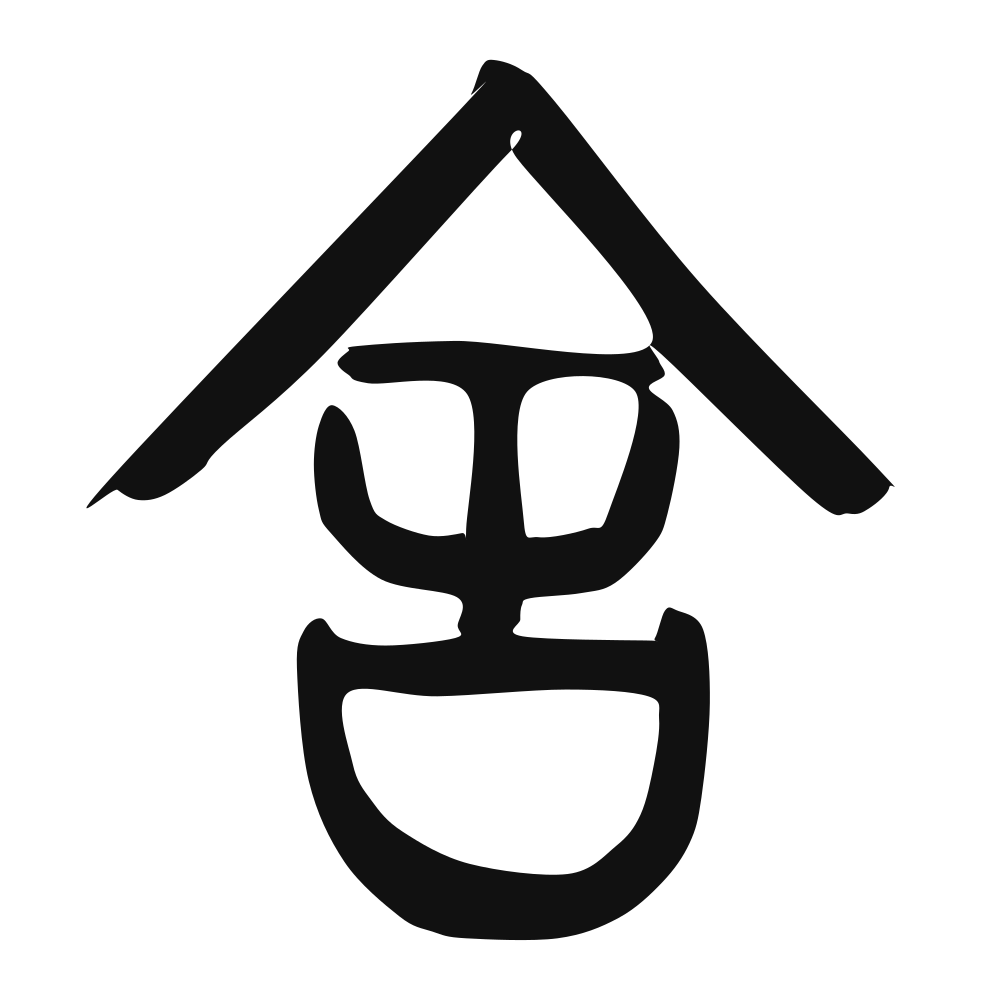
舍
to give up; to abandon; to give alms; surname She; (bound form) residence; house; (bound form) my (in speaking of relatives younger than oneself, as in 舍妹[she4 mei4]); (archaic) unit of distance equal to 30 li 里[li3]
Closest English meanings
house·give up·lodge·abandon·dormitory
The Calligrapher — Lǐ Dōngyáng 李东阳
Ming statesman and literatus of refined seal and regular script.
Ming calligrapher (), master of seal script/regular script — known for 茶陵派. Ming dynasty
Cultural Story
舍 first meant a lodging house — in early usage, a way-station set every thirty li along the roads for travelers. From dwelling it turned to dwelling-on: 荀子's 鍥而不舍, carve without stopping, and the warning that perishing by the nine-story terrace begins with one basket of earth. 孟子 raised the stakes to 舍身 — to give up one's life for righteousness — while the humble host called his home 寒舍, my cold little house.
Common words & phrases
- 宿舍 dormitory · lodgings · quarters
- 舍得 willing to give up · part with · grudge not
- 舍弃 abandon · give up · discard · forsake
- 舍身 sacrifice oneself · give one's life · sacrifice the self
- 取舍 accept or reject · choice · trade-off
- 寒舍 my humble home · my house · humble abode
Read the story behind the character
You move into the 宿舍, the dormitory, with two suitcases and a rice cooker, and slowly learn 取舍, the trade-off of what to keep and what to reject. Your roommate refuses to 舍弃, give up, any of his twenty novels. At Spring Festival your friend texts from his 寒舍 — calling his brand-new apartment a humble abode, the old politeness intact — and invites you to dinner.
Why this character belongs on skin
The hand opens. What it held — a grudge, a lover, a year of rain — drops and is gone, and the palm feels suddenly vast. 舍 is to abandon, to release, to give up what clings; its twin reading names the humble 舍, the thatched hut where the traveler lays down his burden for the night. The Buddha taught 捨 as the first gesture of freedom: nothing is yours to keep. The Daoist leaves the carriage at the river's edge. To wear 舍 is to practice the hardest courage — the courage of the empty hand. We spend our lives accumulating; this mark argues the opposite, that what you can set down is what finally makes you light enough to move. Let it sit on your skin as a small door left ajar, a daily permission to release, to forgive, to walk on unburdened.
Own this character
Purchase delivers the original SVG of this glyph, brushed by Lǐ Dōngyáng 李东阳, ready to place on skin, paper, or screen.