
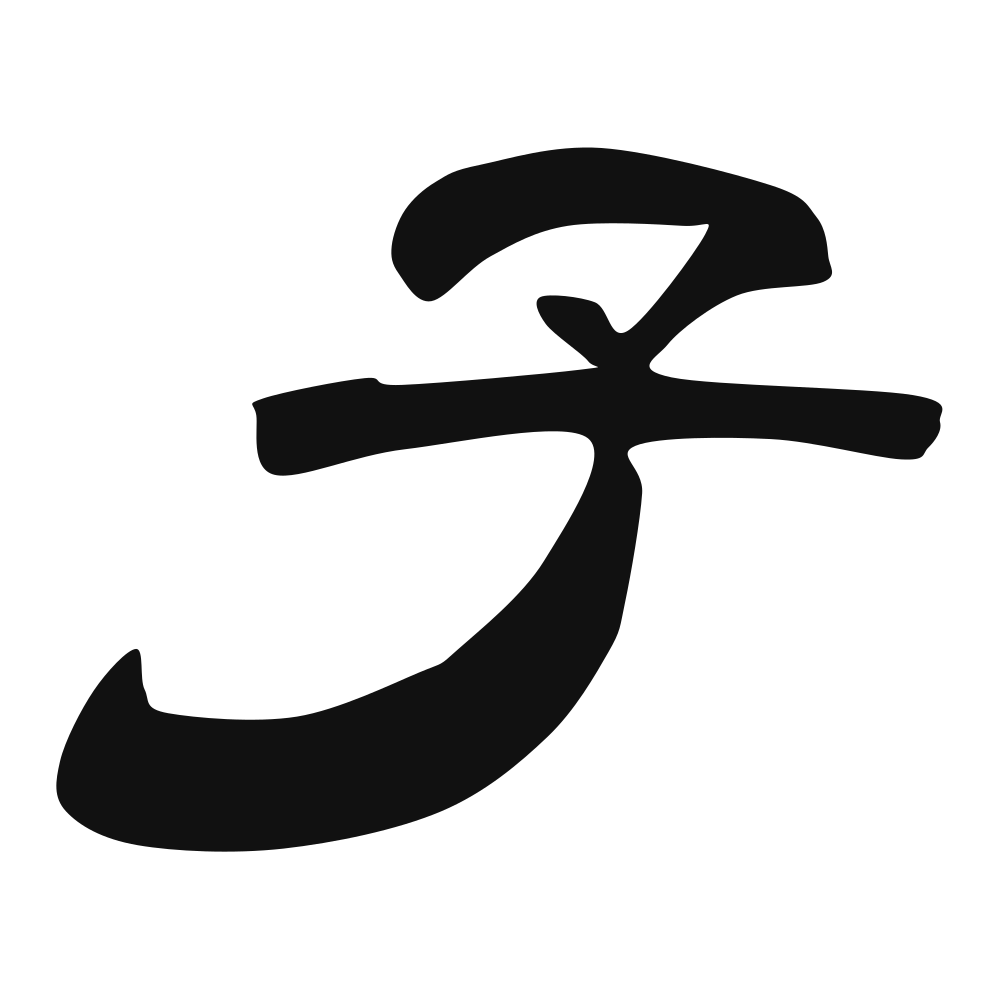
子
son; child; seed; egg; small thing; 1st earthly branch: 11 p.m.–1 a.m., midnight, 11th solar month (7th December to 5th January), year of the rat; viscount, fourth of five orders of nobility 五等爵位[wu3 deng3 jue2 wei4]; ancient Chinese compass point: 0° (north); subsidiary; subordinate; (prefix) sub-; noun suffix, as in 椅子[yi3 zi5] "chair"
Closest English meanings
child·son·seed
The Calligrapher — Lǐ Lóngjī 李隆基
Tang Emperor Xuanzong who wrote the Shitai Xiaojing in eight-division clerical script (bafen).
Tang calligrapher (), master of 八分/regular script — known for 唐玄宗,《石台孝经》. Tang dynasty
Etymology & Meaning · 字义溯源
2 · The Character: 子 Zǐ (3rd tone). The Shuowen Jiezi glosses 子 as 「十一月,阳气动,万物滋,人以为偁。象形」 — the eleventh month, when the yang breath stirs and all things are born; the graph is a pictograph of a newborn with a crown of hair and thrashing arms. In the classics it splits two ways. As 'child / son' it anchors the family line: 《诗经·小雅·斯干》 sings 「乃生男子,载寝之床…乃生女子,载寝之地」 — a boy laid on the bed, a girl on the ground. As a learned 'Master' it opens the Confucian corpus: 《论语·学而》 begins 「子曰:学而时习之,不亦说乎」 — 'The Master said: to learn and repeat it in season, is that not joy?' Grading: a free, wholly positive morpheme — a child, a teacher, the seed of a lineage. No mistranslation landmine; among English speakers 子 is sometimes read as a mere suffix, so disclose that it carries the dignity of both infant and sage.
Cultural Story
Ancient men received a 字, a courtesy name, at adulthood — Li Bai styled Taibai, Zhuge Liang styled Kongming — while 子 itself honored a master: 孔子, 老子, 墨子. The 'Analects' opens on 学而时习之. 种子 filled the agricultural 'Essential Arts of the People,' and 子孙 kept the ancestral line alive through rites.
Where a Western reader can stand: Where a Western reader can stand: 'child, son' — the child who carries the parent, the very structure of filial piety, inscribed by Emperor Xuanzong in the Stone Platform Classic. Honest note: 子 is fully positive alone; imperial inscriptions were often carved by others, though the authorship is traditionally accepted.
Common words & phrases
- 孩子 child · kid
- 儿子 son
- 子女 children · sons and daughters
- 子孙 descendants
- 种子 seed
- 日子 day · date · life
Read the story behind the character
Children tap 种子 into farming apps each planting season, and 孩子 fill the morning school run. 子女 appear as dependents on tax forms, 子孙 in genealogy uploads, and 日子 on every calendar notification. The little graph spans nursery, field, and inbox, doing more daily work than any sage who bore it as a title.
Why this character belongs on skin
A child, a seed, a sleeping infant with the round head and soft limbs the ancients drew with three strokes. Zǐ is the child, the son, and by extension the master—Confucius is Kǒngzǐ, the teacher as spiritual son of tradition. It holds birth and authority in one small glyph, the beginning and the one who begins things for others. The West separates the baby from the sage; here they share a character, as if to teach well you must stay a beginner. To wear zǐ is to honor both: the vulnerable newness in you and the elder you are becoming. It is a mark of lineage and of humility, for every master was once the small one at the threshold. Quiet, round, foundational—place it where a life began or a lesson landed, a tiny character that says you are someone's beginning and someone's student, still.
Own this character
Purchase delivers the original SVG of this glyph, brushed by Lǐ Lóngjī 李隆基, ready to place on skin, paper, or screen.