
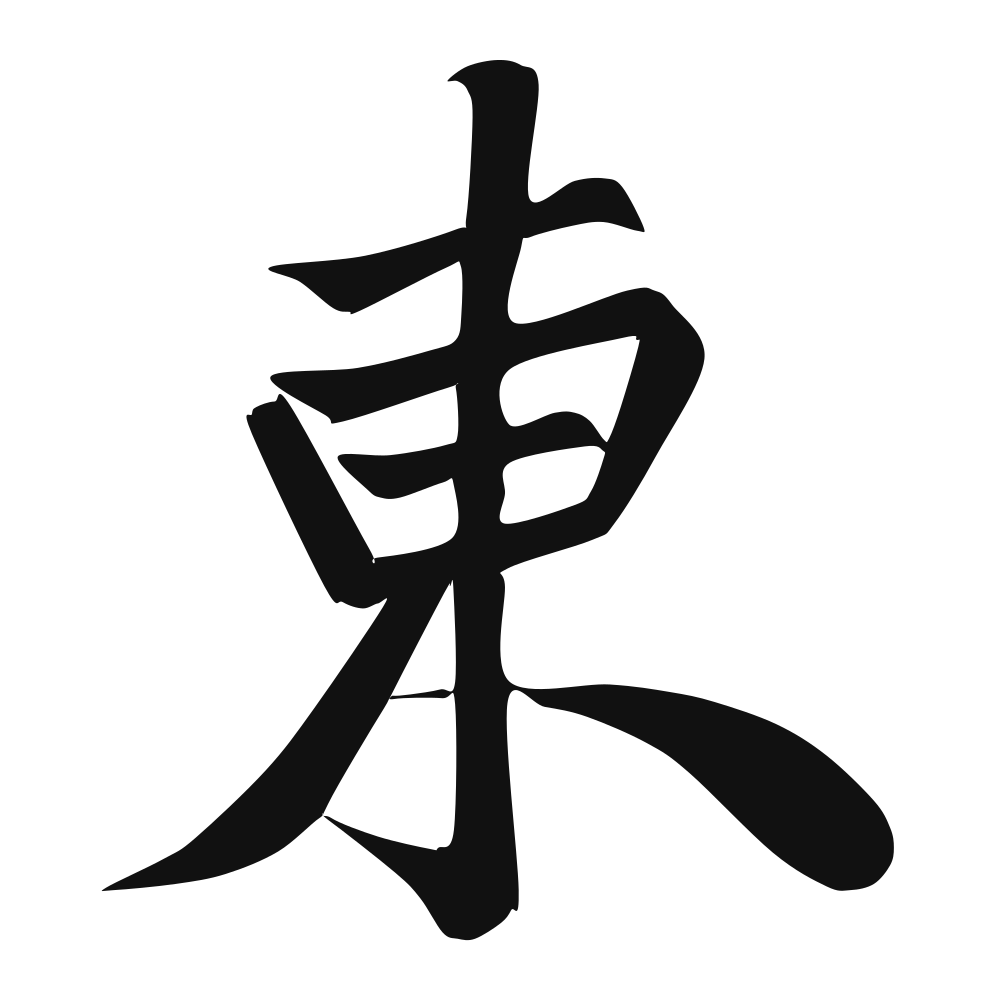
东
surname Dong; east; host (i.e. sitting on east side of guest); landlord
Closest English meanings
east·eastern·host (as in 房东)·master
The Calligrapher — Lǐ Sī 李斯
Qin chancellor who standardized the small-seal script for China's first empire.
Qin calligrapher (约前284–前208), master of small seal script — Qin chancellor who standardized the small-seal script for the first empire. Qin dynasty
Etymology & Meaning · 字义溯源
2 · The Character: 东 东 (dōng, 1st tone; traditional 東) is, in Xu Shen, the sunrise made visible: 動也。从木。官溥說:从日在木中 — 'movement; from 木 (wood); Guān Pǔ says: from the sun within the wood.' The form shows the sun rising through trees — the east, the quarter of dawn and spring. The classics fix it as direction and renewal: the Shujing (尧典) '平秩东作' orders the eastern labours; the Huainanzi (天文训) names '东方木也' (east is wood); the Shijing (小雅) and Yijing (既濟) speak of '東隣' (the eastern neighbour). As a free morpheme 东 means 'east,' and is wholly benign — 东方, 东升, 紫气东来. Honest disclosure: 东 is the compass point; on skin it is a clean, balanced character and reads well, but pair it with a noun (东来, 东风) so it is not mistaken for a brand initial or a 'C/E' mark. In Japanese it is higashi. The Wuxing link is firm: 东方属木 (east = wood).
Cultural Story
東 pictures a sun wedged in a wooden bag, the sun rising, bundled at the horizon, the east. 東風, the spring wind from the east, opened the willows in a thousand Tang poems. 红樓夢's 贾宝玉 is told 东风不与周郎便, fortune's wind. The host at a feast sat facing 东, which is why 房东 and 股东 still carry master of the house.
Where a Western reader can stand: Where a Western reader can stand: 东 (東) is the quarter of dawn — the Shuowen reads the graph as 从日在木中, the sun caught within the trees — and in the five phases it is Wood, spring, the arousing thunder of Zhen, with 紫气东来 promising auspicious vapour arriving from that side. Li Si is the apt hand precisely because his small seal is the script in which that picture is still legible; the simplified 东 no longer shows it. Honest caveat: as a bare direction the character is clean but abstract, and readers may take it for a brand initial or simply 'E'; pair it (东风, 东来) so it stays a dawn rather than a compass bearing. In Japanese it is read higashi.
Common words & phrases
- 东西 thing · stuff · goods · east-west
- 东方 east · the East · orient
- 房东 landlord · house owner · lessor
- 山东 Shandong · Shantung · Shandong province
- 东风 east wind · spring wind · east breeze
- 东边 eastern side · the east · eastern part
Read the story behind the character
东西 means a thing, 什么东西, what is this thing, and also stuff you carry home. 房东 is the person who raises the rent; 山东 the province of Confucius and beer. 东风 is the car brand and the wind that brings rain. 东边 is the side of the building with morning light. The sun-in-a-bag has become a direction, a landlord, and the most ordinary word for an object.
Why this character belongs on skin
The east is where the light begins. 东 is the character the ancients drew as the sun tangled in the branches of a tree, the first gold caught in wood before the day announced itself. To face east is to be a person of mornings, of second chances, of the belief that darkness is only ever temporary. Pilgrims in every faith turn toward it; the Christian church lifts its altar to it; the Taoist seeks the dawn breath. To wear 东 is to tattoo hope onto your body in its oldest form—a small sun behind a tree, always about to rise. It is for the ones who have been flattened and still got up facing the light. Carry it where the sun will first find your skin, and let it be the promise you made to yourself in the worst night: this is not the end. The east is coming.
Own this character
Purchase delivers the original SVG of this glyph, brushed by Lǐ Sī 李斯, ready to place on skin, paper, or screen.