
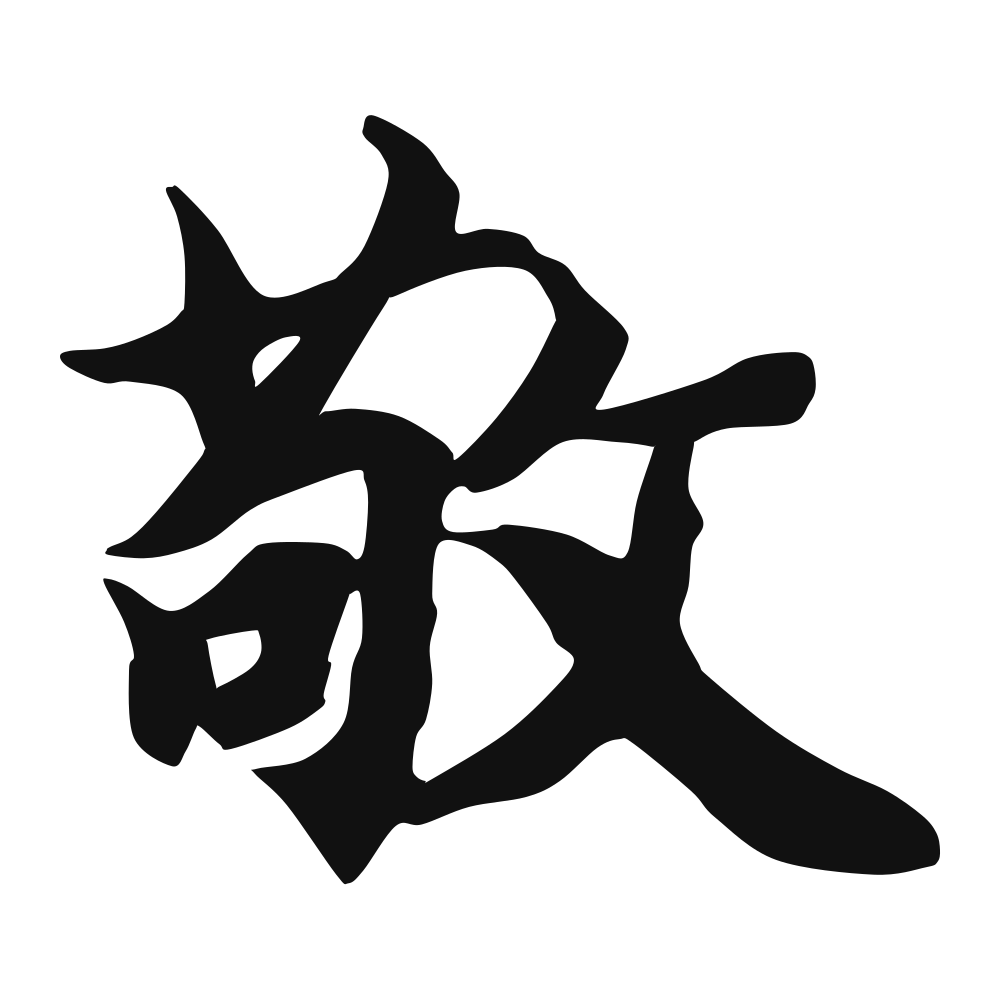
敬
敬 (jìng) — respect, reverence. Composed 苟 + 攵 (strike): to rectify oneself in awe. Classical life: 敬业 — devotion to one's work; 敬 is deep respect. Grammar: free morpheme — also: (bound form) respectful; to respect; to offer politely
Closest English meanings
respect·revere·honor·salute·esteem
The Calligrapher — Lǐ Sī 李斯
Qin chancellor who standardized the small-seal script for China's first empire.
Qin calligrapher (约前284–前208), master of small seal script — Qin chancellor who standardized the small-seal script for the first empire. Qin dynasty
Etymology & Meaning · 字义溯源
2 · The Character: 敬 Jing (4th tone). The Shuowen Jiezi gives 「敬, 肃也」 — reverent, grave. The Erya and the Book of Rites, Qu Li, open with 「毋不敬」 (let there be no lack of reverence). The Book of Changes, Hexagram Kun (坤), teaches 「君子敬以直内, 义以方外」 (the noble is reverent within, thereby straight; right without, thereby square). The Major Odes, Chang Wu, urge 「既敬既戒」 (reverent and wary), and the Zuo Zhuan calls reverence 'the gathering of virtue'. Name-lore assigns Wood (木) and thirteen Kangxi strokes. As a free morpheme 敬 is a high virtue — respect, seriousness, the inner posture behind all rite. Honest route: 敬 pairs with 畏 (awe) but is not fear; disclose that it is self-possession and regard for the other, the Confucian cardinal of demeanor.
Cultural Story
敬 is the upright heart. The Analects makes 敬 the attitude of the official at his post and the son at the rite. 敬 is not fear but attentive respect — 敬酒 the cup raised; 敬献 the offering laid. A stele says the magistrate 敬 the people's grain. The word is reverence as daily posture, the bow that costs nothing and means everything.
Where a Western reader can stand: Where a Western reader can stand: 敬 is reverence as a practice — standing straight before something larger than yourself, with a genuine edge of fear in it (敬畏), not merely good manners. Honest caveat: it is strongly hierarchical in Chinese life, since you 敬 upward toward elders, teachers and the dead, so it carries a sense of one's own place that English 'respect' has largely shed.
Energy Reading
Wood (木)
Comparative symbology, not fortune-telling.
Common words & phrases
- 尊敬 respect · honor · esteem · revere
- 敬爱 respect and love · cherish · admire
- 敬礼 salute · pay respects · greet
- 敬佩 admire · esteem · look up to
- 敬重 respect · revere · value highly
- 敬献 respectfully present · offer with reverence · present respectfully
Read the story behind the character
尊敬 is what you owe the teacher; 敬礼 the salute and the email sign-off. 敬佩 the rival you grudgingly admire; 敬重 the elder. 敬爱 the poster's word. The word frames the funeral and the form letter, the raised glass and the lowered voice — respect performed, often sincerely, sometimes because the room requires it. The bow fits either way.
Why this character belongs on skin
The disciple bows not because he is small but because the moment is large. 敬 gathers the offering and the fist, as if reverence were a force, a thing that moves the hands to solemn work. Confucius taught that 敬 is the heart of every rite — to sweep the courtyard as if the ancestors watched, to meet the stranger as if he were guest. There is no weakness in this; the warrior who honors his enemy fights clearer. Reverence is attention made holy. To carry 敬 is to refuse the lazy eye, to meet the world with the care it secretly asks for. Ink it where you would place a vow, a single character that turns the everyday into the sacred — the way you pour the tea, keep the promise, lower your voice in the presence of grief. Let it be the mark of one who knows that to respect is to be awake.
Own this character
Purchase delivers the original SVG of this glyph, brushed by Lǐ Sī 李斯, ready to place on skin, paper, or screen.