
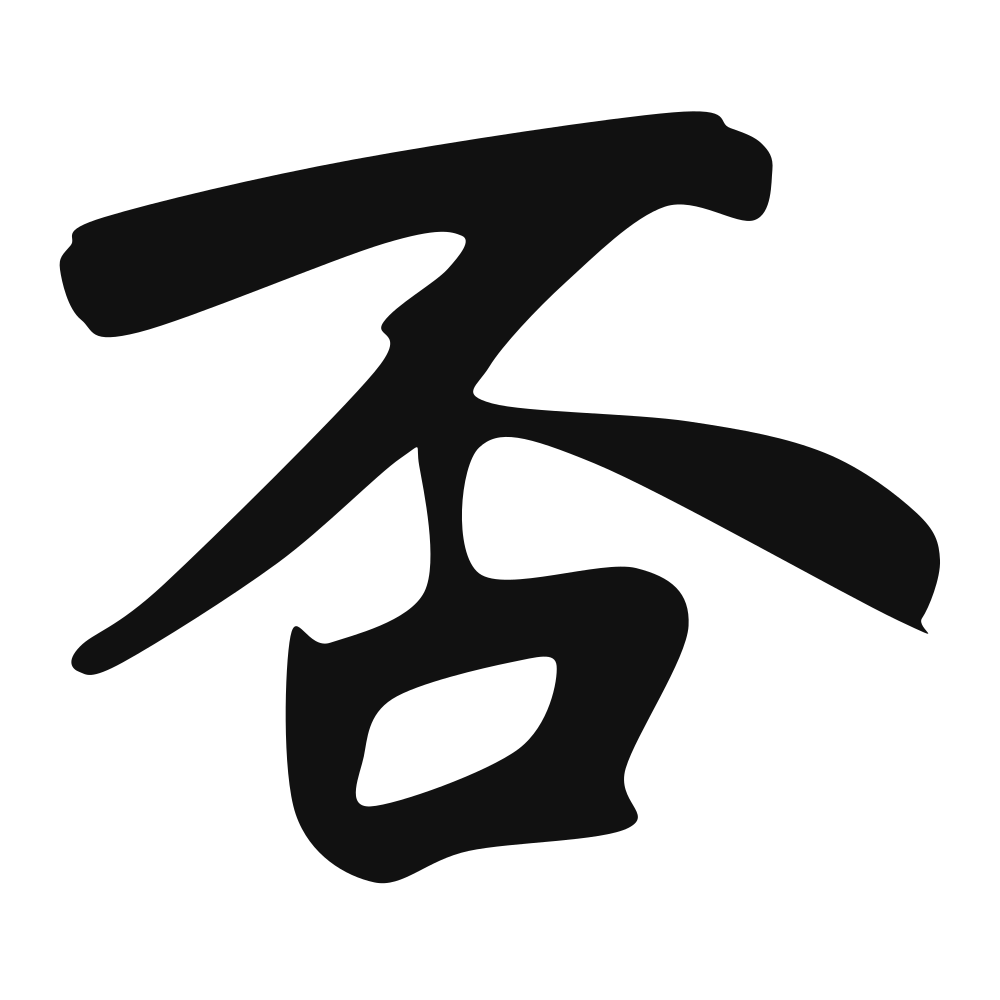
否
to negate; to deny; not; clogged; evil
Closest English meanings
no·not·deny·bad
The Calligrapher — Lǐ Yōng 李邕
Tang running-script master famed for his stele inscriptions.
Tang calligrapher (678–747), master of running script — known for 《麓山寺碑》(李北海). Tang dynasty
Etymology & Meaning · 字义溯源
2 · The Character: 否 Fǒu (3rd tone), also read pǐ (3rd tone). 《说文·口部》: 「否,不也。从口从不。」 — a mouth over 不: negation made speakable. Under the pǐ reading it names the twelfth hexagram of the 《易经》, and there it is anything but neutral: 彖 「天地不交而万物不通也,上下不交而天下无邦也」 — heaven and earth do not intercourse, so the ten thousand things do not circulate; above and below do not meet, so there is no state at all. 《易·杂卦》 pairs it with its opposite: 「否泰,反其类也」. The one common phrase that redeems it, 否极泰来 ('when blockage reaches its extreme, peace arrives'), needs all four characters to work. Honest disclosure: standing alone, 否 both says 'no' and pictures stagnation. To a Chinese eye it is an ill-omened glyph — closer to a jinx than to a defiant slogan. If you want the turn in fortune, tattoo 泰.
Cultural Story
否 sets 不 (not) above 口 (mouth)—what is not spoken, rejected, or ill-fated. The 易經 uses 否 as a hexagram of blockage and stagnation, the opposite of 泰 (peace); "否极泰来" teaches that worst gives way to best. 論語 and histories employ 否 to negate and refuse. In law and debate it marks denial and veto. The character carries both a simple "no" and the heavier sense of decline and obstruction in the cosmic order.
Where a Western reader can stand: Li Yong was the Tang master whose running script was so monumental it was carved on steles across the empire. Set 否 — 'no / not' — in that public, weighty hand and the character becomes a boundary, a deliberate full stop. Western wearers should know 否 reads as refusal; pair it with 是 ('yes') if the intent is balance, or let it stand as a bold 'no' to everything unworthy.
Common words & phrases
- 否定 negate · deny · negative
- 是否 whether · if · or not
- 否决 veto · reject · overrule
- 否认 deny · disavow · repudiate
- 否则 otherwise · else · if not
- 可否 is it possible · may I
Read the story behind the character
At the meeting the committee 否决 (vetoes) the plan, and a poll asks 是否 (whether) residents approve the new park. A politician 否认 (denies) the rumor, refusing to 否定 (negate) his own record, while the sign says 否则 (otherwise, if not) you will be fined. A shy student raises a hand to ask 可否 (may I, is it possible) to leave early. The character threads through elections, exams, and arguments as the small gatekeeper of refusal and condition.
Own this character
Purchase delivers the original SVG of this glyph, brushed by Lǐ Yōng 李邕, ready to place on skin, paper, or screen.